I sat down with Claude on a Saturday morning. By that night I had a domain, an archetype, four foundation documents, and three new client leads. Here is exactly how the day ran.
Why one day is enough now
Most people building a personal brand spend weeks agonizing over the foundation work. Picking the niche, writing the about page, choosing colors and fonts, buying the domain, deciding which platforms to be on. Each one is its own rabbit hole, and most of them are decisions you cannot validate without making them.
Before AI, the slow pace made sense. Every decision carried real friction.
Hire a designer, book a strategist, write a brief, sleep on it, come back for revisions. The whole loop took weeks because every step required a person who was not you.
That is not the math anymore.
I sat down with Claude on a Saturday and ran the entire foundation in one focused day. Not a perfect first version.
Not a polished launch. The actual foundation: who I am, who I am talking to, what I am calling this thing, where it lives on the internet, and what I will do tomorrow morning.
The decisions stay yours. The execution speed is no longer the bottleneck.
The whole rebuild started with that day, and I have written about why I am rebuilding the brand with AI in public if you want the bigger picture.
If you have been putting off your own foundation work because it feels like too much, the day-one marathon is the way to compress it into something you can actually finish.
What the day actually looked like
Saturday morning, April 18, 2026. Coffee in hand and MacBook open at the kitchen table.
Linh was up. Alice was at my feet.
I had been carrying the rebuild idea for months without doing anything about it.
Twenty plus years of career sat behind me. Air Force, then a Fortune 500 retailer, then an aerospace company, then my own web design agency with my wife, then a marketing director role at Beaver Builder, a software company.
Seven quiet years online after a burnout I barely survived. The whole story was already inside me.
What I did not have was a way to compress it into something I could ship.
So I started typing.
I told Claude the truth about my career. Where I had been.
What had worked. What had broken.
The burnout. The seven quiet years.
The day job. The planning I had been doing for months on what came next.
I dumped the whole thing into a chat in plain language with no outline and no structure. Just the truth, end to end.
Claude reflected it back. Asked me twenty questions about the way I talk.
The phrases I use. The phrases I never use.
The ones that make me cringe when I see them in marketing copy. By lunch I had a voice document that read like me.
Not a sanitized brand voice. The actual one.
Then we worked on the audience. I told Claude who I wanted to help and the trap I had fallen into the last time, talking to nobody specific.
We landed on the audience after an hour of back and forth. People building their own personal brand.
Solo operators, specifically people roughly my age who needed someone to go first.
I bought the domain after lunch. anthonytran.ai. Twelve dollars a year. The cheapest part of the day.
Then we worked on the visual identity. Six iterations.
The first one was generic dark tech. The second one was less generic.
The third one was almost something. By the sixth pass, the words “The Architect” came out of one of Claude’s suggestions and I knew that was it.
Blueprint vocabulary. Drafting feel.
Sheet codes. A methodology line came with it.
See it. Plan it.
Build it. I locked it.
I sent an outreach message to past Marketing Access Pass clients while the design system was being assembled. Three potential projects came back the same afternoon.
AI did not write the outreach and AI did not generate the leads. AI gave me the momentum to finally send a message I had been sitting on.
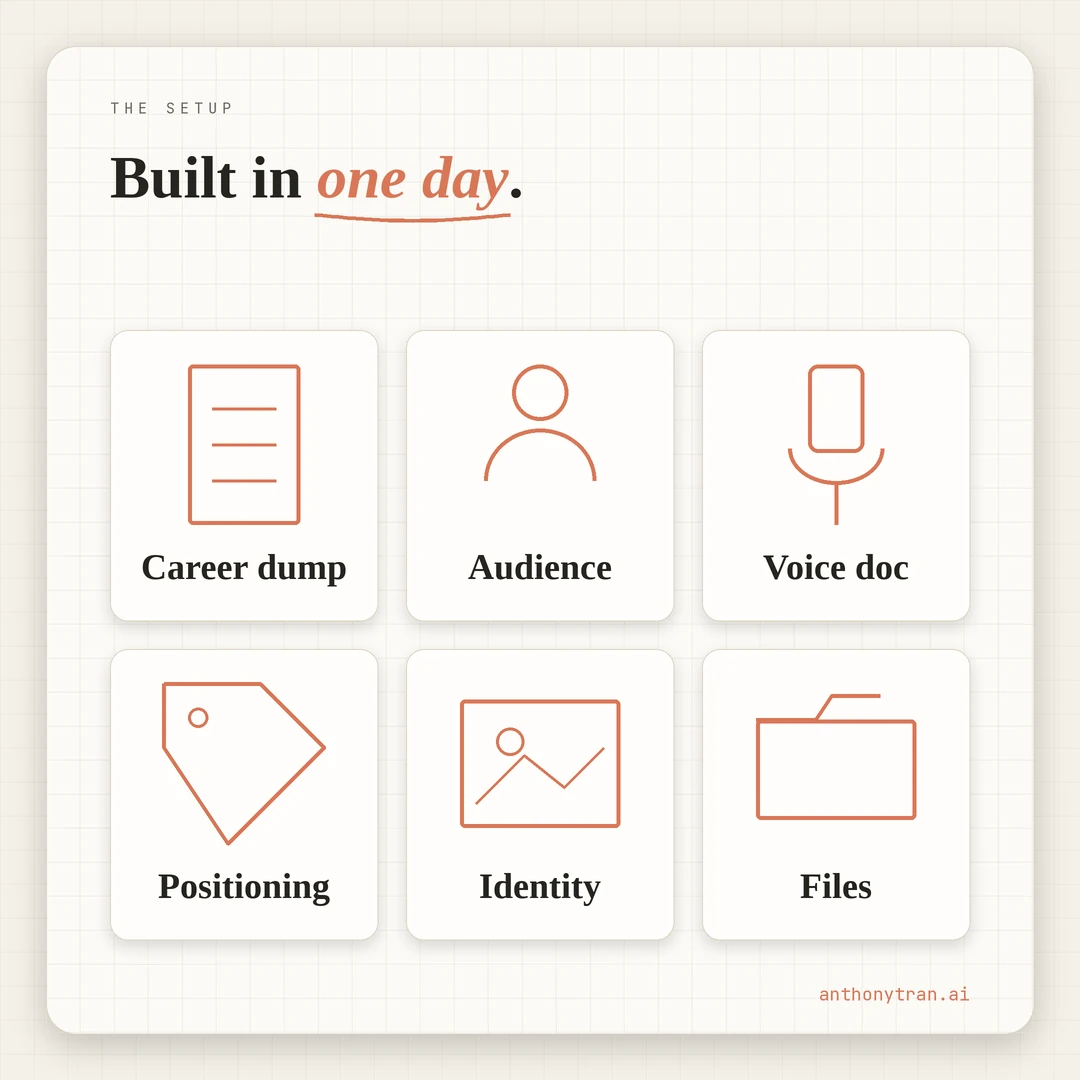
By the time I closed the laptop that night, I had a domain, a name for the work, an archetype, a methodology, a visual system, four foundation documents (about-me, writing-rules, memory, global-instructions), a workspace plan in Claude, and three real client leads from one outreach. Not a launched website.
Not a published post. The foundation underneath all of that.
The day ran about twelve hours with breaks for food and walking the dog. The same work would have taken me six to eight weeks if I had done it the way I did it the first time in 2013.
What made the day work
The day was not magic. It was not even the AI doing the heavy lifting. Three things made it work, and any one of them missing would have killed the day.
The first thing was the source material. I brought twenty plus years of real life to the table.
Career history. Burnout story.
Family situation. The exact tools I had used, the people I had worked with, the things that had broken.
AI cannot give you a personal brand because a personal brand is a translation of who you already are. If the truth you bring is thin, the output is thin. Mine was thick because I had lived a long time first.
The second thing was that I let Claude push me. When the audience was still vague, Claude asked again.
When the visual system was generic, we threw it away and started over. When I tried to lead with “I help solopreneurs scale” because it sounded like marketing, Claude flagged that I had said the opposite ten minutes earlier.
I listened. The day was not me dictating to AI.
It was a real conversation where I was the source and the AI was the partner that would not let me stop at the first answer.
The third thing was that I committed to one focused day instead of stretching it out. The reason most foundation work takes weeks is that every decision gets opened, half-made, closed, and reopened the next morning when you wake up second-guessing yourself.
The marathon format collapses that loop. You decide.
You move on. The next decision is on the same page in the same chat.
Momentum carries you through the spots you would have stalled out on otherwise.
If you ran the day with thin source material, you would get a thin foundation. If you ran the day refusing to be pushed, you would get a generic one.
If you ran it across six weekends instead of one focused day, you would rewrite half of it. The marathon has to be all three pieces or it does not work.
What does the day-one workspace setup actually produce?
By the end of one focused session, you should walk away with the same set of artifacts I walked away with on April 18.
A career truth dump. The full long version of where you have been. Saved as a document so you can paste it into future AI sessions instead of retelling it every time.
An audience definition. One real person who fits your audience. Specific enough that you could write a letter to them tonight.
A voice document. The phrases you use, the phrases you never use, examples of writing you love and writing that makes you cringe. This is what keeps every future piece sounding like you instead of like AI.
A positioning line. A one-line headline and a one-line subheadline.
Plain language. No buzzwords.
A visual identity and a methodology. Three to six archetypes explored, one chosen, the methodology that sits underneath it locked.
Four foundation documents. About-me, writing-rules, memory, and global-instructions.
These four files travel with you into every future AI session and keep the context loaded so you are not starting from zero each time. The short version: they are how you stop reintroducing yourself to AI every Monday morning.
A domain. The cheapest part of the day. Twelve dollars a year.
That is the foundation. Not the building. The foundation.
Put This Into Practice
Block four to six hours on a single day. Not split across mornings.
Not “I will do an hour each evening this week. One block. The momentum is the point.
Then paste this prompt into Claude (or any capable model) at the start of the session.
I am running a one-day foundation sprint for my personal brand. Walk me through these phases one at a time. Wait for my full answer at each phase before moving to the next. Push me on vague answers. Do not let me stop at the first version of anything.
Phase 1: Career truth. Ask me to tell you the long version of where I have been, what I have built, what worked, what broke. We are using this as the source for everything that follows.
Phase 2: Audience. Ask me who I want to help. Then ask me who specifically. Then ask me to describe one real person who fits that audience.
Phase 3: Voice. Ask me twenty questions about how I talk. Phrases I use. Phrases I never use. Examples of writing I love and writing that makes me cringe. Build me a voice document I can paste into future sessions.
Phase 4: Positioning. Help me write a one-line headline and a one-line subheadline that name what I am building and who it is for. Plain language. No buzzwords.
Phase 5: Identity. Walk me through three to six visual archetypes for the brand. Describe each one in plain English. After we land on one, lock the methodology line that goes with it.
Phase 6: Foundation files. Generate four documents I can save and reuse: about-me (who I am), writing-rules (voice rules), memory (running context for future sessions), and global-instructions (how I want you to behave when I work with you).
If anything I say is generic or vague, ask me again before moving on.
When the session ends, save the four foundation files somewhere you will actually open them again. Buy the domain.
Close the laptop. The follow-up work in the days after is shorter than the day itself.
What this day does not give you
The day-one marathon is foundation. It is not a launched website.
It is not a published post. It is not an audience.
It is the load-bearing layer that everything else stands on.
If you skip the foundation and go straight to publishing, you will rewrite your blog posts three or four times because the foundation underneath them keeps shifting. I know because I did it.
After this Saturday, I jumped ahead and started publishing before the foundation was fully locked. The voice rules kept evolving.
The visual identity kept settling. I rewrote twelve blog posts three times each when the foundation moved under them.
The day produced the foundation. The mistake was publishing before stress-testing it.
That whole pattern got its own post: the three phases of the build, and the trap I already fell into.
Run the day. Then do the rest of the work in shorter sessions afterward.
I had to do my whole career one slow step at a time. Twenty years of input.
Seven quiet years of learning to delegate and build systems. Then one day to compress all of that into a foundation I could build on.
The compression is the gift. The work that earns the compression is still the work.
~ Anthony
Frequently asked.
How long does it take to set up an AI workspace for a personal brand?
For someone who already has years of career material to draw from, a capable AI can help compress the foundation work into a single focused day of about four to eight hours. The follow-up work after the marathon is shorter than the day itself.
What do you need before starting an AI workspace day?
Real source material to draw from. Career history, what worked, what broke, the actual story of how you got here. AI cannot generate a personal brand on its own. It can only translate the truth you bring to the session.
What gets built in a one-day AI workspace marathon?
Career truth, audience definition, a voice document, positioning, a visual identity, a methodology line, four foundation files (about-me, writing-rules, memory, global-instructions), and a domain. Not a launched website. Not published content. The foundation everything else stands on.
Stop re-explaining yourself to Claude.
Grab the free AI Starter Kit: my exact Claude setup, so it knows your business. Plus the lessons as they land.
Anthony Tran
13 years in marketing and an Air Force veteran. I use Claude every day to market and grow my own business, and I break down what works in plain English. Writing and recording from Arizona.