
Burnout is usually called a willpower problem. It is not. It is a system problem. The fix is structural, not motivational.
If you have ever burned out, or watched it from the inside
If you have ever burned out, or watched someone you love burn out, you have probably been told the cause was working too hard. The lesson, in that telling, is to slow down, take more breaks, set better boundaries.
That diagnosis treats burnout like a willpower problem.
I do not buy it anymore. I burned out in 2019, and the years since have taught me that the cause was not how hard I worked. The cause was what I had built.
Burnout is a system problem.
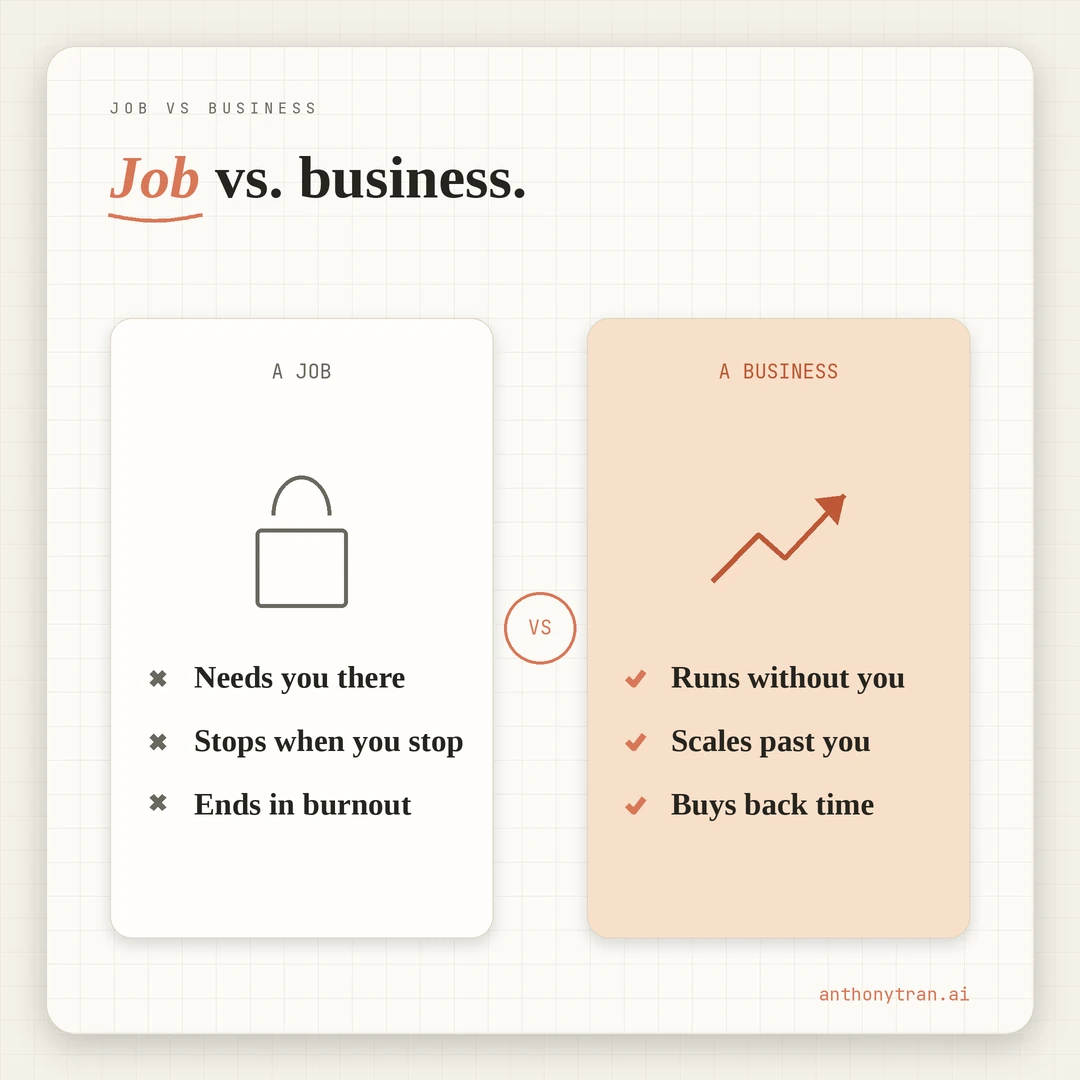
A business runs without you. A job requires you to be there.
This is the cleanest definition I know.
A business is a system designed so that the work continues whether or not any one person is in the room. Roles, processes, tools, documentation, decisions made in advance. The owner can take a vacation, get sick, get hit by a truck, and the business keeps running because it does not depend on the owner specifically.
A job is the opposite. A job is work that requires a specific person to be present and operating at full capacity. The moment that person stops, the work stops with them.
The shape of the activity does not decide which one it is. Two people can do the exact same work, one running it as a business and one running it as a job. The difference is what the work depends on.
When I built my first personal brand from 2013 to 2019, I told myself I was building a business. The reality is I had built a job that called itself a business.
Everything in that work depended on me being the central actor. The voice, the face, the hours, the decisions. There was no version of the work that ran without me at the middle of it.
When I hit the wall in 2019, the system did not just slow down. It broke, because the system was a person.
That is what burnout actually is. A structural collapse, not a willpower failure.
What I would do differently in the next build
The seven quiet years between 2019 and now were not a vacation. They were a re-education. I learned three things that would have changed how I built the first time around.
First, delegate from day one. Trust other people to do the work and accept that their version will be different from mine.
The first time around, I treated my own hands as the quality bar. Anything not done by me felt like a downgrade.
That mindset guarantees the work cannot scale beyond your own hands.
Second, build systems before you need them. The cost of designing a system feels high before the work is heavy.
After the work is heavy, you do not have the time to design it, so you keep doing the work yourself. Build the system early, while the work is still small.
Third, use AI to staff the roles you would have hired for. The first time around, the only way to take work off my plate was to hire a person.
AI now handles the writing assists, the research, the formatting, the first-draft cleanup. Each one used to be a role I had to either fill myself or pay someone for.
The point is not that I get to work faster. The point is that the system stops depending on me to carry every piece of it.
None of these prevent hard work. All of them prevent the structural collapse that comes when the work depends on one human running at full capacity for years.
If you are wondering whether you are the problem
There is a question that hides under most burnout conversations. Am I weak?
Am I lazy? Am I just not built for this?
The honest answer is almost always that the system you are operating inside was not designed to run without breaking the person inside it.
If you have been told to push harder, rest more, set better boundaries, and the cycle keeps repeating, the issue is not your discipline. The issue is the design of the work itself.
Put This Into Practice
Run the diagnostic. Open Claude or ChatGPT and walk through your current work honestly.
I want to know if I have built a job or a business. Walk me through these questions one at a time and wait for my answer before moving to the next:
- If I disappeared for two weeks with no internet, what would still keep running on its own?
- What would stall completely without me?
- For each thing that would stall, why does it depend on me specifically? Is it knowledge, relationships, skill, or just habit?
- What decisions am I still making repeatedly that should already be made by a rule, checklist, template, or role?
- Which of those dependencies could be moved to a process, a tool, or another person?
- What is the smallest first step I could take this week to remove myself from one specific thing the work depends on?
After I answer all six, name the pattern. Tell me whether I have built a job or a business, and where the highest-risk dependency is.
The exercise takes fifteen minutes. The answer is uncomfortable on purpose. It surfaces what the system actually runs on.
Burnout is not a badge of honor
Hustle culture treats exhaustion as evidence of commitment. Eighty-hour weeks become a flex.
Vacation skipped becomes a virtue. The burned-out worker becomes the heroic worker.
I will not be using that framing.
Burnout is not a badge of honor. It means you built a bad system. The badge belongs on the person who can take a real vacation without the work falling apart.
If you have burned out before, the next build is the chance to design the work differently. Not less ambition.
Different architecture. The goal is to build something that lasts, including the human running it.
~ Anthony
Frequently asked.
Why is burnout a system problem and not a willpower problem?
Burnout shows up when the work depends on one person staying at full capacity to keep running. That is a system that needs you for everything. The breakdown is structural, not motivational. The fix is to redesign what the work depends on, not to push through harder.
What is the difference between a job and a business?
A job requires you to be there or it stops. A business runs without you. The same activity (writing, designing, consulting, building) can be a job or a business depending on whether the system depends on you specifically or on roles, processes, and tools that any qualified person could fill.
How do you know if you have built a job or a business?
Take a two-week vacation without checking in. If the work survives, you built a business. If it stalls or breaks, you built a job in business clothing. The vacation test is uncomfortable on purpose. It surfaces what the system actually depends on.
Stop re-explaining yourself to Claude.
Grab the free AI Starter Kit: my exact Claude setup, so it knows your business. Plus the lessons as they land.
Anthony Tran
13 years in marketing and an Air Force veteran. I use Claude every day to market and grow my own business, and I break down what works in plain English. Writing and recording from Arizona.