
You don't need to be everywhere. You need 2 or 3 platforms where your audience already hangs out, that rank on Google, and that run from one source piece of content.
The platform trap
Saturday morning. Coffee.
I opened my laptop and looked at the nine platform profiles I had set up that month. Zero posts on any of them.
YouTube. X.
LinkedIn. Medium.
Reddit. Quora.
A podcast plan. The blog.
The website. Nine usernames claimed.
Nine half-filled bios. Zero content published.
I sat there with my coffee and asked myself one question. “Why do I think more is going to help this time?”
I felt the same weight in my chest that I felt in 2017. Back then I was running a podcast, a blog, a YouTube channel, courses, conferences, and client websites at the same time.
That was the year burnout started eating me alive. Different platforms. Same trap.
When you start building a personal brand, the advice hits from every direction. Be on YouTube.
Post on X. Start a newsletter.
Get on LinkedIn. Don’t forget TikTok.
Reddit has communities for this. Maybe a podcast too.
So I did what most people do. I signed up for everything. And then I sat there staring at all of it, paralyzed.
The filter that fixed it
I needed a rule. Something I could apply in five minutes and be done.
The filter is for discovery platforms, the places where new readers find your work. Email is the relationship channel where existing subscribers stay close.
Different job. So I built the filter for the discovery platforms and kept email by default.
For each discovery platform on my list, I asked four questions:
- Is my audience already on this platform, consuming content about my topic?
- Does content on this platform rank on Google?
- Can I cross-link from here to my other platforms?
- Can I feed it from one source piece of content?
If the answer was not yes to all four, it got cut.
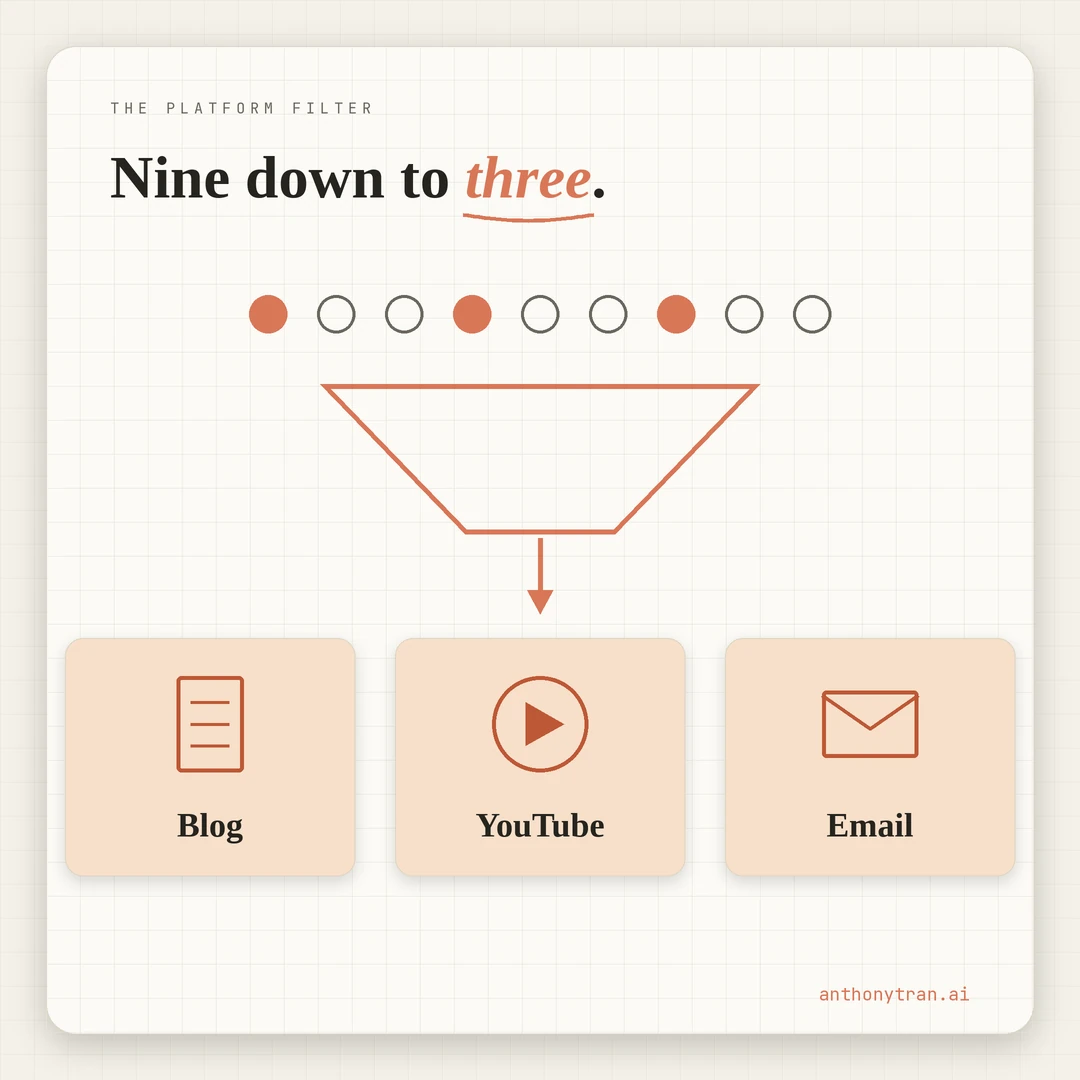
Six platforms went in five minutes. Two ranking platforms passed cleanly: the blog and YouTube.
Email kept its spot as the relationship channel. Three pieces from one source.
What survived and why
The blog is the canonical home. Every long-form piece lives there. Posts compound. A blog post written today can show up in search results for years. The blog passes all four questions. My audience reads long-form there. Google ranks it. It cross-links to everything else. It is the source piece.
YouTube is where my target audience already watches how-to content. It ranks on Google. It cross-links to the blog. It runs from one recording session that reads the blog post on camera. Passes all four questions.
Email is the relationship channel, not a discovery platform. Subscribers gave me their inbox. That trust is the most valuable real estate in this whole stack. The filter was for discovery. Email did not need to pass it.
What got cut and why
Medium got cut. Not because Medium is bad, but because my audience does not live there. Medium readers skew toward self-help and career-change content, not personal brand building. Even with canonical set correctly to point search traffic back to my blog, the maintenance overhead of another platform was not worth it for my specific niche.
X got cut for now. Posts do not compound the way a blog post or video does. A tweet lives for a few hours. A blog post lives for years. I claimed the handle and I will use it eventually. Not a Phase 1 priority.
LinkedIn is on hold for now. My existing profile is tied to my professional career, and mixing personal brand content into that feed would muddy the signal for both audiences.
Reddit was a mess. My existing accounts had years of random comments and personal posts. Starting a fresh account just to post personal brand content felt forced. And Reddit requires constant engagement to build credibility. You cannot just post and leave. It is a hamster wheel.
Quora used to rank well on Google. It does not hit the way it used to. The effort-to-return ratio does not work for one person doing everything.
The podcast plan got shelved. I ran one before. I know what production time it eats. Phase 1 is foundation work. I will revisit if the audience asks for it.
The pipeline
The blog post is the source. The same content gets sent to email subscribers (paste into the email tool, or auto-send via RSS).
The same content gets read on camera for YouTube. The blog and the YouTube video rank on Google. The email lives in the inbox where the relationship is.
One source idea creates content for three channels in the time it used to take to make one.
That is the math. Not “be everywhere.
Not “post on 7 platforms and hope one hits. Two ranking platforms plus one relationship channel, all fed from one source piece.
It sounds obvious written out. But when you are staring at a blank YouTube channel, a blank email list, and a blog with zero posts, the pull to sign up for more feels real.
More platforms feel like more chances. In reality, more platforms just mean more places to be inconsistent.
Justin Welsh built a 250,000+ subscriber audience for years using LinkedIn and a newsletter. Two platforms.
James Clear did the same with email and his own site. Dan Koe ran X for years before he expanded.
None of them needed to be everywhere to grow something real.
You do not need 9 platforms. You probably need 1 or 2 ranking platforms that pass the filter, plus an email channel for the relationship, all fed from one source piece.
How to run this filter yourself
If you are building a personal brand and you feel the pressure to be everywhere, stop. Ask the four questions.
Is your audience there? If they are not consuming content about your topic on that platform, it does not matter how good the platform is. You are posting to an empty room.
Does it rank on Google? If no, your content has a shelf life of hours instead of years. Every post you make there disappears fast.
Can it cross-link? If no, it is a silo. Your content cannot help your other content grow.
Can you feed it from one source? If no, you are creating original work for every platform separately. That is the burnout recipe. I have lived it.
The hard part of the filter is not running it. The hard part is being honest about which platforms you are keeping because they passed and which ones you are keeping because you just like them.
I wrote about a similar trap with AI tools in picking tools without the rabbit hole. Same principle.
The urge to add more is almost always the wrong move early on. And if you want a filter for the content you put on whatever platforms survive, the four things people actually care about is a good one.
Put This Into Practice
Here is a prompt you can paste into Claude, ChatGPT, or any AI tool right now.
I’m building a personal brand about [your topic] and I’m currently on or planning to be on these platforms: [list your platforms]. My target audience is: [describe them in 1-2 sentences].
For each platform, answer four questions:
- Is my target audience already on this platform consuming content about my topic?
- Does content on this platform rank on Google search results?
- Can I add links from this platform back to my other platforms?
- Can I create content for this platform by repurposing one source piece of content like a video or long-form blog post?
Based on the answers, tell me which platforms to keep, which to cut, and why. Then suggest a simple content pipeline where one source piece of content feeds all the platforms I keep.
Take whatever it gives you and be honest with yourself. If a platform only survived because you like using it, not because it passed the filter, that is the one to cut first.
For the full picture of how I am building this from scratch, start with the manifesto.
Come build with me.
Frequently asked.
How many social media platforms should a personal brand use?
Two or three is enough if they pass a four-question filter: your audience is already there, content ranks on Google, you can cross-link, and you can feed each from one source piece of content. More than that and you are creating busywork instead of compounding work.
What is the four-question platform filter?
Four yes-or-no questions to ask about every platform on your list. Is my audience already on this platform consuming content about my topic? Does content on this platform rank on Google? Can I cross-link from this platform to my other platforms? Can I feed this platform from one source piece of content? If the answer is not yes to all four, the platform gets cut.
Stop re-explaining yourself to Claude.
Grab the free AI Starter Kit: my exact Claude setup, so it knows your business. Plus the lessons as they land.
Anthony Tran
13 years in marketing and an Air Force veteran. I use Claude every day to market and grow my own business, and I break down what works in plain English. Writing and recording from Arizona.