
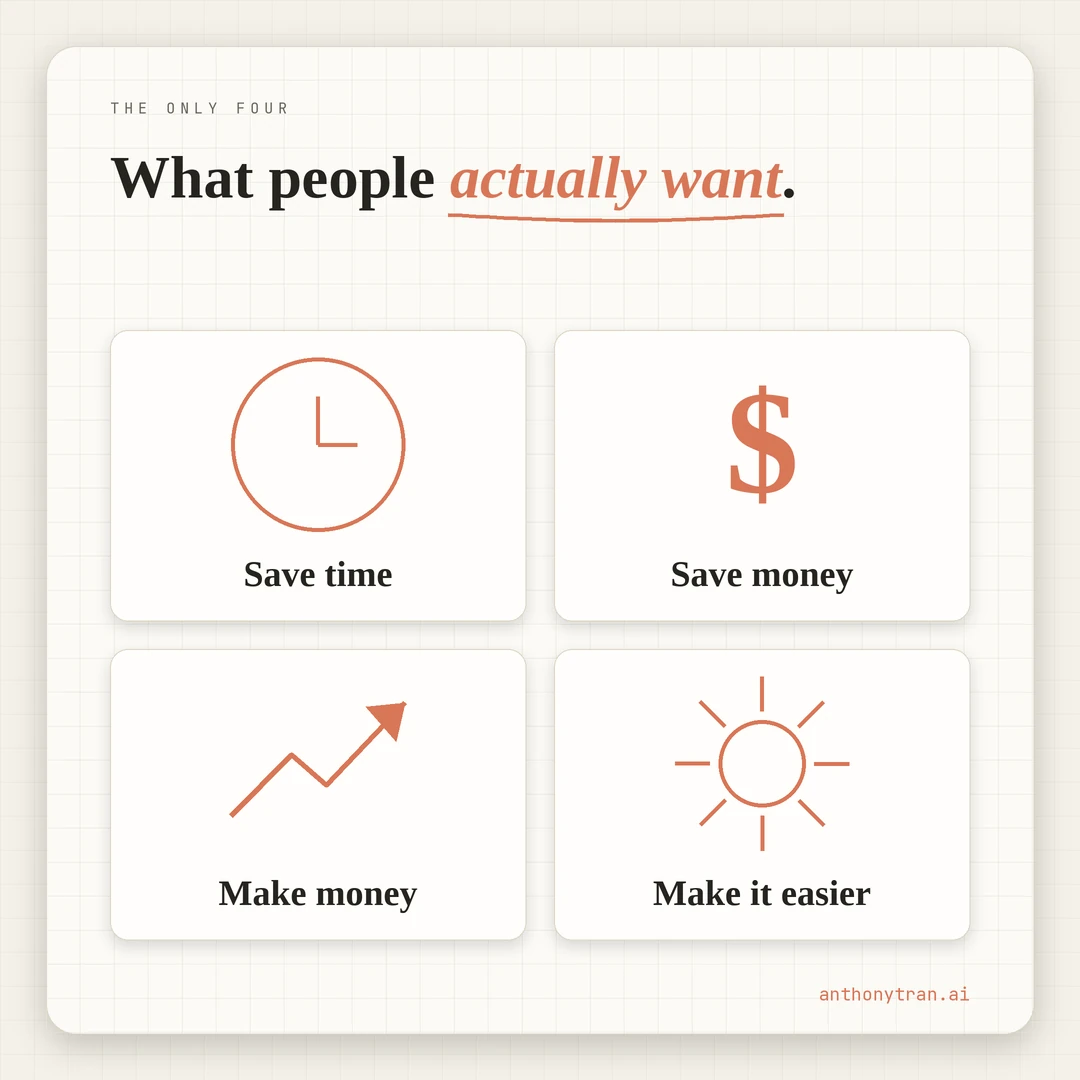
Save time. Save money. Make money. Make things easier. Every piece of content that works hits at least one. Everything else is noise.
I sat in client meetings for over a decade asking what people actually wanted from their websites. The answer was always the same four things, in different words.
Save time. Save money.
Make money. Make things easier.
Every brief I ever wrote eventually collapsed into one of those four. Once I saw that, I could not unsee it. It is also the only filter that actually works for personal brand content.
Why these four things matter
Nobody wants AI. They want what AI gives them.
Nobody wants a content system. They want the freedom that comes from having one.
Nobody wants to create YouTube videos. They want the revenue and reach that videos can build.
The tool is never the point. The outcome is the point. And all outcomes collapse into four categories.
Save time. Does this help them get something done faster?
Save money. Does this help them avoid wasting money on tools or mistakes?
Make money. Does this help them grow their personal brand, attract clients, or increase revenue?
Make things easier. Does this simplify something that felt complicated?
If a piece of content does not hit at least one, it is content for you, not for them.
The 75 episodes I got wrong
I did 75 episodes of a podcast about digital marketing tactics. SEO tips.
Social media hacks. Video strategies. Stuff I personally found interesting.
Some episodes got decent listens. But the audience never grew because I was leading with features, not outcomes. I was saying “here is a cool tactic” instead of “here is how to save five hours this week.”
When someone clicks on a blog post called “10 AI tools for content creators,” they do not want 10 tools. They want to create content faster (save time) or publish better content without hiring help (save money).
The tool list is the feature. The outcome is the benefit.
I had been doing the opposite for 75 episodes. The episodes were good. The framing was wrong.
How to use this as a content filter
Before you create anything, write down the topic. Then ask: which of the four does this hit?
If you can name at least one clearly, keep going. If you cannot, rethink the topic.
Here is how it works for me. Say I have an idea for a post about prompt engineering.
That sounds like a good topic. But “prompt engineering” is a feature. Nobody wakes up thinking “I need better prompts today.”
They wake up thinking “I spent an hour writing and it still sounds robotic.” That is the pain. The outcome is “sound like yourself in half the time.”
Before filter: How to write better prompts for AI.
After filter: How to get AI to sound like you in half the time.
Same content. Different framing.
The second one leads with the outcome. The first one leads with the feature.
The four-things filter turns a generic topic into one that matters.
The Cool Factor Trap
It is easy to create content about topics you find interesting instead of topics that solve your audience’s problems. I did it for 75 episodes of my old podcast.
I talked about tactics I thought were fascinating. The audience never grew because fascinating to me did not mean useful to them.
The fix is simple. Every topic should pass the “does anyone actually want this?” test before you start creating it. If the answer is “I think it is cool,” that is the Cool Factor Trap talking.
Put This Into Practice
Here is a prompt you can paste into Claude, ChatGPT, or any AI tool right now.
I’m building a personal brand and I want to make sure my content ideas actually matter to my audience. Here are my next 5 content ideas. For each one, tell me which of these four outcomes it hits: save time, save money, make money, or make things easier.
If it hits at least one clearly, keep it and explain why. If it doesn’t hit any, tell me it’s a “Cool Factor” topic, something I find interesting but my audience doesn’t need. Then rewrite it so it leads with one of the four outcomes instead of the feature.
My audience is: [describe your target audience in 1-2 sentences]
My 5 content ideas:
- [idea]
- [idea]
- [idea]
- [idea]
- [idea]
If your content is still centering you instead of the audience, the Me vs Them Trap post is the next step. For the full picture of what I am building, start with the manifesto.
Come build with me.
Frequently asked.
What do audiences actually care about when consuming content?
Your audience only cares about four things: saving time, saving money, making money, and making things easier. Every piece of content that works hits at least one of these outcomes. Everything else is a feature disguised as a benefit.
How do you use the four things framework as a content filter?
Before creating anything, write down the topic and ask which of the four it hits. If you can name at least one clearly, keep going. If you can't, rethink the topic and reframe it from a feature to an outcome.
What is the Cool Factor Trap in content creation?
The Cool Factor Trap is creating posts about topics you find interesting instead of topics that solve your audience's problems. The fix: every topic should pass the 'does anyone actually want this?' test before you start. If the answer is 'I think it's cool,' that's the Cool Factor Trap talking.
Stop re-explaining yourself to Claude.
Grab the free AI Starter Kit: my exact Claude setup, so it knows your business. Plus the lessons as they land.
Anthony Tran
13 years in marketing and an Air Force veteran. I use Claude every day to market and grow my own business, and I break down what works in plain English. Writing and recording from Arizona.