
Most personal brands fail because the creator talks about themselves instead of solving problems. If your content is about you, it will not grow. Period.
In 2013 I started a podcast to share my journey building a web design agency. By 2017 I had four years of content, conference talks, and features in Entrepreneur and Huffington Post.
The audience was growing slowly. But the people showing up were fans of the story, not builders who needed help.
That gap had a name I did not know yet. The Me vs Them Trap.
What is the Me vs Them Trap?
The Me vs Them Trap is the default setting for most new personal brands. You launch a YouTube channel or a blog.
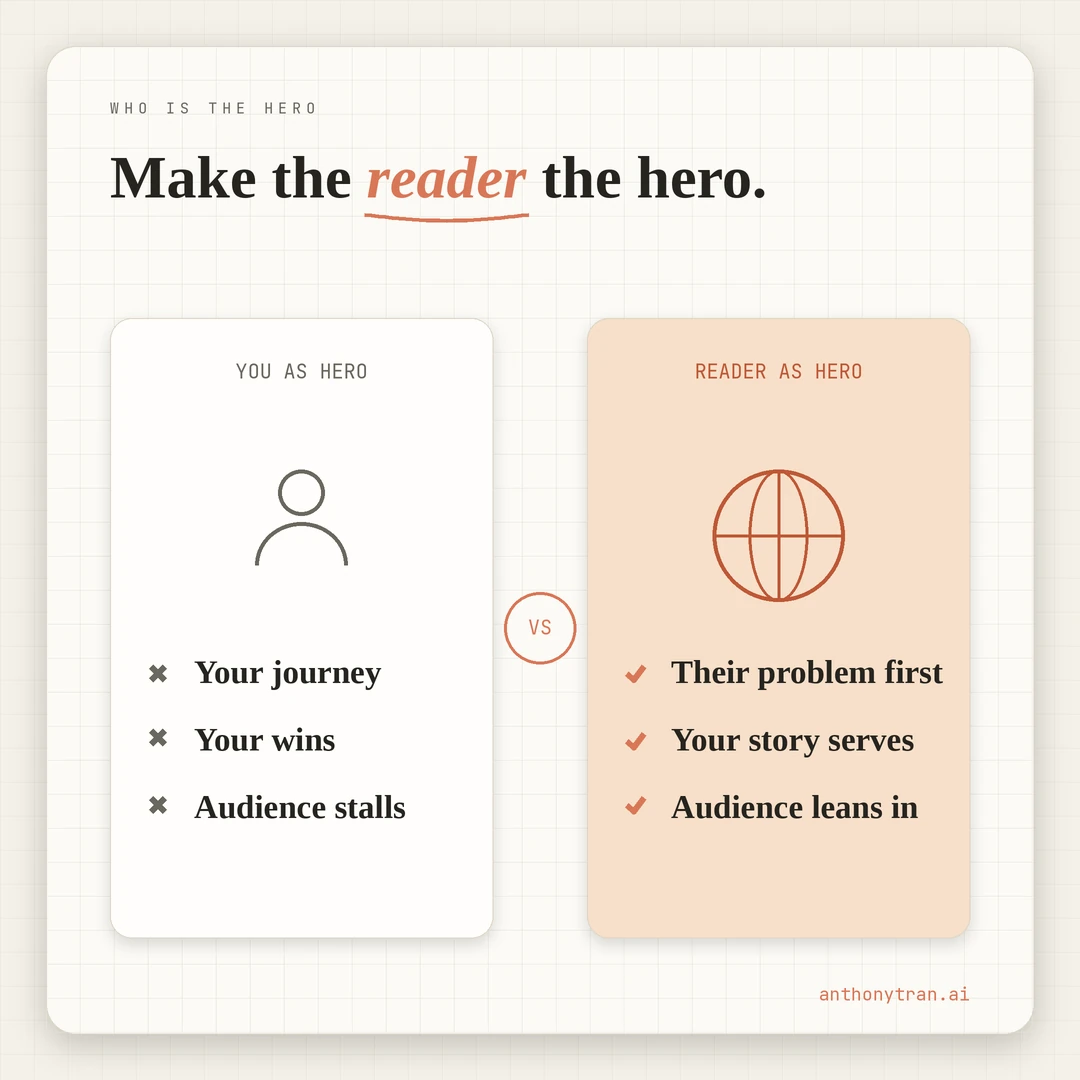
You talk about your journey, your wins, your process. You share what you are excited about.
The audience does not grow. You cannot figure out why.
The content is good. You are showing up consistently. But nobody is engaging.
Here is the problem. You are the hero of your own content.
Your audience needs to be the hero. That flip is the entire game.
Why it feels right to talk about yourself
Personal brands are personal. The name is right there.
You think the audience wants to know your story, your credentials, your results. And some of that matters.
But only after they trust that you understand their problem.
Think about the last time you followed someone online. Did you follow them because their bio was impressive? Or because their content made you think “this person gets what I am going through?”
It was almost always the second one.
The counter-argument: is not vulnerability the point?
Fair pushback. The advice for years has been “be authentic, share your story, be vulnerable.
And that is not wrong. Vulnerability builds connection.
But vulnerability without relevance is a journal entry, not content. The test is simple: does this story serve the reader, or does it serve your ego?
My burnout story matters because my audience is on the same path. My Air Force story matters because it shows how I handle setbacks. If my audience were accountants learning Excel, neither story would matter at all.
The story has to serve the reader’s problem. If it does not, it is about you.
Why AI makes this trap harder
AI makes it easy to create more content faster. That means you can fall into the Me Trap at scale.
Ten posts a week about yourself instead of two. More volume, same mistake.
The fix is not creating less. It is running every idea through one filter: does my audience need this?
Not “would they like it” or “would they engage with it. Do they need it?
My audience needs to save time, save money, make money, or make things easier. If the content does not hit at least one of those four, I do not publish it.
How to escape the trap
Read your last five posts. For each one, ask: who is the hero of this content? Me or the reader?
If you are the hero in more than two of them, flip the ratio. Start the next post with the reader’s problem, not your story. Use your story as evidence, not the main event.
Here is the test I use. Can I replace my name with any other person’s name and the post still works?
If yes, the content is generic. If no, the personal experience is doing the heavy lifting it should.
The goal is content where your experience proves the reader’s problem is solvable. Not content where you perform your experience for applause.
Put This Into Practice
Here is a prompt you can paste into Claude, ChatGPT, or any AI tool right now.
I want to find out if my personal brand content is about me or about my audience. I’m going to paste my last 5 posts or videos below. For each one, answer these questions:
- Who is the hero of this post, me or the reader?
- How many times do I say “I” in the first paragraph versus how many times I reference the reader’s problem?
- Does the post lead with my story or with the reader’s pain?
- If you removed my name and swapped in someone else’s, would the post still work? If yes, the personal experience isn’t doing enough work.
After the audit, give me a scorecard. Tell me how many of the 5 are “Me” posts versus “Them” posts. Then take the worst offender and rewrite the first paragraph so it leads with the reader’s problem instead of my story. Keep my voice. Just flip who the hero is.
[Paste your 5 posts here]
If you want to see how StoryBrand connects to this, read the StoryBrand post. Or start from the beginning with the manifesto.
Come build with me.
Frequently asked.
What is the Me vs Them Trap in personal branding?
The Me vs Them Trap is when you launch a personal brand and talk about your journey, your wins, and your process, then watch the audience fail to grow. The problem is that you're the hero of your own content when your audience needs to be the hero.
Isn't vulnerability the whole point of personal brand content?
Vulnerability builds connection, but vulnerability without relevance is a journal entry, not content. Your personal story only matters when it proves the reader's problem is solvable, not when you perform it for applause.
How do you escape the Me vs Them Trap?
Read your last five posts and ask: who is the hero of this content? If you're the hero in more than two of them, start the next post with the reader's problem, not your story. Use your experience as evidence, not the main event.
Stop re-explaining yourself to Claude.
Grab the free AI Starter Kit: my exact Claude setup, so it knows your business. Plus the lessons as they land.
Anthony Tran
13 years in marketing and an Air Force veteran. I use Claude every day to market and grow my own business, and I break down what works in plain English. Writing and recording from Arizona.