
StoryBrand says the customer is the hero. I learned that in 2017 and have been catching myself getting it wrong ever since. Here is what the trap looks like and how I am climbing out of it.
I keep rewriting my About page. The first draft is always about me. Then I catch myself, scrap it, and start over with the question I should have started with: who is the reader, and what do they need from this page?
This is the lesson I have been carrying around for years and still need to remind myself of. Making yourself the hero of your own personal brand is the most natural mistake there is. It is also the exact mistake StoryBrand was written to prevent.
What StoryBrand actually says
StoryBrand is a marketing framework by Donald Miller. Every brand story follows the same structure as a movie.
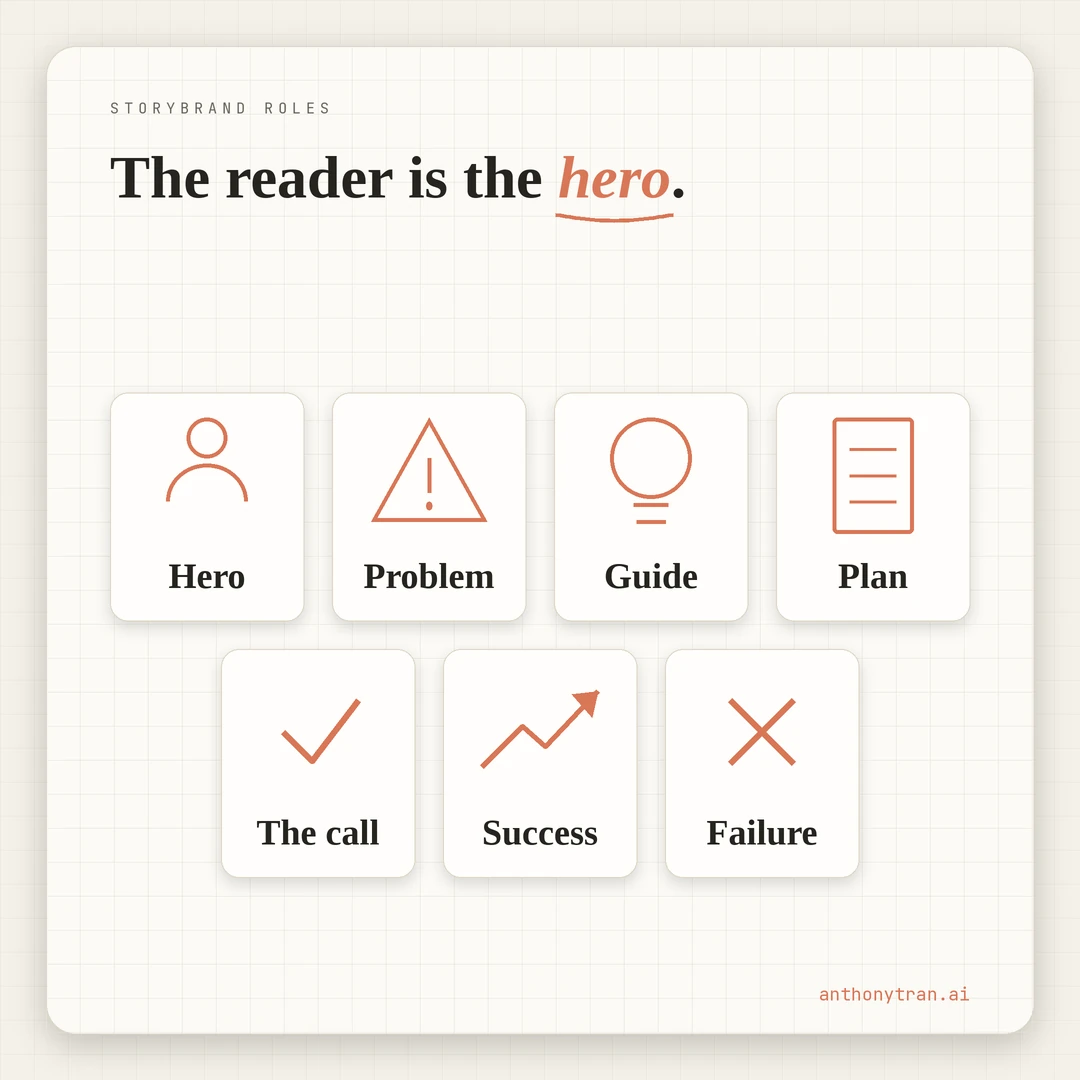
The customer is the hero. You are the guide.
Think Star Wars. Luke Skywalker is the hero.
He has a problem: the Empire. He meets Obi-Wan, who gives him a plan, a lightsaber, and a reason to act.
Luke saves the galaxy. Obi-Wan does not.
The guide never saves the day. The guide helps the hero save the day. That difference changes everything about how you write, what you post, and how you talk about yourself.
Why the trap is so hard to escape
I read Building a StoryBrand in 2017. I applied it to my web design clients right away.
Their websites changed. Their conversion changed. I knew the framework worked.
I just did not apply it to my own personal brand. Not really.
When you build a personal brand, the pull to make it about you is constant. The words on the door imply it.
Personal brand. Your name.
Your story. Your face on the homepage.
Of course you start writing about yourself. That is what the brand is, on the surface.
The trap is sneaky because it does not feel wrong. Sharing your story feels honest.
Sharing your wins feels like proof. Sharing your credentials feels like earning trust.
But the reader is asking one question the whole time: “what is in it for me?” If the first three paragraphs of your About page do not answer that, they scroll.
What I was actually doing wrong the first time
I built my first personal brand starting in 2013. I helped people.
I gave away free content. I gave free advice.
I coached web designers building their own businesses. I helped a lot of them make their first dollars online.
The work itself was right. The positioning was wrong.
The way I framed everything was about me. My podcast was about my journey.
My YouTube was about my projects. My social media was about my wins.
I talked about stages I had spoken on, publications I had been featured in, numbers I had hit. I thought sharing my success would attract people.
It attracted attention. It did not build trust.
The audience was watching me talk about me. Even the help was framed as proof of how much I knew. They were never seeing themselves in the story.
That ego drove the content. It also drove the burnout.
Recognition was the goal. Service was the side effect.
By 2018 I was running on empty, and even though the business kept going, I broke.
What I am doing differently now
The discipline I am trying to live by this time is “service before self.” It is an Air Force core value I carried out of the military. It also happens to be the actual point of StoryBrand.
When I read my own copy now, I am asking three questions:
- Why should my reader care?
- What is in it for them?
- How does this help them solve a problem they have right now?
If the first paragraph does not answer those, I rewrite. Even when the content is technically about me (origin story, mistakes I made, lessons learned), the framing has to come back to the reader. My experience is only useful as evidence that I understand their problem.
This is why my About page keeps getting revised. The first draft is about me.
The second is less about me. The one I am working on now is about who I am writing for. The next one might still need work.
The balance
You do need to talk about yourself when building a personal brand. The reader needs to know who you are, what you have done, why they should listen.
Wins and credentials build trust. Origin stories build connection. None of this works if you skip it.
The balance is this: talk about yourself in service of the reader. Not about you. For them.
A win you mention because it proves you understand a problem they have? Useful.
A win you mention because you want them to be impressed? Filler.
Same content. Different framing. The reader can tell the difference.
The framework filled in for my brand
Here is StoryBrand applied to Anthony Tran AI.
The hero: A career professional who wants to build a personal brand on the side using AI.
The problem: They do not have enough time. They are overwhelmed by platforms and tools. They are scared of sounding fake. They have tried before and stalled out.
The guide: I built a personal brand, burned out, came back, and I am doing it again with AI. I have made the mistakes they are about to make.
The plan: Follow along. Watch what I try. Take what works. Skip what does not.
The call to action: Subscribe, read the blog, watch the videos. Use what helps.
Success: A growing personal brand that does not require 12-hour days. Content that sounds like them. Progress that compounds.
Failure avoided: Burnout. Wasted time. Starting over again in two years.
Every piece of content I create runs through this. If the reader is not the hero, I rewrite it.
The test that catches you
Read your last three posts or videos. Count how many times you say “I” in the first paragraph. Count how many times you reference the reader’s problem versus your own accomplishments.
If the “I” count is high and the reader’s problem is missing, you are the hero of your own story. Your audience will scroll past.
The fix is one move. Open any post.
Find the first sentence about yourself. Rewrite it as a sentence about the reader’s problem. That one change shifts everything.
I do this check on every post before it goes live. It catches me almost every time.
The pull toward talking about yourself is strong, especially when you have real experience to share. The discipline is pointing that experience at the reader’s problem instead.
Put This Into Practice
Here is a prompt you can paste into Claude, ChatGPT, or any AI tool right now.
I’m building a personal brand and I want to make sure my messaging puts my audience first, not me. Help me fill in the StoryBrand framework for my brand. Ask me these questions one at a time and wait for my answer before moving on:
- Who is the hero? Describe the one person my content is for. Their age, job, daily life.
- What is their problem? What are they struggling with right now that my content helps solve?
- Why am I the guide? What experience do I have that proves I understand their problem?
- What is the plan? What steps am I giving them to follow?
- What does success look like for them if they follow the plan?
- What failure do they avoid?
After I answer all six, write me a one-paragraph brand message that leads with the hero’s problem, not my credentials. Then take my last three social posts or blog posts [paste them in] and count how many times I say “I” in the first paragraph versus how many times I reference the reader’s problem. Tell me if I’m the hero or the guide.
If you are talking about yourself more than you are talking about their problem, you are the hero of your own story. Your audience will scroll past.
For the full picture of what I am building, start with the manifesto. Or read about how I picked my niche, which is where the audience-first thinking started.
Come build with me.
Frequently asked.
What is StoryBrand and how does it apply to a personal brand?
StoryBrand is a marketing framework by Donald Miller built on the idea that the customer is the hero and you are the guide. Applied to a personal brand, your content should center on your audience's problem, not your own journey. Your credentials and story only matter after the reader sees themselves in it.
What do most people get wrong when applying StoryBrand?
Everyone quotes 'the customer is the hero' and still gets it wrong. The real insight is that the customer doesn't care about your story until they see themselves in it. Your origin story, credentials, and wins mean nothing until the reader thinks 'this person understands my problem.'
How do you test whether your content follows StoryBrand?
Read your last three posts and count how many times you say 'I' in the first paragraph versus how many times you reference the reader's problem. If the 'I' count is high and the reader's problem is missing, rewrite the opening sentence about yourself as a sentence about the reader's problem.
Stop re-explaining yourself to Claude.
Grab the free AI Starter Kit: my exact Claude setup, so it knows your business. Plus the lessons as they land.
Anthony Tran
13 years in marketing and an Air Force veteran. I use Claude every day to market and grow my own business, and I break down what works in plain English. Writing and recording from Arizona.