Your story already exists. You just haven't organized it yet. AI can help you pull it out, not make it up.
I had 23 years of career experience and no origin story. Not because I did not have one. Because I had never sat down and written it.
Why your origin story matters for your personal brand
Every personal brand needs one. Not a resume.
Not a bio. A story that answers one question: why should this person listen to you?
I knew my story. I had lived it.
Air Force officer. Fortune 500 manager.
Entrepreneur who burned out. Marketing director for the past seven years.
But it was all scattered in my head. Bits and pieces. No thread connecting them.
I tried writing it myself a few times over the years. Every time I would get three paragraphs in and stall.
Too much to cover. Too many rabbit holes.
I would start with the military. Jump to the burnout.
Loop back to the podcast. Lose the thread completely.
How AI helped me find the story I already had
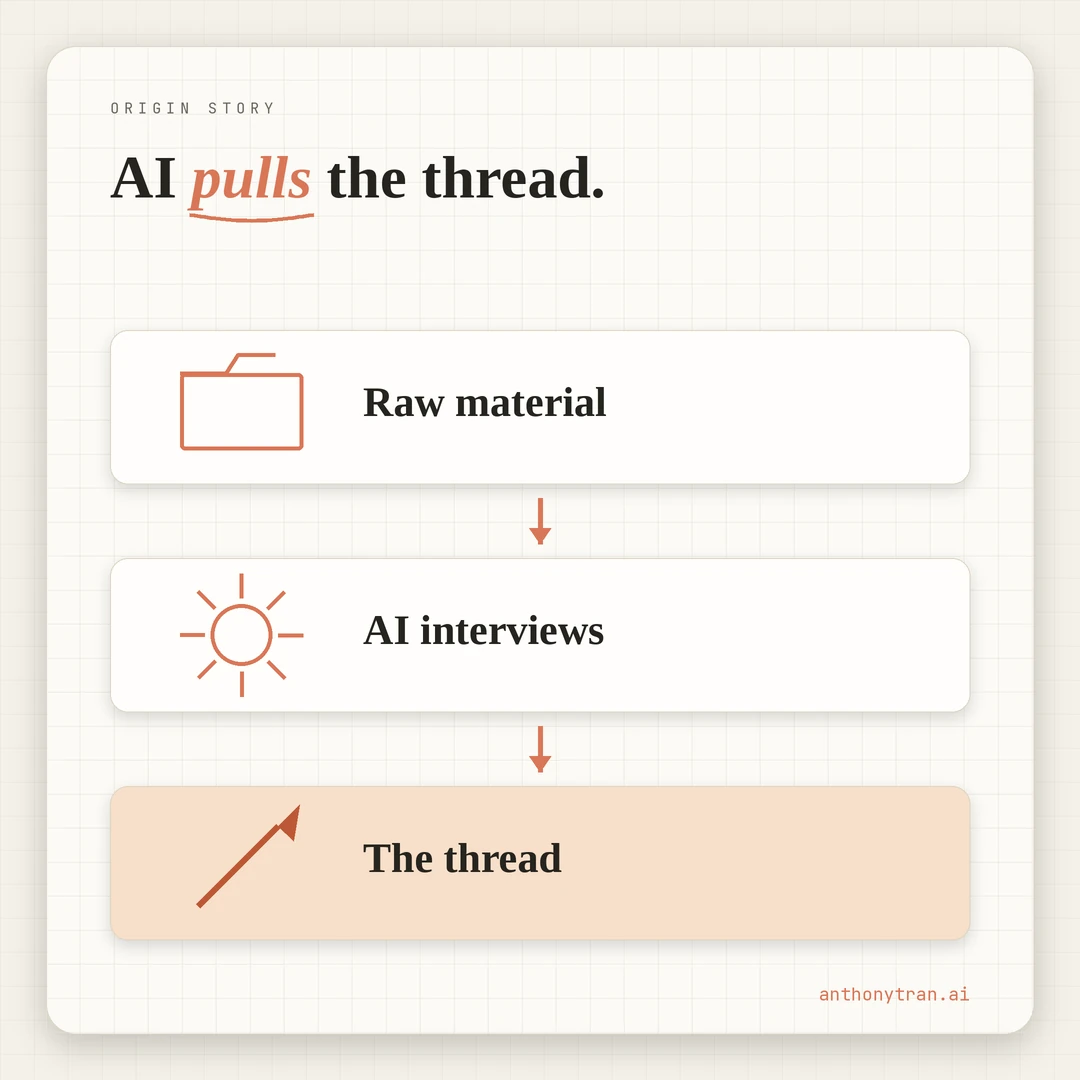
I sat down with Claude and did something simple. I talked. It asked questions.
Not “tell me your life story.” More like “what happened after the Air Force?” and “why did you quit the agency?” and “what was the moment you knew you were burned out?”
The AI did not write my story. It interviewed me.
I gave it the raw material. Dates, places, turning points, mistakes.
It organized the mess into a timeline that actually made sense.
Some things I thought were important turned out to be filler. Other things I almost skipped turned out to be the heart of the story.
The two red dots at MEPS that ended my fighter pilot dream. The 3 AM feeling that told me to apply for a job I had been ignoring for a month.
Linh giving me 12 months to figure it out in 2013, with one line I have not forgotten since: “Everything you put your mind to, you accomplish. I will give you one year.”
Those were the moments that mattered. I knew they happened. I just did not know they were the story.
The part most people get wrong
The first draft was over 3,000 words. It read like a memoir chapter, not a personal brand origin story.
So I asked Claude to help me cut it. What is the shortest version that still makes someone care?
We went back and forth. I would say “keep the fighter pilot part” and Claude would ask “why does that matter for your audience?
Good question. It matters because it shows I have been redirecting setbacks into new plans my entire life. That is the thread.
The final version has a full-length story and a short About page version. The full version lives in my brand documents.
The short one goes on the website. Both came from the same conversation.
Here is what I learned: the AI did not make the story better by adding words. It made it better by asking which words to keep.
How to write yours
Start talking. Open Claude or whatever AI tool you use.
Do not type a polished paragraph. Just answer questions.
Where did you grow up? What was the first job that shaped you?
When did things go wrong? What did you learn from it? Why are you doing what you are doing now?
Then ask the AI to find the thread. The one theme that connects everything.
For me it was “See it. Plan it.
Build it. Same method in every role, every chapter, every restart. I did not see that pattern until the AI pointed it out.
Your story is already there. You do not need to invent anything.
You just need someone to ask you the right questions. AI is surprisingly good at that part.
Put This Into Practice
Here is a prompt you can paste into Claude, ChatGPT, or any AI tool right now.
I need to write my personal brand origin story but I don’t know where to start. Interview me. Ask me one question at a time and wait for my answer before moving on. Start with these:
- What was the first job or experience that shaped who you are today?
- What happened next? Walk me through the major chapters of your career.
- When did things go wrong? What broke or didn’t work out the way you planned?
- What did you learn from that failure or setback?
- Why are you doing what you’re doing now? What changed?
- What’s the one thing that’s been true about you in every chapter, even when everything else changed?
After I answer all six, find the thread. Tell me the one theme that connects everything. Then write two versions of my origin story: a full version (500 words max) and a short version for an About page (150 words max). Use my words, not yours. Keep it honest. Cut anything that sounds like a resume.
Don’t edit yourself when you answer. The messy answers are where the real story lives.
If you want the bigger picture of what I am building and why, the manifesto post is where this started.
Come build with me.
Frequently asked.
Why does your personal brand need an origin story?
Every personal brand needs one. Not a resume, not a bio, but a story that answers one question: why should this person listen to you? Without it, your experience is just scattered bits and pieces with no thread connecting them.
How do you write your origin story using AI without it sounding fake?
Don't start with a polished paragraph. Just talk. Open an AI tool and answer questions about where you grew up, what shaped you, when things went wrong, and what you learned. Then ask the AI to find the thread connecting everything. The AI organizes the raw material. It doesn't invent the story.
What is the most common mistake people make writing their origin story?
Going too long and leading with what felt important to you rather than what actually moves the audience. A 3,000-word memoir chapter is not a personal brand origin story. The fix is asking the AI which words to keep. It makes the story better by cutting, not by adding.
Stop re-explaining yourself to Claude.
Grab the free AI Starter Kit: my exact Claude setup, so it knows your business. Plus the lessons as they land.
Anthony Tran
13 years in marketing and an Air Force veteran. I use Claude every day to market and grow my own business, and I break down what works in plain English. Writing and recording from Arizona.