
Your visual identity should come from who you are, not what looks trendy. I picked mine from a career pattern I almost missed.
I almost went with a fighter pilot theme. It would have been wrong.
Why your visual identity matters more than you think
A visual identity is how your personal brand feels before anyone reads a word. Colors, fonts, vocabulary, the overall mood.
Most people pick whatever looks cool on Pinterest. That is how you end up looking like every other personal brand online.
I needed something that was actually mine. Not borrowed.
Not trendy. Something rooted in who I am and how I work.
The obvious choice I almost made
I am an Air Force veteran. I served during Operation Iraqi Freedom.
I wanted to be an F-16 pilot since I was a kid watching Top Gun with my dad on Saturday afternoons and going to the El Toro airshow every year. The military shaped me in ways I carry every day.
So when it came time to pick a visual direction, the fighter pilot theme was right there. Aviator imagery.
Call signs. Mission briefings. It would have been easy.
But it would have been wrong. My content is not about the military.
It is about building a personal brand with AI. Wrap everything in fighter jet vocabulary and the audience thinks they landed on a veterans’ page. Not a content site.
Your visual identity has to match what you are building now, not just what you are proud of from before.
How I found the real pattern
I was working through my origin story with Claude when something clicked. Every chapter of my career followed the same pattern.
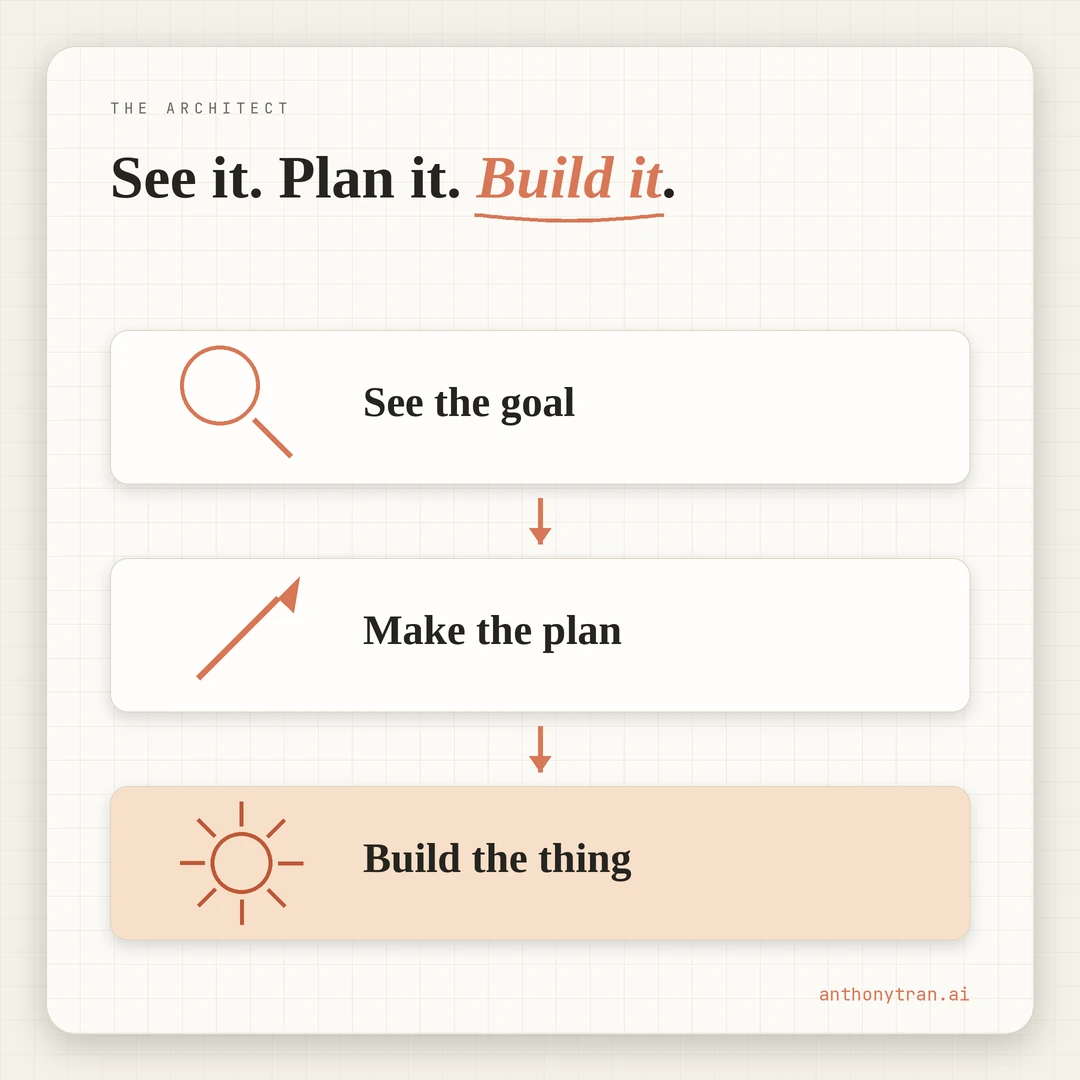
See the goal. Make the plan. Build the thing.
Air Force logistics. Fortune 500 operations at CarMax.
Aerospace planner at Parker Hannifin. Web design agency I built with Linh.
Marketing director at Beaver Builder, a WordPress company. Different industries, different tools.
Same three steps every time. I had been doing it for 23 years without naming it.
That pattern has a name. It is what architects do.
They see the vision, draw the blueprint, and build the structure. That became everything.
What the Architect looks like in practice
Dark mode. Blueprint aesthetics. Sheet numbers like A-01 and A-02 on content series.
Revision marks on updates. Drafting vocabulary like “revision,” “elevation,” and “section.”
Two accent colors. Cyan for the technical, AI side.
Amber for the human, personal side. Both on a dark background.
The methodology line: See it. Plan it.
Build it. Three words that describe everything I do and everything I teach.
None of this came from a mood board. It came from looking at my own career and pulling out the thread that was already there.
The AI helped me see it. I just had to stop trying to pick something cool and start looking at what was true.
How to find your visual identity
Do not start with colors and fonts. Start with the question: what pattern shows up in everything I do?
Maybe you are a teacher at your core. Maybe you are a builder, a connector, a translator, a coach.
That word becomes your archetype. The visuals flow from there.
If you are stuck, try this. Open an AI tool.
Paste in your resume or career history. Ask it to find the one verb that describes how you have worked across every role. The answer might surprise you.
I went through five possibilities before landing on Architect. Strategist, mentor, operator, builder, architect.
Each one got pressure-tested. Architect won because it matched the visual direction and the methodology in one word. The other four got cut.
That is the move. Not “pick the most impressive thing you have ever done.” Pick the one verb that has been quietly true about you in every chapter.
Put This Into Practice
Here is a prompt you can paste into Claude, ChatGPT, or any AI tool right now.
I need to find a visual identity for my personal brand, but I don’t want to just pick colors that look cool. I want something rooted in who I actually am. Here’s my career history: [paste your resume or a quick summary of every job you’ve held].
Based on this, do three things:
- Find the one verb or role that describes how I’ve worked across every chapter. Not my job title. The pattern underneath. Was I always teaching? Building? Connecting? Translating? Organizing?
- Give me five archetype options based on that pattern. For each one, suggest a visual direction: color mood, font style, and vocabulary I’d use in my content.
- For each archetype, tell me what audience it would attract and what audience it would accidentally repel.
Then ask me which one feels most like me, not which one looks the coolest.
The right visual identity is not the one that looks best on a mood board. It is the one that has been true about you for years and you just haven’t named it yet.
If you want the full story of what I am building and why, start with the manifesto.
Come build with me.
Frequently asked.
How do you choose a visual identity for your personal brand?
Don't start with colors and fonts. Start with the question: what pattern shows up in everything I do? That word becomes your archetype, and the visuals flow from there. A visual identity rooted in who you actually are will outlast anything pulled from a trend.
How can AI help you find your visual identity?
Open an AI tool, paste in your resume or career history, and ask it to find the one verb that describes how you've worked across every role. The answer may surprise you. The AI doesn't pick the identity. It helps surface a pattern that was already there but not yet named.
Why shouldn't your visual identity just reflect your most impressive credential?
Because your visual identity has to match what you're building now, not just what you're proud of from before. Wrapping your content in imagery tied to a past chapter signals the wrong thing to the wrong audience.
Stop re-explaining yourself to Claude.
Grab the free AI Starter Kit: my exact Claude setup, so it knows your business. Plus the lessons as they land.
Anthony Tran
13 years in marketing and an Air Force veteran. I use Claude every day to market and grow my own business, and I break down what works in plain English. Writing and recording from Arizona.