
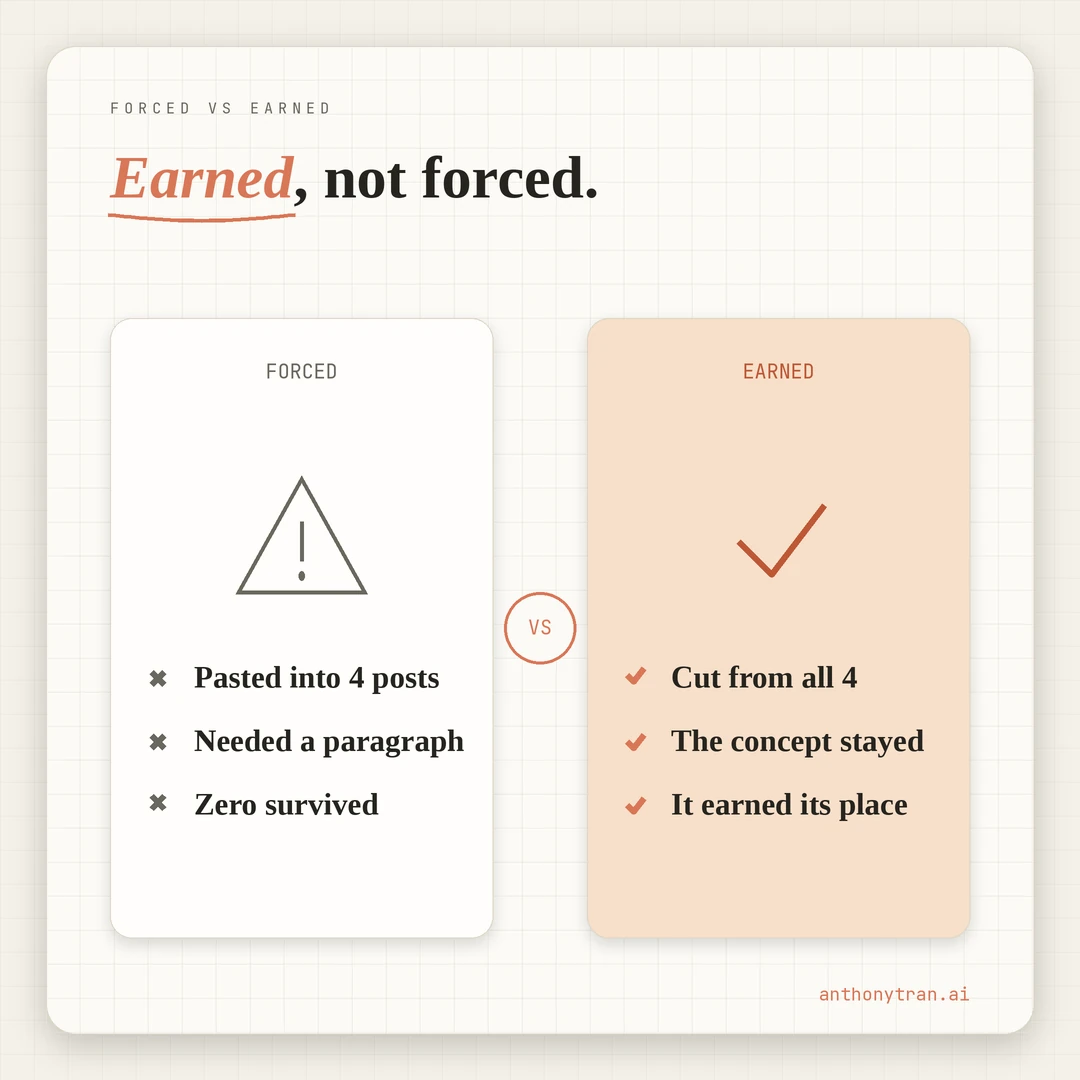
I had a personal brand tagline I liked. I pasted it into four blog post rewrites to test it. Every time it appeared, it needed a paragraph to explain itself. So I cut it.
Why most personal brand taglines get locked too early
Every guide on building a personal brand tells you the same thing. You need a tagline. A short line that sums up what you do and why.
So you sit down and write one. It feels punchy on first read.
You start using it. You stamp it on your About page.
You sign your emails with it. You drop it into the next blog post you write. You assume it works because you wrote it.
The problem with locking a tagline this early is that nobody knows yet, including you, whether the line actually works. Punchy on first read is not the same as right. And every time you use a tagline that has not earned its spot, you are training yourself to defend a phrase that the writing keeps having to explain.
For most solo operators, the tagline ends up being the thing they like more than the audience does. They keep it because they wrote it, not because it earned the spot.
This post is the experiment I ran on my own candidate, what broke, and the rule I now use before locking any phrase in. If you want the bigger picture of what this personal brand is and why, the manifesto post is the starting point.
The phrase I tried, and where I tried it
I had a candidate tagline. “Less.
Better. Earned.”
I liked it. It came out of a real idea I have been building toward, the contrarian take that you finish one thing before starting the next, and that you earn the right to add the next level.
The concept is real. The phrase felt clean. Three beats, no fluff.
So I tried it. I dropped “Less.
Better. Earned.” into the rewrites of four early blog posts on this site.
Posts two through five, one after another. Each insert was meant to test the line in the wild, see if it earned a place at the close of the post, see if the reader would walk away holding it.
Then I read the four posts back top to bottom.
Every time the tagline showed up, it needed a paragraph next to it. Three short words, and then I had to translate.
Less what? Better by whose standard? Earned how?
The phrase sounded finished to me because I already knew the idea behind it. To a reader meeting it cold, it opened three questions instead of answering one.
It read like every other line I had ever written that I wanted to be a tagline. A phrase that needed a tour guide.
The translation was doing the work, and the tagline was just sitting there taking credit.
After running the test, I pulled “Less. Better.
Earned.” out of all four posts. The concept stayed in the prose where it fit naturally. The phrase did not survive.
What broke when I read it back
A good tagline carries its own meaning when the reader meets it cold. Famous taglines like “Just do it.” had decades of ad budget to teach the meaning to the world. Yours will not have that.
But the bar is the same inside your own writing. The phrase has to do the job when the reader hits it for the first time, with no paragraph of explanation next to it.
When my candidate needed that paragraph to land, the phrase was failing the test inside its own context. That is not a small bar. That is the bar.
The concept I cared about, the idea that you finish one thing before starting the next, was solid. The concept can run in normal sentences. The phrase was the test, and the phrase failed it.
When is your personal brand tagline actually ready?
Here is the rule I now use, after killing a candidate phrase I had liked for a month.
The lock test: wait until the phrase shows up in your own writing without you putting it there.
If you sit down to write a post and the phrase comes out of your fingers naturally, in a sentence that does not need a translation, the phrase has started to earn its spot. Once you see it happen three or four times across different posts, written days or weeks apart, you have a real candidate.
If you have to insert the phrase by hand into every draft, the phrase has not earned its spot. Pull it out.
Let the concept run as normal prose. See if the phrase comes back on its own.
You can still shape the language once it appears. You just should not crown it before the work has shown you it belongs.
The reason this test works is that it removes you from the decision. You stop trying to be your own taste-tester.
The writing decides. The phrase either survives the act of writing, or it does not. Anything else is a forced lock.
For me, what I keep landing on is that I have a new candidate marinating right now. Different shape than the one I killed.
Different territory, closer to motivation than method. I am not naming it yet, not even here, because the test only works if the writing decides whether the phrase lives.
If it shows up unprompted in a sentence that does not need explanation, that is when I will know.
For you, your candidate might be different. Maybe you already have a phrase that fits your story.
Maybe you have three of them and cannot decide. The test is the same either way.
Pull the candidates out of every draft. Let the writing decide which one comes back.
Put This Into Practice
If you have a candidate tagline you have been stamping on drafts, here is the prompt I would paste into Claude or ChatGPT before you commit any further. Do not use the tool to invent your identity. Use it to pressure-test whether the words you are already using are carrying their weight.
I have a candidate personal brand tagline I have been using in my own writing. I am not sure yet whether it has earned its spot or whether I am forcing it because I wrote it.
Help me run the earn-its-spot test. Walk me through this one step at a time and wait for my answer at each step:
- Ask me what the candidate tagline is, in the exact words I have been using.
- Ask me to paste in the last 3 to 5 places I used it in my own writing. A blog post, a homepage, an email, an About page, a social post.
- For each appearance, ask whether the tagline needed a sentence of explanation next to it. If yes, that is a flag.
- Tell me whether the phrase carried its own meaning on first read in each case, or whether the surrounding sentence was doing the work.
- Help me decide whether to keep using the phrase, pull it from every draft and write around the concept instead, or kill the phrase entirely and let a new candidate marinate.
Keep your tone honest. If the phrase is not earning its spot, tell me. I would rather know now than after I have stamped it across my personal brand.
The prompt walks you through the same review I ran on “Less. Better.
Earned. Different phrase, same test.
Honest answers from the AI matter more than kind ones here. Pick a tool you trust to push back.
Until the phrase locks itself, write around the concept
Here is the part that took me longest to get comfortable with. You can keep the idea even after you kill the phrase.
When I cut “Less. Better.
Earned.” out of those four posts, the concept did not leave. The idea that you finish one thing before starting the next is still in the posts.
It runs as normal prose where it fits the topic. It does not need three branded words to land.
That is the move when you are between taglines. Write around the concept.
Let the language stay flexible. Trust that the right phrase will show up later in a sentence you did not plan, in a post that was just trying to make a clean point.
If it never shows up, the concept was real and the tagline was unnecessary. If it does show up, you will recognize it the moment it lands. That is what earning the spot looks like.
Come build with me.
~ Anthony
Frequently asked.
When is a personal brand tagline ready to lock in?
When the phrase shows up in your own writing without you putting it there. If you sit down to write a post and the tagline comes out of your fingers naturally, in a sentence that does not need a translation, it has started to earn its spot. If you have to paste it into every draft by hand, it has not.
How do you know if your personal brand tagline is forced?
Read it back in the places you have used it. If the tagline needs a sentence of explanation next to it every time, the phrase is failing the intuitive test. Real taglines carry their own meaning on first read. If yours needs a tour guide, pull it from the drafts and write around the concept instead.
What do you do when you kill a tagline but want to keep the idea?
Let the concept run as normal prose where it fits the topic. The idea does not need branded words to land. Keep the meaning, drop the phrase, and trust that the right wording will show up later in a sentence you did not plan.
Stop re-explaining yourself to Claude.
Grab the free AI Starter Kit: my exact Claude setup, so it knows your business. Plus the lessons as they land.
Anthony Tran
13 years in marketing and an Air Force veteran. I use Claude every day to market and grow my own business, and I break down what works in plain English. Writing and recording from Arizona.