
My last brand was a three-word company name. Almost no one remembered it. This time I built the name around what people would actually remember and search.
The name people forgot
From 2013 to 2019, I built Marketing Access Pass into a podcast, a blog, a YouTube channel, and a coaching offer. The show ran 75 episodes.
Listeners emailed in. The reviews were strong.
There was a quiet pattern in every conversation I had with a new person.
“What’s the name of your show again?”
They remembered me. Anthony Tran. They could not remember the company name.
I would say “Marketing Access Pass.” They would nod. A few minutes later, it was gone.
The same pattern showed up on social. When my profile picture was the company logo, people did not follow. When my profile picture was my actual face, they did.
The lesson was right in front of me. When you are the face of the brand, people remember the face. The company name needs more work to stick.
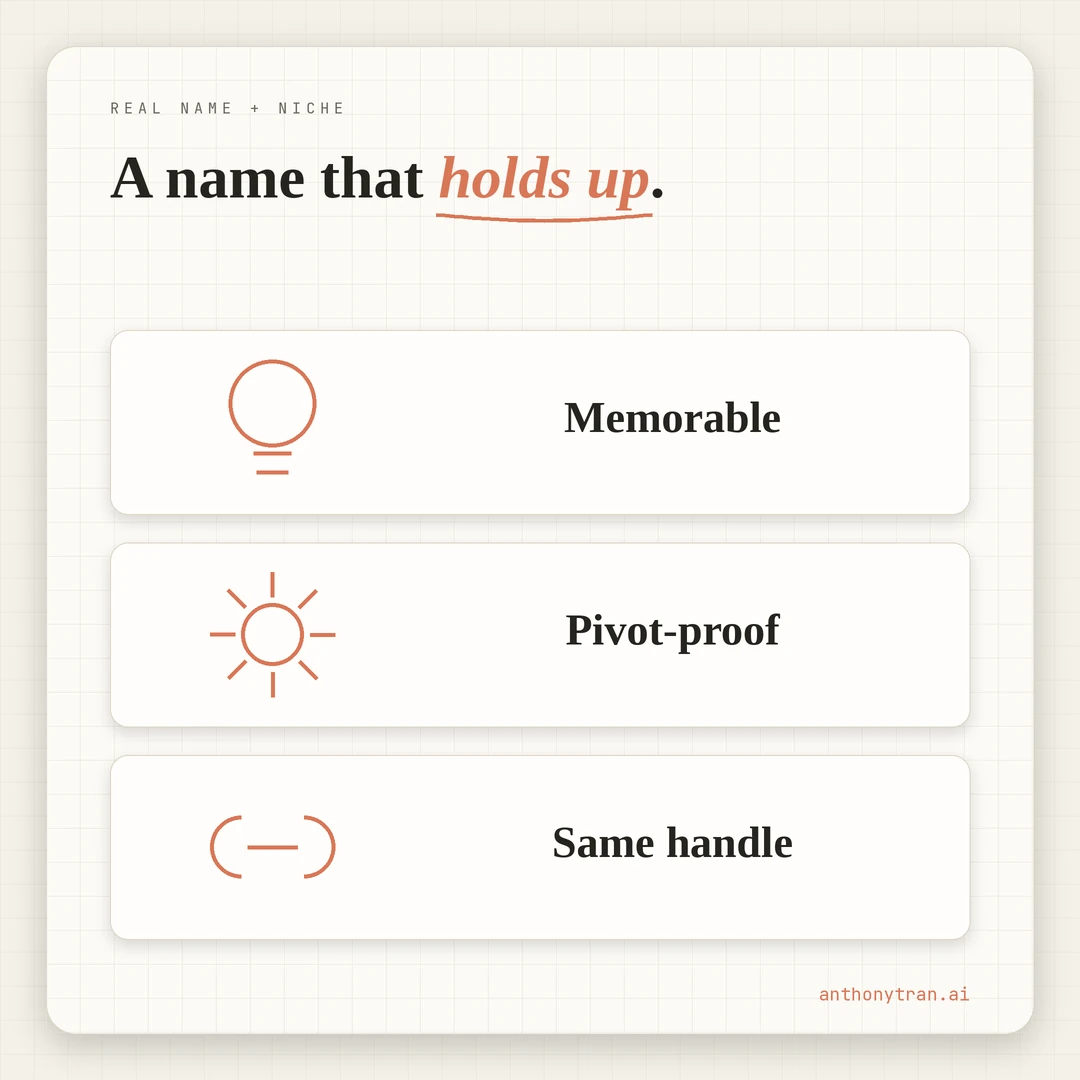
What I should have built the first time
If I had named my first brand around my own name instead of “Marketing Access Pass,” I would have had a much wider lane.
Two reasons.
First, pivot freedom. The name “Marketing Access Pass” locked me into the marketing space.
If I had been on the air with a personal-brand name, I could have pivoted topics inside the same channel. With “Marketing Access Pass,” that move would have meant starting over with a new name.
A personal brand under your own name has more room to evolve. The audience will still associate you with a topic, but the name itself does not trap you.
If next year I want to talk about something other than AI, the name still holds. The reader follows the person, not the topic.
Second, memorability. “Anthony Tran” is two words.
People got it the first time. They could spell it on their phone without asking me how. The friction was zero.
Why “AI” got attached
There is a problem with going pure-name. There are a lot of Anthony Trans in the world.
The handles for “Anthony Tran” alone were all taken on the platforms I checked. The clean domains were gone too.
I needed a differentiator. Something that did three things at once.
It needed to signal what I teach, without naming a tight topic that would lock me in again. It needed to free up the handles. It needed to anchor the domain.
“AI” did all three.
It signals the niche without being narrow. AI is a wide enough umbrella that I can teach anything inside it (content systems, prompt design, knowledge bases, workflow setups) without re-naming the channel. If I shift inside that space over time, the name still holds.
It freed up the handles. Every “@anthonytranai” username was open.
The handle sits the same across YouTube, Instagram, X, TikTok, Reddit, and GitHub. If someone finds me on one, they can find me on all of them by typing the same string.
It made the domain work. anthonytran.ai. Short.
Easy to type. The .ai at the end says what the site is about before someone clicks.
Once I had the shape (Anthony Tran plus a tag), I worked through it with Claude. We tested which tags signaled the niche without locking me in. AI was the one that fit all three tests.
AI was broad enough to give me room, but specific enough to tell people why they should care. The tradeoff is honest: a niche tag is a bet on the category having staying power.
If AI ever stops being the right umbrella for what I teach, the name will need a refresh. Same bet applies to whatever tag you pick.
The pattern: Real Name + Niche Tag
This is the rule I would give my younger self.
If you are starting a personal brand, name it [Your Real Name] + [Niche Tag]. The real name carries memory and pivot freedom. The niche tag differentiates you from the other people who share your name and signals what you teach.
The tag has to be short. One word is best, two at most.
It has to be wide enough that you can change topics inside it without re-naming the channel. If your name is rare enough that the handles are open, you can drop the tag entirely.
Justin Welsh is just Justin Welsh. Dan Koe is just Dan Koe. When the name is common, you add the tag.
Put this into practice
If you are deciding what to name your channel, your handles, or your site, run your candidate through three tests.
Memorability test. Say it out loud once, then ask a friend to say it back to you in five minutes. If they can’t, the name is too clever or too long. Cut it.
Pivot test. Imagine you want to change topics in two years. Does the name still hold? If “Marketing Access Pass” forced me to stay in marketing, what does your candidate force you into? If the answer locks you in, change it.
Availability test. Check the handle on YouTube, Instagram, X, TikTok, Reddit, and a domain registrar. Pick a name where you can claim the same handle on every platform. Consistency across surfaces is how people find you when they search.
The format that survives those three tests is almost always Real Name + Niche Tag. Use your name as the anchor. Add the tag if your name is common or the handles are taken.
If you want to stress-test a candidate fast, paste this into Claude or your AI of choice:
Test my personal brand name candidate against three filters: memorability (can a stranger repeat it after one hearing), pivot (does the name still hold if I change topics in two years), and availability (can I claim the same handle on YouTube, Instagram, X, TikTok, Reddit, plus the domain). My candidate is [PASTE NAME]. My niche is [PASTE NICHE]. Tell me which test the candidate fails and what to change.
Mine is Anthony Tran AI. Yours might be different. Whatever it is, name it once and pick something the audience can repeat back to you the first time they hear it.
~ Anthony
Frequently asked.
Should I name my personal brand with my real name or a company name?
Use your real name as the anchor whenever you can. A company name locks you into one topic, and a personal name lets you pivot inside the same brand. People also remember real names faster than branded acronyms, and they follow real faces on social platforms more than logos.
What do I do if my name is too common to claim handles?
Add a short niche tag after your name. The pattern is Real Name + Niche Tag. The tag should be one word, wide enough that you can change topics inside it later, and available as a handle across the platforms you actually plan to use.
How do I test a personal brand name before I commit?
Run it through three tests. Memorability (can a stranger repeat it after one hearing). Pivot (does the name still work if you change topics in two years). Availability (can you claim the same handle on every social platform plus the domain). A name that fails any of the three is the wrong name.
Stop re-explaining yourself to Claude.
Grab the free AI Starter Kit: my exact Claude setup, so it knows your business. Plus the lessons as they land.
Anthony Tran
13 years in marketing and an Air Force veteran. I use Claude every day to market and grow my own business, and I break down what works in plain English. Writing and recording from Arizona.