
If you are in your 40s and still feel the pull to prove yourself, you may already be past the stage where proving was the point. The runway ahead is longer than the one behind.
Why mid-40s feels heavier than it should
You are old enough to feel time moving and young enough to still be doing the work. The clock thing creeps in.
Your friends start mentioning retirement plans. Your parents are getting older.
Your kid is growing up faster than you expected. There is a weight to it.
But the weight is not actually about time. It is about a leftover instinct from earlier seasons.
The instinct to prove. Prove you can do the job.
Prove you belong in the room. Prove the gamble was worth it.
In my 20s, that instinct was fuel. It pushed me through ROTC and toward pilot training, an MBA in uniform, two more Masters on VA benefits after I left the Air Force, and a senior manager job before 30.
I needed it then. By the time I hit my 40s, the same engine was still trying to drive, but the road had changed.
There was nothing left to prove to anyone whose opinion really mattered. The instinct kept running. The point had quietly disappeared.
The proving stage does end. You just have to notice it ended.
The Entrepreneur write-up that taught me proving was the wrong target
In 2017, my first personal brand peaked. The podcast hit number one in New and Noteworthy at launch.
Entrepreneur, Huffington Post, and GoDaddy ran write-ups. I was speaking at conferences.
From the outside it looked exactly like the kind of success I had been chasing for years.
When the Entrepreneur piece came out, I felt nothing.
Not relief. Not pride.
Not even a quick rush before the next thing. Just a quiet hum of the same low-grade stress I had been carrying for a while.
I did not have words for it then. I have them now.
The recognition was a proxy for what I actually wanted, and I had not figured out yet what the real want was. I had built the career version of running on a treadmill at full speed.
The harder I sprinted, the more obvious it became that the machine was not going anywhere.
The proving stage looks like winning from outside. The pictures, the press, the download numbers.
From inside, it was hollow because I was chasing the wrong target. The target itself was the trap.
A year or two later, I burned out hard enough that I had to sit in front of a counselor and admit out loud that I had built a prison, not a business. (More on that in the seven quiet years post.
The seven years that followed were not a setback. They were a slow lesson about which targets had been mine all along and which ones had been borrowed.
Why “past the proving stage” is a gift, not a loss
When I tell people in their 20s that the proving stage ends, they look slightly worried. Like the engine that has been driving them this far is going to disappear and they will be left coasting.
That is not what happens.
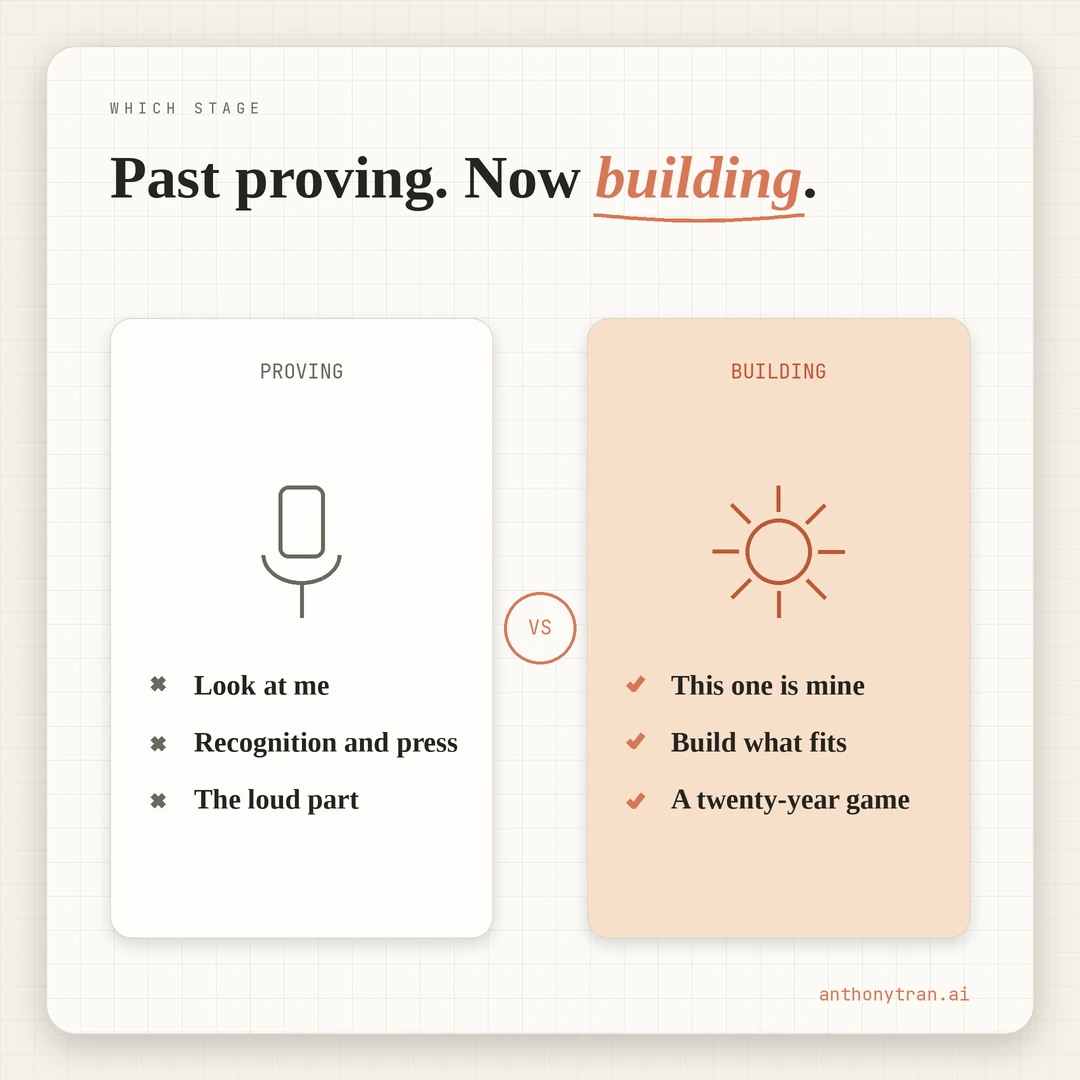
What happens is the engine quietly switches. The need to prove gets replaced by the need to build something that fits.
The fuel changes from “look at me” to “this is mine. Both are real.
Both can move you forward. The second one moves you somewhere worth going.
Past the proving stage does not mean past being ambitious. It does not mean past being driven.
It means you are done with that older version of the work. You stop performing for an audience that was never really watching, and you start building for your family and the small handful of friends who will still be there in 20 years.
The proving stage is the loudest part of your career. The post-proving stage is the most meaningful one. Most of the work that matters in a life gets done in the second half, not the first.
20 years is still a long runway
The other half of the title is the part most people skip. Past the proving stage AND 20 years still on the runway. Both halves matter equally.
If you are 45, and you live to a normal modern lifespan, you have another 35 years or so on the planet. Twenty of those are productive working years, even at a relaxed pace.
The math is not pretty if you frame it as “running out of time. It is gorgeous if you frame it as “I have two more decades to build the thing I want, with skills I did not have last time, and tools I have never had before.”
Twenty years is enough time to start a business and run it for two full economic cycles. It is enough to raise a kid all the way to adulthood and still have years left.
It is enough to become genuinely good at something new from scratch, the kind of slow apprenticeship that only stacks up if you keep showing up. It is enough to put together a body of work.
It is enough to repair a few of the relationships you let slide during the proving years.
For me, the next 20 years look like writing this personal brand the way I should have the first time. Slowly.
One post at a time. Building the kind of life where a quiet Tuesday at 2pm belongs to me, Linh, and Alice instead of to someone else’s calendar.
That is the work after proving. Quiet on the outside. Worth showing up for on the inside.
This is not a victory lap. It is not the back nine. It is a fresh round on a course you finally know how to play.
The mistake is treating mid-40s like a deadline. The truth is closer to a starting line for the work you can actually do now that the proving instinct has burned off enough to let you see what you really want to build.
Put this into practice
If you are not sure whether you are still chasing the proving stage or building from the post-proving runway, run this audit. It takes about 10 minutes and you can do it in any AI chat you trust.
I am in my 40s and trying to figure out which parts of my work are about proving something versus which parts are about the life I actually want to live. Walk me through these questions one at a time and wait for my answer before moving on:
- List five things you spent the most time on this past month.
- For each one, ask yourself: would you still do this if no one ever knew you did it?
- For each one, ask yourself: are you doing this because it impresses someone, or because it fits the life you want?
- After we go through all five, give me an honest read on the balance: how much of my time is going into proving versus into building?
The point is not to get a clever answer. The point is to look at where your time is actually going, and whether it is going toward what you want now or toward what you were trying to prove ten years ago.
For me, when I ran my own version of this exercise during the find-your-real-why work a few weeks back, the answer was uncomfortable. A lot of what I was calling “ambition” turned out to be leftover proving instinct in a new outfit.
The cleanup is still in progress. But I can see the difference now, which is most of the battle.
Your version may land somewhere completely different from mine. The exercise is the same. The answer is yours.
The work after proving
The cleanest version of the post-proving stage I have come across is four words. Less impressive, more durable.
The work after proving does not look like a sprint. It looks like a long, deliberate build.
Quiet. Boring on the outside.
Rich on the inside. The runway is plenty long for it.
The proving stage was always temporary. The work that comes after is the real one.
If you are still on the runway, you are not running out of time. You are just done with the part that needed an audience.
~ Anthony
Frequently asked.
What does it mean to be past the proving stage?
Past the proving stage means you are done chasing recognition, titles, and external validation as the engine of your career. The drive does not disappear. It switches from 'look at me' to 'this is mine,' and the work you do next fits the life you actually want.
How do you start a personal brand in your 40s?
Start by auditing what you actually want now versus what you were trying to prove a decade ago. A lot of the proving instinct from your 20s and 30s does not serve you anymore. Build from what fits, not from what you think will impress people whose opinions you have already outgrown.
Is mid-40s too late to rebuild a career?
No. If you live a normal modern lifespan, you have around 20 productive working years left at 45. That is enough time to start a business, raise a kid to adulthood, become genuinely good at something new, and put together a real body of work.
Stop re-explaining yourself to Claude.
Grab the free AI Starter Kit: my exact Claude setup, so it knows your business. Plus the lessons as they land.
Anthony Tran
13 years in marketing and an Air Force veteran. I use Claude every day to market and grow my own business, and I break down what works in plain English. Writing and recording from Arizona.