
AI keeps producing choppy drafts because it mistakes human voice for stacked short fragments. Real human writing breathes.
Why your AI drafts sound choppy
You ask AI to write in your voice. It comes back punchy. Short sentences, quick beats, lines that look the way confident writers online sound.
But when you read it back, something feels off. The rhythm is too consistent.
Every paragraph hits the same staccato pattern. The pieces sound right alone, and the whole thing sounds robotic.
That feeling has a cause. AI has learned that punchy online writers use short sentences for emphasis.
So when you ask it to be punchy, or to sound like you, or to match the voice of a confident writer, it overcorrects. It strips every connective word.
It cuts every conjunction. It stacks fragment after fragment until the post reads like a list of bullet points wearing prose clothes.
Real human writing is not built like that. It breathes.
The short sentences are the punctuation, not the structure. The medium sentences that connect them carry the thought.
This post is the trap, the catch, and the rhythm calibration I now run on every AI draft before I ship it. If you want the bigger picture of why I am building this personal brand with AI in the first place, the manifesto post is the starting point.
The opening I had to kill in one of my own posts
A few weeks ago I was rewriting one of my earlier posts on this site, the one about why a personal brand site only needs five pages. I asked Claude to take a stab at a new opening, and the first draft came back in the staccato pattern AI defaults to when you ask it to sound punchy.
Short noun phrases stacked one after another. Each line a two-or-three-word beat.
The kind of writing that looks confident on the screen and falls apart the moment you read it out loud.
The draft had what I now call the “Saturday morning, coffee” shape. A few words, a period, a few more words, a period. Four fragments before the writing finally settled into a longer sentence.
It looked confident on first read. It looked like punchy human voice.
It is the exact pattern Claude defaults to when you ask it to be human. So I read it out loud, the way I would say it sitting across the table from a friend, and the rhythm fell apart immediately.
Nobody actually talks like that. Nobody actually pauses that hard between coffee and the laptop, between the laptop and the tabs, between the tabs and the topic.
The fragments were not earning the beat. They were imitating the rhythm AI thought I wanted. I rewrote the opening into one connected sentence that read the way I would actually say it: a Saturday morning at the kitchen table, coffee warm, five tabs open on the laptop, looking at the five-page personal brand site I was finally close to calling done.
That rewrite was the start of locking my sentence rhythm rule in.
What does real human voice actually do?
After that catch, I looked at the published writing I actually liked across years of reading. James Clear’s essay archive, Tim Ferriss in essay mode, Justin Welsh’s email archive, the grandfather memorial speech I wrote for my own family. None of those pieces rely on stacked fragments.
Most of the sentences land somewhere between eight and twenty words. Some short ones show up for emphasis.
Fragments appear about once a paragraph at most, and when they do, the fragment is doing real work, not filling space.
The calibration that came out of that look is a rough heuristic, not math:
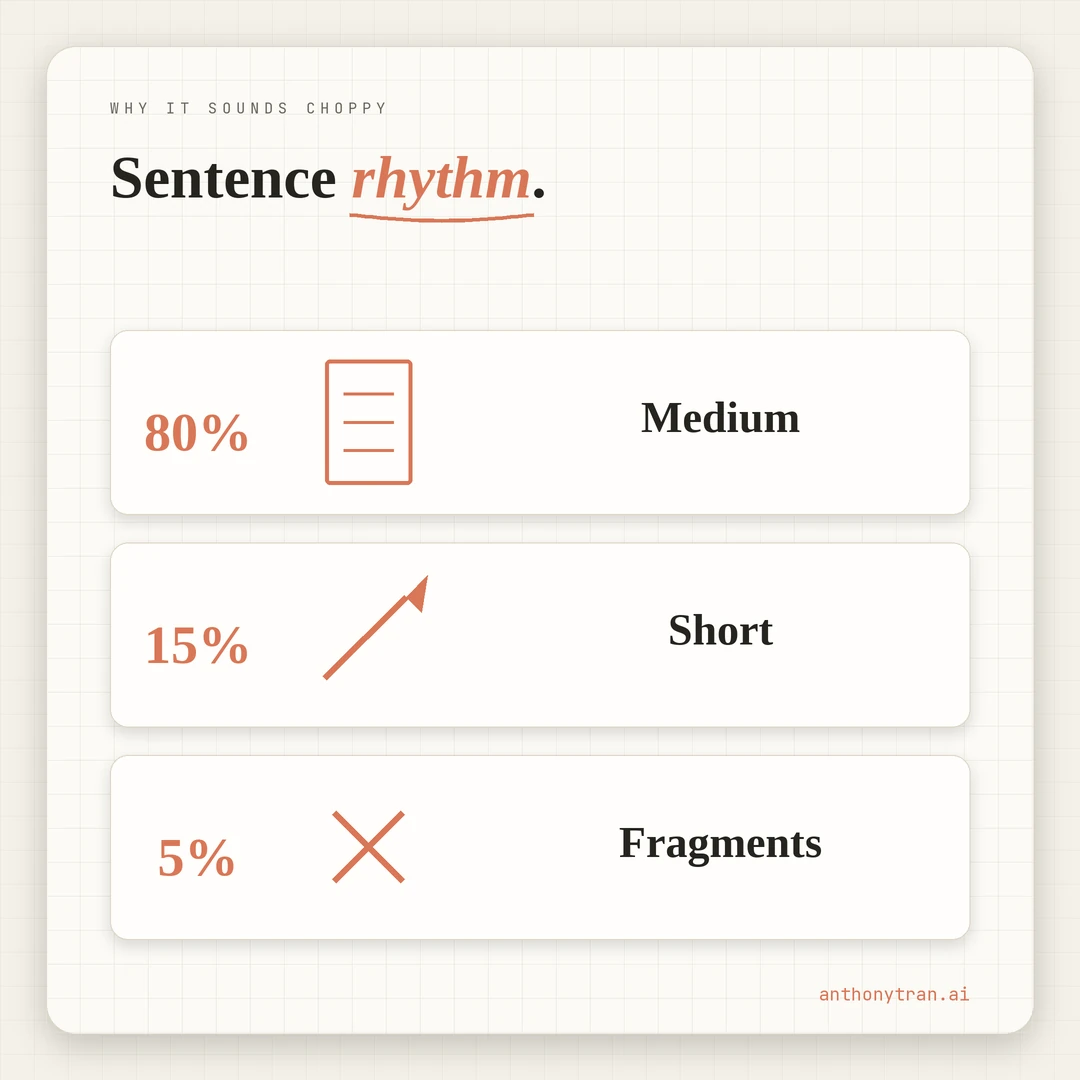
- Around 80% medium sentences (roughly 8 to 20 words). The structure that carries the post. The reader settles in, and the breath is steady.
- Around 15% short sentences (roughly 4 to 8 words). The emphasis beats. The places where the writing tightens to a point.
- Around 5% fragments (2 to 5 words). Used sparingly. Each fragment has to earn its place, usually as anaphora, parallel structure, or a hard stop the writing cannot afford to lose.
The exact numbers matter less than the restraint behind them. Even strong writers who feel punchy use fragments less than you might guess. The punchiness comes from where the fragments land, not from how many of them there are.
When I look at a draft now, my eye goes to where the fragments are doing work and where they are just filling space. A fragment that opens a section can earn its place because it is anchoring an idea.
A fragment that ends a paragraph can earn its place because it is landing the beat. A fragment that lives in the middle of a paragraph, between two other fragments, with no parallel structure, is almost always pattern-matching, not writing.
How to catch the fragment trap before you ship
Here is the rule I now run on every AI draft before publishing.
The 3-in-a-row test: any time you find three or more short sentences in a row, around eight words each, stop and ask whether they are earned.
Earned means anaphora, parallel structure, or a deliberate beat the writing cannot afford to lose. “Real planning.
Real pressure. Real stakes.” earns the run because the parallelism is doing rhythmic work.
“Saturday morning. Coffee.
Five tabs open.” does not earn the run because there is no parallel structure, no anaphora, just three short noun phrases hitting in a row because AI thinks that is what human writers do.
When the run is not earned, combine the sentences with commas or conjunctions. Saturday morning, coffee in hand, five tabs open on the laptop.
One breathing sentence. The rhythm now matches how someone would actually say it.
The five-in-a-row run is the hard fail state. If you ever see five short sentences stacked one after another, do not try to patch them.
Rebuild the section. The AI has gone full cosplay mode and the only fix is to rewrite the passage in your actual voice.
The reason this catch works is that it forces you to read for rhythm, not just for words. You are not editing for grammar.
You are editing for breath. The grammar can be flawless and the rhythm can still be the giveaway.
The catch happens at the rhythm layer, which is where the AI tell actually lives.
It pairs with the lesson from the tagline post too. Both are the same family of trap: AI defaults to a pattern that looks like confident writing on first read but only the writer can tell whether it is earning its place or just imitating other writing that did.
Put This Into Practice
If you have an AI draft that sounds choppy and you cannot tell exactly why, here is the prompt I would paste in next to the draft.
I am going to paste in a draft you helped me write. It reads choppy when I say it out loud. I think the rhythm is the problem, not the words. Here is the calibration I am aiming for: roughly 80% medium sentences (8 to 20 words), 15% short sentences (4 to 8 words) for emphasis, and 5% fragments at most.
Walk through the draft with me one paragraph at a time. For each paragraph:
- Count the short sentences (under 8 words). If three or more land in a row, flag the run.
- For each flagged run, tell me whether the run is earned (anaphora, parallel structure, deliberate beat) or unearned (just stacked short noun phrases with no parallel work).
- For every unearned run, rewrite the sentences as one breathing sentence using commas and conjunctions. Show me the before and the after.
- Do not change the meaning. Do not add new ideas. Only fix the rhythm.
After we finish, give me a short read-back: how many runs we caught, how many we combined, and whether any paragraph needed a full rebuild.
Be honest. If a section sounds like AI cosplay of human voice, tell me. I would rather rebuild it than ship it choppy.
Run the prompt on any AI draft that feels off when you read it out loud. The fix is usually rhythm before it is word choice. The grammar can be perfect and the rhythm can still be the giveaway.
The rhythm is the work
The mistake most people make with AI writing is treating “punchy” as the goal. Punchy is a side effect of writing that knows where to land its weight. It is not a style you can stack up.
When the rhythm is right, the punchy moments take care of themselves. The short sentences land hard because the medium sentences around them earned the moment.
The fragments stay rare because they are doing actual work when they show up. The reader sinks in instead of skimming through.
When the rhythm is wrong, no amount of clever phrasing rescues it. The reader feels the staccato.
They feel the cosplay. They keep reading for a paragraph or two, then they bounce.
I want to write to a human, not a bot. Sometimes that means using more words to connect the thought, not fewer words to make the writing look sharp.
The rhythm is the work, every time, even when the words look fine on first pass.
Come build with me.
~ Anthony
Frequently asked.
Why does AI writing sound choppy?
AI has learned that punchy online writers use short sentences for emphasis. When you ask it to sound punchy or to match your voice, it overcorrects. It strips connective words and stacks fragment after fragment, which reads as confident on the screen but falls apart when you say it out loud.
What is the right sentence rhythm for personal brand writing?
Around 80% medium sentences (roughly 8 to 20 words), 15% short sentences (around 4 to 8 words) for emphasis, and 5% fragments at most. Treat the numbers as a rough heuristic, not math. The structure that carries the post is the medium sentences. The short ones land the beats. Fragments do real work only when they earn it through anaphora or parallel structure.
How do you fix choppy AI writing?
Run the three-in-a-row test on any AI draft. If you find three or more short sentences in a row without anaphora or parallel structure, combine them with commas or conjunctions. If you find five short sentences in a row, rebuild the section. The AI has gone full mimic mode and the only fix is a rewrite in your actual voice.
Stop re-explaining yourself to Claude.
Grab the free AI Starter Kit: my exact Claude setup, so it knows your business. Plus the lessons as they land.
Anthony Tran
13 years in marketing and an Air Force veteran. I use Claude every day to market and grow my own business, and I break down what works in plain English. Writing and recording from Arizona.