
Most of the strongest lines I have ever written live inside blog posts where almost nobody reads them twice. The fix turned out to be one file, sorted by topic, with attribution. Now my best writing keeps working long after the post ships.
Why your best lines die inside the post they live in
You publish a long-form post. A reader scrolls through it once, gets the main point, and moves on.
Somewhere in the middle of the post, there is a line you spent real time on. A sentence that captures the thesis cleaner than the rest of the article.
The line lands for the few readers who actually noticed it, and then it dies. It never gets quoted, never gets reused, never shows up again.
Multiply that across thirty posts and you have dozens of strong lines sitting in archives almost nobody will return to. The post you published last month does not get re-read this month.
Your audience does not memorize your archive. The strongest pieces of writing you produce are quietly disappearing into the file system.
This is a workspace problem, not a writing problem. The lines are there.
They just have nowhere to live except inside the post they were born in. The fix is a file.
I call it a brand anchor lines file. A single place where the strongest standalone sentences from your writing live, sorted by topic, with a one-line note on where each came from and where it might be reused.
The moment I started saving them
A couple of weeks into the catch-up arc on this blog, I started running every new post through an external AI review pass. ChatGPT first, then Genspark on the later ones. The review was useful for the obvious reasons: repetition catches, factual precision, occasional structural suggestions.
The surprising part was what kept showing up at the end of every review. A “strongest line in the piece” callout.
One or two specific sentences pulled out and named. Different posts, different topics, same shape of feedback every time.
The first few times, I just nodded and moved on. By the fourth or fifth review, I noticed I was losing those lines into the same posts the reviewer was pulling them out of.
The reader who scrolled past would never see them again. The reviewer was telling me which sentences were the brand equity, and I was leaving the brand equity inside posts most readers would only ever encounter once.
So I made a file. brand-anchor-lines.md. Organized by topic.
Each line saved verbatim with a one-line note on where it came from and where it might be reused. Now the file is the bank, every post adds a few lines, and the strongest writing keeps working after the post moves into the archive.
What makes a line worth saving?
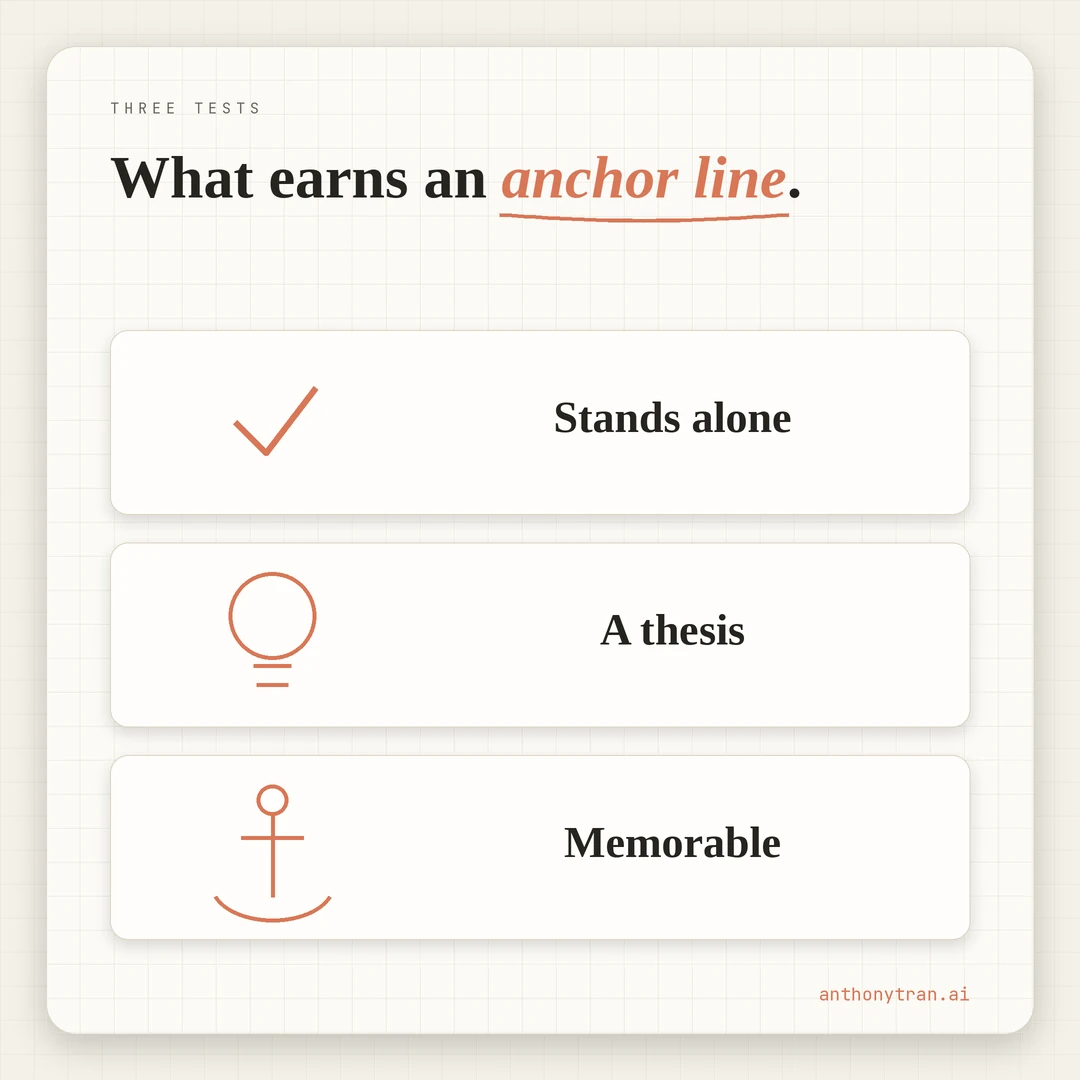
Not every sentence belongs in the file. If the bar is too low, the file becomes noise and you stop opening it. The lines that earn their place pass three tests.
Stands alone without context. A stranger could read the line cold, with no setup, and feel something. If the line only makes sense after the three paragraphs above it, it does not belong in the bank yet. It might still be a good sentence inside the post. It is not a quotable anchor on its own.
Captures a thesis, not a detail. The line should say something about the world, the work, or the rule. Not just describe a specific moment in the post. “I was working at the kitchen table that morning” is a fine scene-setting sentence. It is not an anchor. “Cinematic is for fiction, honest is for everything else” is an anchor because it states a rule.
Memorable on first read. If you had to read the line twice to get it, it is too dense. Anchors are sticky. The reader holds onto them after one pass, and they show up in your head later when you are trying to explain the idea to someone.
The reviewer often pulls out one line per piece that hits all three tests. Sometimes you catch a second one on your own pass.
Three or four per post is rare. One is the typical haul.
How to use the bank
Once the file is a few weeks old, it stops being a list and starts being repurposing material. Every channel you publish on has a place for these lines.
- Newsletter subject lines. The strongest anchor of the week often works as the subject for the broadcast that points to the post.
- YouTube hooks. Open the video by reading one of these lines aloud. The viewer hears the punch line first, then watches you walk through the story behind it.
- Social posts. Most anchors work as standalone posts on whatever channel you use. Add the link to the source piece below the line.
- Slide titles for talks or presentations. When you are scrambling for a section header, the bank usually has one ready.
- Homepage pull quotes. The rotating quote in your hero section can pull from the file rather than getting written from scratch.
- About page paragraphs. When you are stuck on how to say something about your personal brand, scan the file for a line that says it cleaner than you can in the moment.
The bank starts paying off the moment you stop writing from a blank page. Most of the time, the line you were about to compose already exists in the file. Faster, sharper, and already proven on a real reader.
This pairs with the single source of truth rule from the sister post: one canonical place for the assets you plan to reuse. The anchor lines file is the source of truth for your repurposing material. Every other place those lines show up across your work points back to it.
Put This Into Practice
If you have published any long-form work, the bank is sitting in your archives waiting to be assembled. Here is the prompt I would paste in to pull the first version together.
I have published a number of long-form pieces and I want to build a brand anchor lines file for my personal brand. Walk me through this one step at a time and wait for my answer at each step:
- Ask me to paste in the full text of each post, one at a time. Tell me when to move to the next post.
- For each post, identify candidate anchor lines using these three tests. Stands alone without context. Captures a thesis, not a detail. Memorable on first read.
- Aim for one to three lines per post. Quality over quantity. Do not pad the list with weaker lines just to hit a number.
- For each candidate, show me the line plus a one-line note on the source (post title and section) and a one-line note on where it might be reused (newsletter subject, video hook, social post, etc.).
- When I am done with all posts, propose a topic-based organization for the file. Group lines by thesis, for example AI thesis lines, voice discipline lines, audience lines.
Do not invent lines. Do not paraphrase to make them sharper. Only pull lines that already exist verbatim in my posts. If a line needs to be sharpened to qualify, flag it as a candidate for a future rewrite, not as an anchor.
Run the prompt once to assemble the starter file. After that, add to the file after every new post you publish. The capture is faster when the lines are still fresh in your head.
Your strongest writing should not disappear
The brand anchor lines file is one of the cheapest pieces of brand infrastructure you can build. Almost no cost to maintain.
Compounds in value every week. Pays off across every channel where you publish.
The lines were always there. The file is what keeps them alive after the post disappears into your archive.
Come build with me.
~ Anthony
Frequently asked.
What is a brand anchor line?
A standalone sentence from your writing that captures a thesis on its own, lands memorably on first read, and works outside the post it came from. Anchor lines are the lines you would quote if you only had ten seconds to explain what your writing is about. Save them so they can be reused across channels instead of dying inside one post.
How do you decide which lines to save in a brand anchor lines file?
Three tests. The line stands alone without context. The line captures a thesis, not a detail. The line is memorable on first read. If a sentence passes all three, it earns its place in the file. One to three lines per post is the typical haul. Quality over quantity, every time.
Where can you reuse brand anchor lines once you have them?
Newsletter subject lines, YouTube video hooks, social posts, slide titles for talks, homepage pull quotes, About page paragraphs, and any place you would otherwise write from a blank page. The file pays off the moment you stop composing a line from scratch and pull a proven one from the bank.
Stop re-explaining yourself to Claude.
Grab the free AI Starter Kit: my exact Claude setup, so it knows your business. Plus the lessons as they land.
Anthony Tran
13 years in marketing and an Air Force veteran. I use Claude every day to market and grow my own business, and I break down what works in plain English. Writing and recording from Arizona.