The first time I built a personal brand, I moved fast because I was under pressure, not because fast was smart. This time there is no clock. Going slow is letting me catch the things speed used to hide.
The clock I built the first time
Back in 2013, I quit my job to build something of my own. I had no income coming in, no business, no website, no audience, nothing built yet. Just an idea and a twelve-month deadline.
I did not call it a personal brand back then, but that is what I was really building. A name people would remember, work they could point to, and a reason to trust me with theirs.
My wife Linh made me a deal at the kitchen table. She said, “Everything you put your mind to, you accomplish.
I’ll give you one year. I’ll keep working and supporting us. As long as we don’t fall into more debt, go for it.”
So the clock started. Twelve months to turn nothing into a living.
For ten of those months I made zero dollars. I was learning WordPress, building a podcast, writing content, and watching the calendar the whole time.
Every week that passed was a week closer to the end of the runway. So I moved fast.
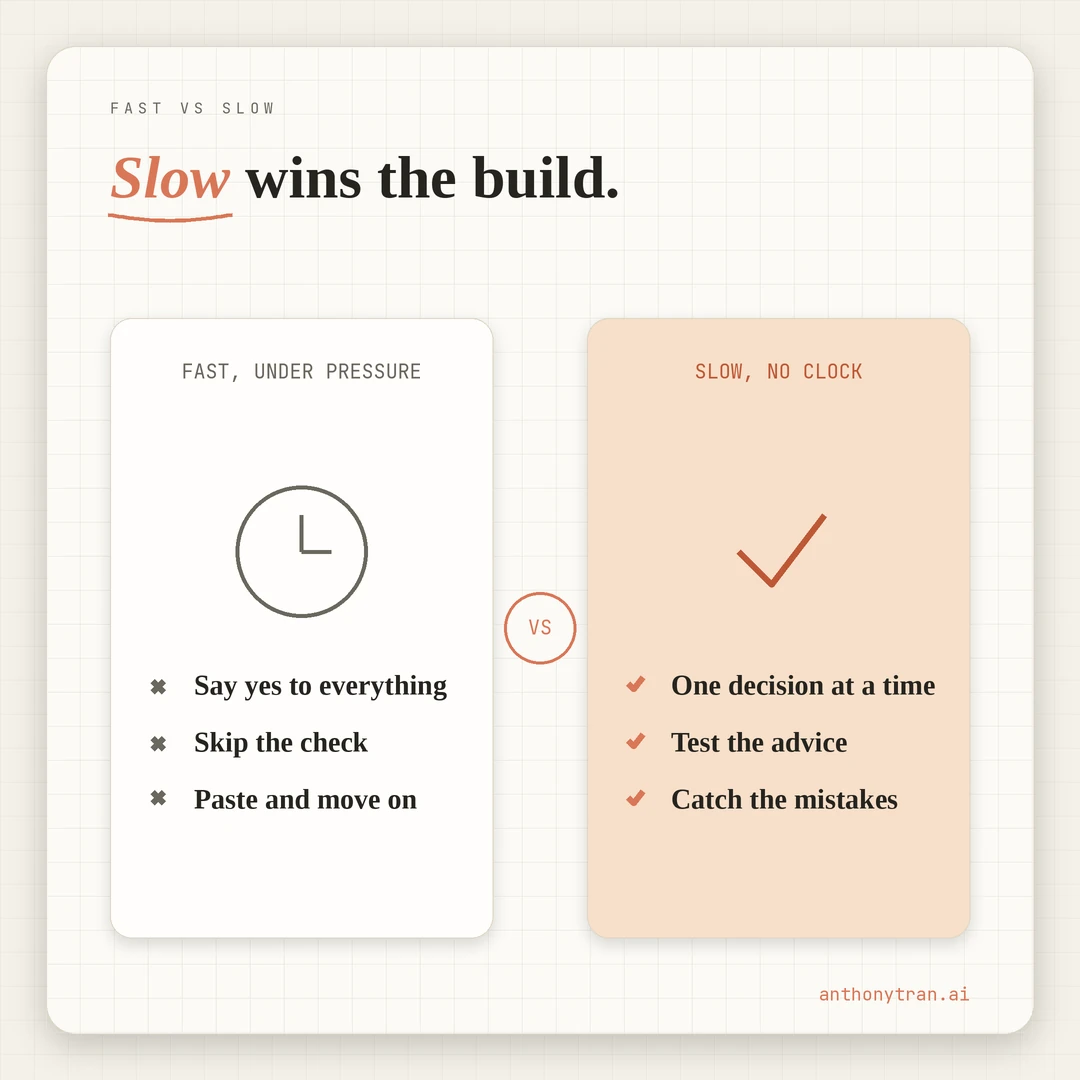
I said yes to everything. I took every call, chased every idea, and grabbed every shiny object that looked like it might turn into money.
It worked, barely. With about thirty days left on the clock, the first real web project came in and I said yes.
Then another one. Then referrals started showing up. We made it.
But here is the part I did not understand until years later. I was excited back then, do not get me wrong.
I loved what I was building. But I was not fast because fast was smart. I was fast because I was under pressure.
Speed was never the strategy
When I look back, the speed came from one place. Necessity.
I had a family counting on me, a deadline I had set myself, and a business that needed to start making money. The pressure to hit that deadline ran everything I did.
It pushed me to grow as fast as possible. It also pushed me straight into burnout by 2019, because a business built on “say yes to everything, right now” has no brakes.
I wrote the longer version of that in why my burnout came from building a job, not a business.
This time there is no clock. Nobody is counting on this to pay the bills by a certain date.
My family is taken care of another way, which means for the first time I get to ask a different question. Not “how fast can I grow this,” but “how do I build this so it lasts.”
That one change, the missing clock, is the whole reason I can go slow on purpose now. And slow, it turns out, is where the real work happens.
What does going slow actually catch?
Here is what fast hides. When you rush, you stop checking things.
You read advice from someone online and you just believe it. You grab a tactic because it worked for somebody else.
You take the first answer in front of you and run with it, because stopping to question it feels like losing time you do not have.
After years of doing this work, reading the books, taking the courses, running my own projects and client websites, I learned something simple. Not everyone giving advice online actually knows what they are talking about.
Some are repeating things they heard. Some are saying whatever gets clicks.
The only way I learned to tell the difference was by slowing down enough to test the advice against what I had actually seen work.
AI makes this matter even more. I use Claude every single day, and most of the time it is right.
Call it eight times out of ten, as a rough feel, not a number I measured. But that other couple times out of ten, it hands me something that is just wrong.
It will state a number I never gave it. It will describe a feature in a tool that does not exist.
It will hand me a tactic that works great for someone with a huge audience and makes no sense for someone starting at zero. People call these AI hallucinations, and the wrong ones look exactly as confident as the right ones.
That wrong slice is the part that matters. And you only catch it if you are going slow enough to read what you were handed instead of pasting it and moving on.
That is the trade. Fast feels productive. Slow is where you catch the mistake before it costs you.
Put This Into Practice
Next time you feel the pressure to move faster on your personal brand, pause before you obey it. This prompt walks you through whether the urgency is real, and what you might be rushing past. Paste it into Claude or ChatGPT.
I am building a personal brand and I feel pressure to move fast. Walk me through these one at a time and wait for my answer before moving on.
What is the deadline driving my urgency? Is it a real one someone gave me, or one I made up?
If I made it up, what am I actually afraid of? Name it plainly.
What is the most important thing I am about to accept without checking it, a piece of advice, an AI answer, a tactic I copied?
Help me pressure-test that one thing. What would I need to verify before I trust it?
Based on my answers, what is one thing I should slow down on this week?
Run it once. Most of the time you will find the clock you are racing is one you made up, and the thing you were about to rush past is the thing worth slowing down for.
I am not giving the time back
The first time, I had a clock and I let it run me. This time I have the one thing I did not have back then.
Room. Room to make one decision at a time, to check the answer before I use it, to build something I can actually keep doing.
I still want to grow this. I still want it to make money one day.
But I want to do it the right way, the way that lasts, and that takes going slow on purpose. If you are building on the side and your income is already handled, you have that same room, even if it does not feel like it. Do not hand it back by racing a clock nobody set.
When a decision is big, I still sleep on it before I commit. Slow is not the thing holding me back. Slow is the thing keeping me here.
~ Anthony
Frequently asked.
Is it better to build a personal brand slowly or fast?
If your income is already handled, slow is better. Fast usually comes from financial pressure, and pressure makes you skip the step where you check whether something is true or whether it will last. Slow is where you catch the mistakes that fast hides.
Why does using AI make building slowly more important?
AI gets most things right but a meaningful chunk wrong, and the wrong part looks just as confident as the right part. You only catch it if you slow down enough to read what you were handed instead of pasting it and moving on.
How do you know if you are building your personal brand too fast?
Check where the urgency is coming from. If the deadline is real and someone gave it to you, fine. If you invented it, the speed is probably pressure you put on yourself, not strategy, and it is worth slowing down.
Stop re-explaining yourself to Claude.
Grab the free AI Starter Kit: my exact Claude setup, so it knows your business. Plus the lessons as they land.
Anthony Tran
13 years in marketing and an Air Force veteran. I use Claude every day to market and grow my own business, and I break down what works in plain English. Writing and recording from Arizona.