I tried to force a big decision about my content setup one night and it stayed a knot. I slept on it. The morning version was simpler than anything I came up with awake, and that is not an accident.
The decision I could not force
One night this spring I sat down to settle how my whole content setup should work. How the blog, the email, and the video all fit together.
What fed what. Where each piece lived.
I kept trying to make it better. And every time I looked at it, better meant more.
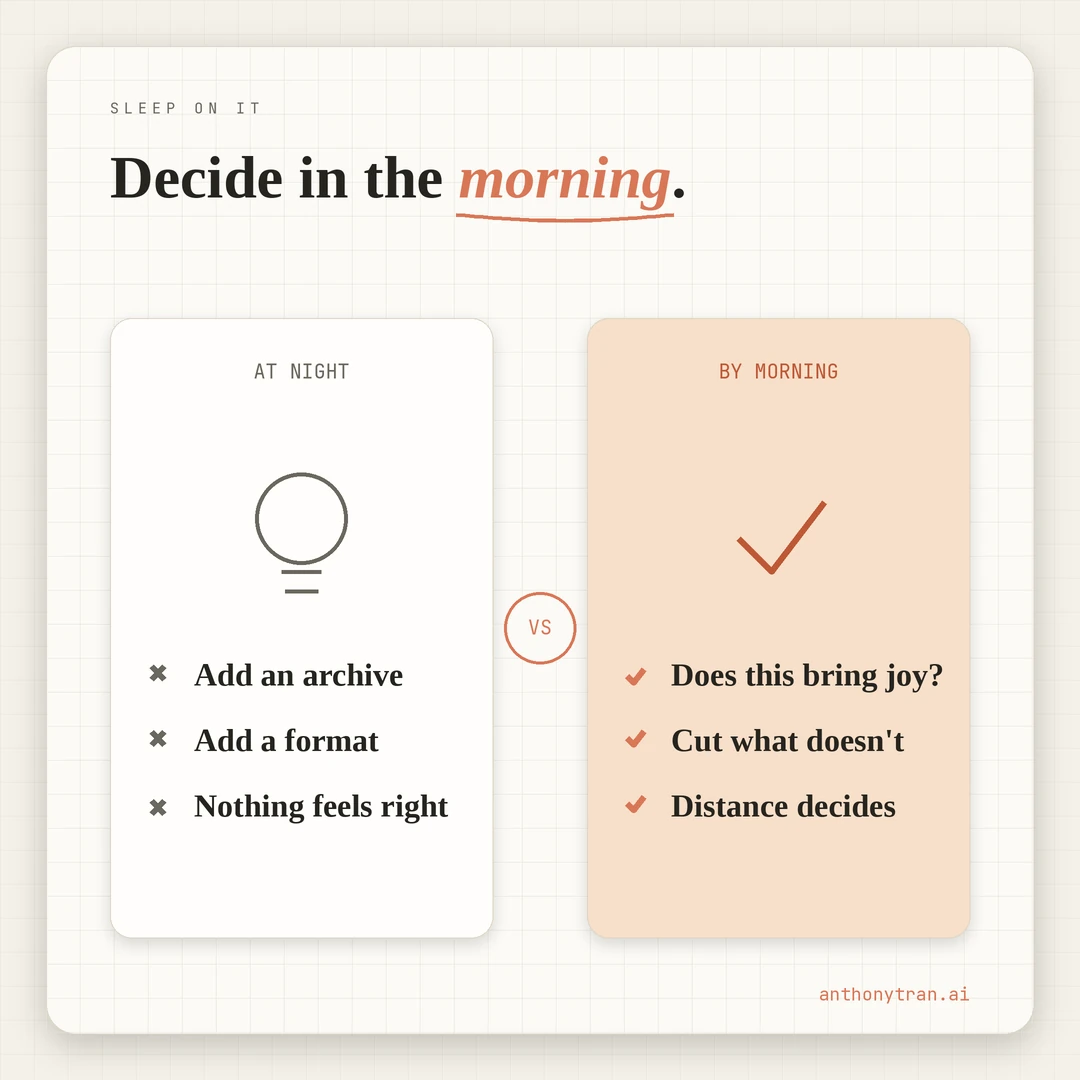
Add an archive, add a second format, add another place to post. By the end of the night I had a bigger, more complicated answer than the one I started with, and none of it felt right.
So I stopped. I closed the laptop and went to bed with the decision unfinished.
The next morning I made coffee and sat with it again. Same question, fresh head. And before I touched anything, one quiet question showed up on its own.
Does this bring me joy?
The answer was no. The complicated version did not bring me joy.
It brought me friction. The minute I asked that, the whole thing got simple.
Cut it down to one main piece, sent out a few ways. That was it.
The answer I fought for all night was obvious the next morning, the moment I stopped pushing.
What sleeping on a big decision actually does
Sleeping on a hard choice is old advice, and the useful part is not mystical. It is distance.
When you are deep in the work, your brain stays in build mode. Build mode adds.
It polishes. It asks “how do I make this better,” and too often “better” quietly becomes “more.”
A night away breaks that loop. In the morning you are not standing inside the decision anymore, so a better question can show up.
Not “how do I improve this,” but “does this need to exist at all? Psychologists call this the incubation effect, the way a problem gets easier to solve after you step away from it.
Sleep may help, but the real ingredient is the break from forcing the answer.
In the moment, you add. With distance, you subtract.
My filter is joy or friction
The reason “does this bring me joy?” cut through that morning is not random. It is the filter I trust most, and I trust it because of where I have been.
I burned out in 2019. Not from working too little.
From building something so heavy it took everything I had and then took more. I am still careful about that.
When a decision adds friction, a small alarm goes off that other people might not have. I have learned to listen to it.
So when I sleep on a big call, the question that surfaces is almost always some version of the same one. Does this make the work lighter or heavier?
Will I still want to do this in six months, or will it quietly grind me down? Less is not the goal for its own sake.
Less is how I protect the part of me that has to keep showing up.
That is my filter. Yours might be different.
For you the morning question might be about time, or money, or whether a choice moves you closer to the thing you are actually building toward. The filter is personal.
The move is the same. Get distance, then ask the one question that tells you the truth.
Which decisions are worth sleeping on?
Not all of them. If you slept on every small call, you would never get anything done.
Save the overnight for the structural ones. The decisions that are expensive to undo, the ones that shape how everything else runs.
How your content system is built, what platforms you commit to, what you name your personal brand. These are the choices you would hate to rebuild.
The small stuff does not need it. Pick a headline, write the post, answer the email.
But when a decision is going to be hard to walk back, give it a night. The morning version is the one you have to live with anyway.
Put This Into Practice
Next time you are stuck on a big decision for your personal brand, do not force it at midnight. Sleep on it. Then in the morning, before you reopen the work, paste this into Claude or ChatGPT and let it walk you through the simple version.
I made a big decision about my personal brand last night and I want to check it with fresh eyes this morning. Walk me through these one at a time and wait for my answer before moving on.
In one sentence, what is the decision I am trying to make?
List everything I am tempted to add or include. Just the list, no judgment yet.
Go down that list. For each item, ask me one question: does this make the work lighter or heavier for me to keep doing?
Based on my answers, what is the simplest version of this decision that still does the job?
Tell me honestly: am I adding things because they help, or because I was in build mode and could not stop?
Run it once. The version you land on in the morning, with that filter, is almost always lighter than the one you built the night before.
Sleep is not the trick
Sleep is just the easiest way to get distance. A walk works too, or a weekend, or any real break from the file. The point is to stop pushing long enough to stop adding.
For the decision that came out of that morning, collapsing three formats into one is where I walk through what I cut and why. For the burnout that taught me to trust the friction alarm, building a job instead of a business is the longer story. And for what happens when you do not give a call enough distance, the post I killed after six rewrites is the other side of the same coin.
The big decisions do not need more hours. They need a night.
~ Anthony
Frequently asked.
Should you sleep on a big decision?
For big, hard-to-reverse decisions, yes. Sleeping on it puts distance between you and the work. In the moment you tend to add and optimize. With distance, you can see the simpler version you could not see while you were in it.
Why do decisions feel clearer in the morning?
Stepping away from a problem lets you stop defending the work in front of you. The next morning you are judging the decision itself, not the effort you put into it. That distance is what makes the simpler answer easy to see.
How do you decide which choices are worth sleeping on?
Sleep on the structural ones. The choices that are expensive to undo or that shape how everything else runs. Day-to-day small calls do not need it. Save the overnight for the decisions you would hate to rebuild.
Stop re-explaining yourself to Claude.
Grab the free AI Starter Kit: my exact Claude setup, so it knows your business. Plus the lessons as they land.
Anthony Tran
13 years in marketing and an Air Force veteran. I use Claude every day to market and grow my own business, and I break down what works in plain English. Writing and recording from Arizona.