
I went from producing three versions of every post to one. The data point that broke the multi-format habit was a simple side-by-side reading test you can run in 15 minutes.
Why one writing setup is better than three
If you are building a personal brand with AI, you have probably set up a workflow that produces more than one version of every post. A blog version, an email version, a LinkedIn post, a Medium variant, maybe a Twitter thread on top of that.
The pull to do this is understandable. Each platform has its own format.
The blog is long. The email is shorter.
LinkedIn is shorter still. Medium wants something in between.
So the workflow grows. Each platform gets its own draft and its own AI prompt and its own version of every piece you write.
That is the trap I fell into. I built a pipeline that produced three versions of every blog post.
One for the blog. One for the newsletter.
One for Medium. I kept them in sync.
I rewrote when one changed. I treated the maintenance work as the cost of doing business across platforms.
It turned out to be cheaper to write only one good version.
This post is the story of how I figured that out, and the simple reading test that broke the multi-format habit for good.
The pipeline I built before I knew better
The first version of my AI writing system, which I built in late April, treated the blog as the source piece. Every post started as a blog draft.
Then a separate step adapted it for email, and another step adapted it for Medium. Three outputs per topic.
Three different drafts to keep in sync if any of them changed.
A week later I rebuilt it. The second version flipped the model.
The newsletter became the source piece. The blog was adapted from the newsletter.
The Medium variant was adapted from the blog. The argument for the flip was that personal voice should start in the format closest to a conversation, which is email.
Adding warmth to a polished blog post is hard. Stripping warmth out of a newsletter is easier.
The second version was the most polished workflow I had built, which made it harder to admit it was wrong. It baked in voice rules, picked a voice mode per topic, and produced three matching versions of every piece. On paper it was a clean upgrade.
In practice it added a real cost I had not measured.
Every change to the newsletter forced two downstream rewrites. Every change to the blog forced a Medium rewrite.
Every fix in one version had to be carried across all three. By the time I was producing the fifth or sixth post under that workflow, the syncing was eating real time.
I told myself the cost was worth it. Each platform has its own audience.
Each format has its own rules. The trade was acceptable.
I was wrong about the trade.
The side-by-side reading test that changed everything
The moment that broke the multi-format habit was simple. I took the manifesto piece I had just rewritten under the second version.
The newsletter version sat in one tab. The blog version sat in another. I read them in order, end to end, without editing.
The blog read better.
It read like writing I would actually send to a friend. The newsletter, the one I had picked as the source, read like a tighter remix of a longer thought.
It had the right voice. It had the right scenes. It just had less room to breathe.
I sat with that for a minute. The newsletter was supposed to be the warmer version.
That was the whole reason I had flipped the model. I had built the entire pipeline around the assumption that the warmth lived in the newsletter and the blog was the adapted, more formal cousin.
The reading test said the opposite. The blog was the better read.
The newsletter was a leftover from a time when newsletters had to stand alone because nothing else was getting published. With a blog backing it up, the tighter newsletter version was not earning its spot. It was a remix of a piece that already worked.
I closed both tabs and went to bed.
In the morning the decision was obvious. Stop posting to Medium entirely.
The audience never matched, and the separate format was carrying weight that did not need to be there. Fold the newsletter into the blog.
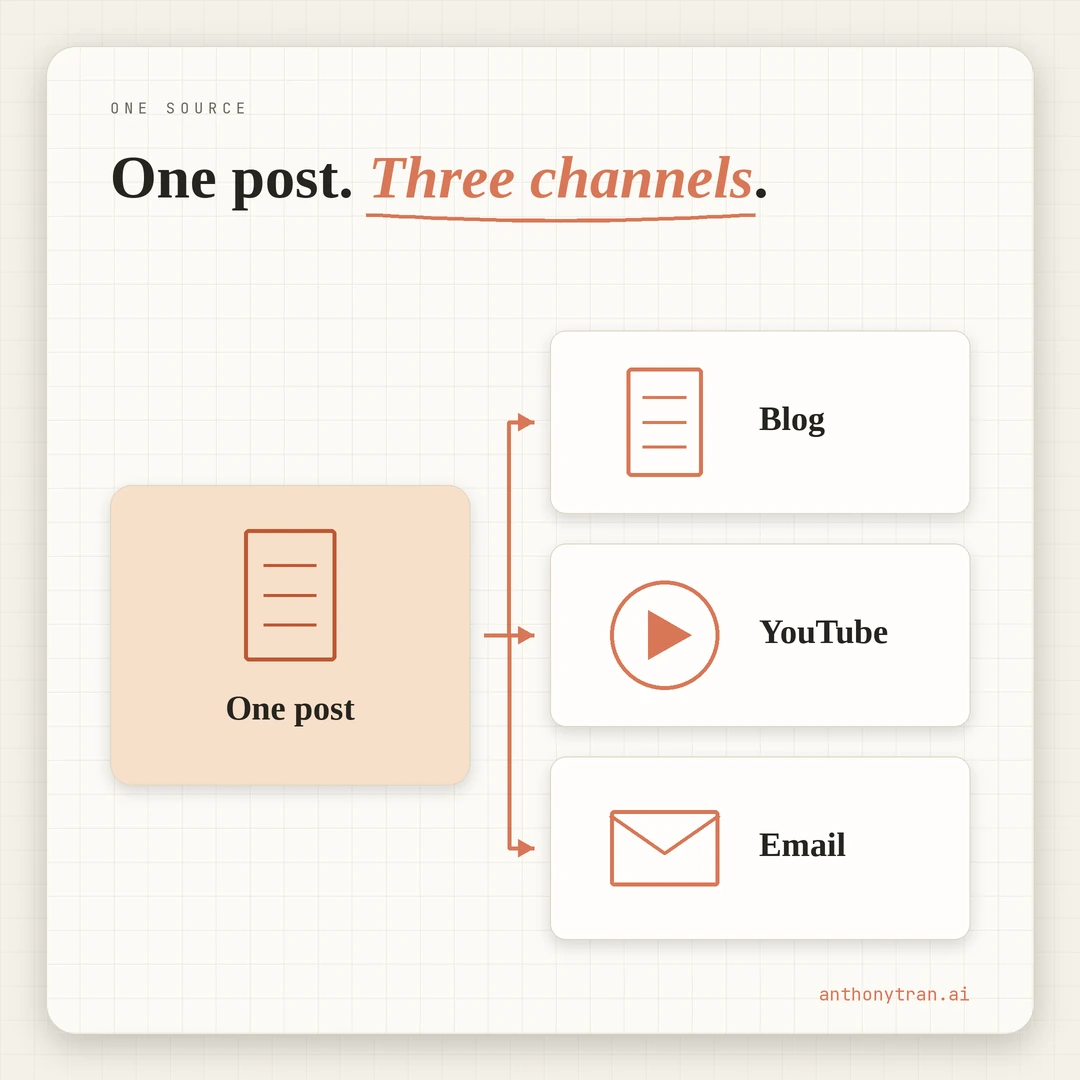
Make the blog the only source piece. Use email as a distribution channel for the same blog content.
Use video as a different distribution channel for the same blog content.
One source. Three channels. Zero drift.
One source, three channels
The new version of my writing system, the third one, has ten steps instead of thirteen. It produces one file. The same content reaches the reader through three surfaces.
The blog is the source. It lives on the site, gets indexed by Google, and has all the room the topic needs. Long-form by default, with sensory specifics, real scenes, real names, and no cap on length.
The email is the same content. I copy the body into ActiveCampaign and send it, or I let an automation pull the post from the site’s RSS feed and send it on a schedule.
The email is not a tighter remix. It is the blog post in the inbox.
If a post is truly too long for email, that is a signal about the post itself, not a reason to maintain a second writing system.
The video is the same content too. I read the blog post on camera, light edit, upload.
No separate script. The voice on the page is the voice I read out loud. The reader and the viewer get the same piece.
One source. Three channels. Zero drift.
The thing I lost was the illusion of optimizing every channel. The thing I gained was every minute I had been spending on the second and third drafts of every piece. That time now goes into the next post instead of the previous one.
Why the blog reads better than the remix
The reason the side-by-side test came out the way it did is worth pulling apart.
A blog post can be the length the topic needs. A newsletter has to feel inbox-sized.
The cap is unwritten but real. Readers expect newsletters to be short enough to read while waiting for coffee.
So newsletters tend to get tightened past the point where the message lands.
A blog post can take a real scene and let the reader stand inside it. Sensory specifics.
Real names. A moment from the writer’s actual life.
A newsletter has fewer paragraphs to spend, so the scene gets summarized. Summary kills immersion.
A blog post sits inside a web of related posts. A newsletter usually lands as a standalone artifact. The blog version of a piece carries context the newsletter version cannot, which makes any single post more useful.
A blog post can be read again. A newsletter rarely is.
For all of those reasons, the blog version of a post is usually the one that reads the way you intended. Not always.
Some pieces are inherently short and inbox-shaped. But most pieces with any real depth read better at blog length than at newsletter length.
The cleaner rule is this: write the version that reads best. Distribute it through every channel that fits.
Put This Into Practice
If you are producing more than one version of any piece of content right now, run this test. Paste the prompt into Claude or ChatGPT and walk through it one question at a time.
I produce more than one version of the same content for different platforms. Help me figure out whether I actually need all of them. Do not give me a fix yet. Ask me these questions one at a time and wait for my answer before moving to the next.
What is the same piece of content you are producing in more than one format right now? Name the two or three versions.
Read the two versions side by side, end to end. Tell me which one reads better. Be specific. What about it reads better?
What is the supposed reason the other versions exist? Is it audience expectation, platform format, distribution mechanics, or habit?
Could the version that reads best be sent or syndicated through the other channels without producing a separate draft? If yes, what would have to change in distribution rather than in writing?
If you collapsed everything to the best-reading version and used the other platforms as distribution channels, what would you lose? Is the loss real, or a story you have been telling yourself?
After the fifth answer, summarize the test result. Tell me whether I should collapse my workflow to one source or whether the multi-format setup is actually earning its spot.
Run the test on your highest-volume piece of recurring content first. If the answer is “collapse,” cut the second draft and use the surviving format as the source for every channel you reach.
The test takes about 15 minutes. The maintenance time it can save you is measured in weeks across a year of writing.
The format you keep is the one that reads better
If you take one thing from this post, take the side-by-side reading test. Most content workflows that span multiple formats are not running on data. They are running on the assumption that each platform needs its own format because that is what the platforms looked like ten years ago.
The platforms have changed. RSS-to-email automations send blog posts straight into the inbox.
Video creators read their own blog posts on camera and call it a day. LinkedIn and Twitter pull from the same source piece.
The format you keep is the one that reads better when you sit and read it. The other formats become distribution channels.
The maintenance overhead drops to zero. The voice gets consistent because the source is consistent.
For the system that holds it all together after the collapse, the four lessons that survived my rebuilds lays out the rules I now use to write every post. For the rewrite tax I paid before any of this settled, shipping 12 posts before the foundation locked covers the deeper cost. For the parallel decision about where to post, cutting my platform list from 9 to 3 is the same simplification move applied to channels instead of formats.
One source. Three channels. Whatever you produce, produce it once.
~ Anthony
Frequently asked.
Why should a personal brand write only one version of every piece of content?
Multiple formats of the same content carry a real maintenance cost. Every change in one version has to be carried across the others. Drift between formats happens fast. One source version distributed through multiple channels keeps the voice consistent and frees up the time you used to spend syncing.
What is the side-by-side reading test?
A 15-minute test where you read two different format versions of the same content end to end, in order, without editing. The version that reads better becomes your source. The other format becomes a distribution channel for the same content, not a separate draft.
Can a blog post double as a newsletter and a YouTube script?
Yes, and that is the cleaner model. Email distribution can pull the blog content directly through an RSS automation. Video distribution can be the same content read on camera. The reader and the viewer and the subscriber get the same piece, just through different surfaces.
Stop re-explaining yourself to Claude.
Grab the free AI Starter Kit: my exact Claude setup, so it knows your business. Plus the lessons as they land.
Anthony Tran
13 years in marketing and an Air Force veteran. I use Claude every day to market and grow my own business, and I break down what works in plain English. Writing and recording from Arizona.