
I shipped 12 blog posts before my personal brand foundation was stable. Every time the foundation shifted, every post had to move with it. Here is the rewrite tax I paid and the audit I now use to avoid it.
Why most personal brand builds rewrite the same 12 posts
If you are starting a personal brand, the pull will be to start writing immediately. The website is up, your AI tool of choice is set up, and you have a few ideas. Publishing feels like progress, and foundation work feels like preparation for it.
So you publish post one. Then post two. Then post three.
Around post six or seven, you notice something shifted. Your voice rules changed because you got better at noticing what makes your writing sound like you.
Your share preview image needs a redesign because the personal brand language sharpened. The URL pattern you used in post one does not match the pattern you used in post six.
The audit prompt at the end of each post is a little different in every version.
Now you have a choice. You can leave the older posts as they are, knowing they are a little off. Or you can go back and rewrite all of them to match your new foundation.
Either way you pay. Leave them and the inconsistency reads as drift to anyone scanning the archive.
Rewrite them and you pay the rewrite tax. The tax compounds every time the foundation shifts again.
I shipped 12 posts before I noticed. By the time I locked the foundation, I had rewritten the same 12 posts about three times each. Every single time my foundation moved, every shipped post had to move with it.
The single most expensive mistake I made in Phase 1 was publishing before my personal brand foundation was stable. This post is the math behind that mistake and the audit I now use to know when the foundation has stopped moving enough to publish on it.
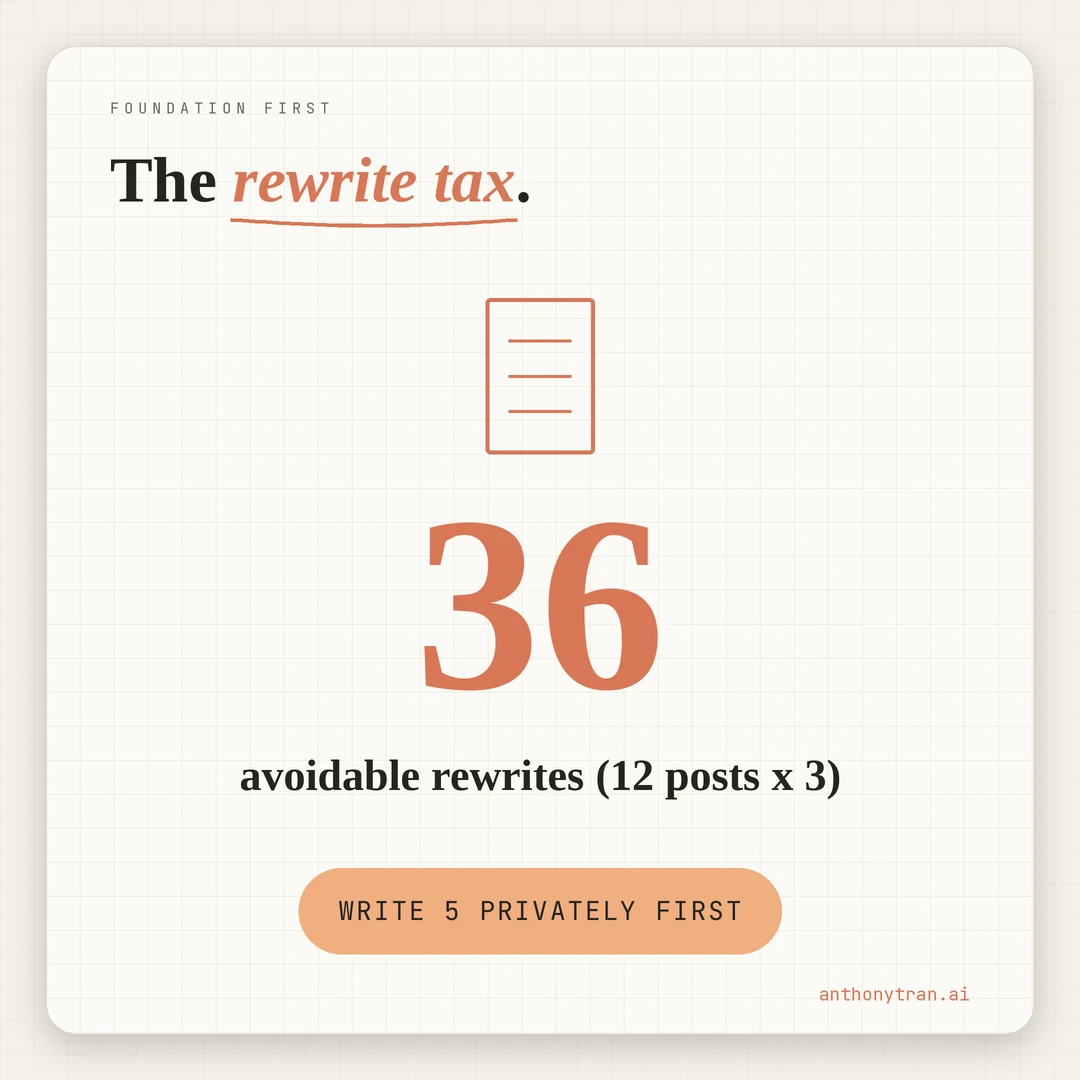
The rewrite tax: one shift, 12 rewrites
The math is simple. Every shipped post is anchored to your current foundation.
Voice rules are baked into the writing. Brand vocabulary is baked into the headlines.
The URL is baked into the file. The share preview image is baked into the post settings.
Internal links point to other posts using your current naming convention.
When any one of those layers shifts, every post built on that layer breaks.
I am using “rewrite” broadly here. Some of the tax was literal rewriting (paragraphs, headlines, calls-to-action).
Some of it was metadata cleanup, image regeneration, URL renaming, internal link repair, and cache refreshes. Either way, the cost was the same: every published post had to be touched again.
A small example. I changed the way my post URLs were named midway through Phase 1.
The old pattern used sequential numbers. The new pattern used a code tied to where each piece sits in my overall publishing arc.
That single change forced me to rename every published file, regenerate every share preview image, update every internal link in every post, and force a cache refresh on every social platform so the new preview would show up. If the URLs were already public (mine were), the same change also requires mapping redirects from the old paths to the new ones, or every old link out there breaks.
One shift. 12 rewrites. That was the cost of one decision.
Then a voice rule changed because I caught a pattern in my own writing I had been blind to. I had been opening paragraphs with short staccato sentences that read fine alone but felt choppy strung together. Once I saw the pattern, I had to fix it everywhere it appeared. 12 rewrites again.
Then my visual identity sharpened. New language for the personal brand.
New section headers. New share preview format.
New footer convention. Each change forced another sweep across the older posts.
By the time the foundation settled, my first 12 posts had each been touched three or four times. That was roughly 36 avoidable rewrites.
The fix would have been to slow down on the publishing side until the foundation actually settled. Every post I shipped before then was a commitment to a version of my foundation I was about to outgrow.
What kept shifting under me
I want to be specific about what kind of changes kept triggering rewrites. If you are building right now, knowing the categories is half the value.
Voice rules. The bans, moves, and rhythm rules my writing has to follow. Voice rules do not stabilize until you have written enough posts to see what your real voice does on the page. Mine kept evolving for the first month. Every evolution forced a sweep across every shipped post that violated the new rule.
Visual identity. The look of the site, the share preview images, the colors, the typography, the vocabulary used in section headers and footers. Mine went through six versions before I picked one. Each shift forced a graphics regeneration on every post.
URL convention. The way each post URL is named. I changed mine mid-build to reflect chronological story order rather than the order I published in. Every URL had to be renamed. Every internal link had to be updated.
Post structure. The settings attached to each post: title, description, category, share preview path, FAQ block, related posts list. Each time I added a new setting (like a separate description specifically for AI search tools), I had to backfill it on every shipped post.
Resource and FAQ format. The way I close every post with a paste-into-AI prompt and a short FAQ. Both formats evolved as I wrote more posts. The early ones used different patterns that had to be retrofitted later.
Internal link patterns. Once I had three or four posts, I started linking them to each other. Then I added a pillar post and had to add pillar links across the archive. Then I refined the link style and had to update every link.
Subscribe placement and copy. The newsletter call-to-action went through three versions in three weeks. Each version meant the older posts carried the old call-to-action.
That is seven categories of foundation change. Every category shifted at least once.
Most shifted two or three times. Each shift, multiplied by 12 shipped posts, is the rewrite tax I paid.
Here is the thing: none of those changes were wrong. Each one made the site better.
The mistake was not the changes themselves. The mistake was publishing before the changes had time to settle.
Write before you publish
Here is the part I missed the first time. Some of those foundation decisions only get sharp once you have written enough to feel them.
Voice rules surface when you draft. URL conventions surface when you name a few files.
Share preview format surfaces when you mock up a few covers. Writing is part of how the foundation settles.
The mistake was not the writing. It was making the writing public before the system underneath it had stopped moving.
If I were starting again, I would write five posts privately first. Use those drafts to test the voice rules, the post template, the URL pattern, the share preview format, and the call-to-action.
When all five drafts can sit on the same foundation without forcing a new decision, that is the signal the foundation is stable enough to publish on. Then start publishing.
Private drafts are cheap. Public rewrites are expensive.
How do you know your personal brand foundation is stable enough to publish?
Here is the test I now use to know whether to keep publishing or stop and finish the foundation.
For each item below, ask whether you have changed it in the last two weeks. If yes, it is still moving.
- Voice rules. The bans, the rhythm rules, the moves. If you are still adding or changing them, your voice is still settling.
- Visual identity. Colors, typography, share preview format, vocabulary used in headers and footers. If you are still tinkering, it is not locked.
- URL convention. The way your post URLs are named. If you have renamed any post URL in the last two weeks, your convention is not stable.
- Post structure. Title format, description, category, FAQ format, resource format. If any field has changed across your archive recently, your structure is not settled.
- Internal link strategy. The way posts link to each other. If you have not picked a pillar or your internal links are inconsistent, this layer is still moving.
- Subscribe and call-to-action. The signup block, the welcome flow, the call-to-action copy on each post. If any of these are still in flux, every post you publish today will need an update later.
If two or more layers are still moving, pause publishing for a week and make the missing decisions. The cost of publishing now is the rewrite tax, multiplied by every post you ship between now and the day those decisions land.
If zero or one layer is still moving, you are stable enough to publish. The remaining churn will be small enough that it will not force a full sweep.
The early Phase 1 trap is believing publishing will lock the foundation for you. It will not. Publishing surfaces a few small things, but most foundation work has to happen before the first public post, not after the twelfth.
Put This Into Practice
Here is the prompt I would paste into Claude or ChatGPT today to run the foundation audit on a personal brand build. If you are already publishing, run it before your next post. If you are about to start, run it before your first post.
I am building a personal brand and I want to figure out if my foundation is actually locked or still moving. Ask me these questions one at a time and wait for my answer before moving to the next:
- My voice rules. Have I added, removed, or changed a voice rule in the last two weeks? If yes, name the change.
- My visual identity. Have I changed colors, typography, share preview style, or section vocabulary in the last two weeks?
- My URL convention. Have I renamed any published post URL in the last two weeks?
- My post structure. Have I added or changed any field (title format, description, FAQ, resource section, category) across my archive in the last two weeks?
- My internal link strategy. Have I added a pillar post, changed how I link posts together, or updated my link style in the last two weeks?
- My newsletter signup and call-to-action. Have I changed the subscribe block, the welcome email, or the call-to-action copy on any post in the last two weeks?
Now count how many came back as “still moving.” If two or more are moving, tell me to pause publishing for one week and make the missing decisions. If zero or one is moving, tell me I am stable enough to publish.
Then, for each item that is still moving, ask me: what is the specific decision I need to make to lock it? Give me a small action I can take this week to settle it.
Run the prompt once. Then run it again before every new post you publish for the next month. Once five or six of the six come back locked for three weeks in a row, you can stop running it.
The audit takes about 10 minutes. The rewrite tax it can save you is measured in weeks.
Lock the foundation. Then publish.
The biggest cost of jumping ahead is not the time spent writing the early posts. It is the time spent dragging those posts forward every time the foundation changes.
I paid roughly 36 rewrites for ignoring that. Those hours could have gone into new work.
If you are staring at a half-built foundation and thinking about publishing your first piece anyway, pause for a week. Write privately if you need the reps.
Lock the voice, the post template, the URL pattern, the share preview format, and the call-to-action. Then ship.
Posts published on a stable foundation stay published. Posts published on a moving foundation become drafts you have to keep revisiting.
For the framework these phases sit inside, start with the three-phases post. For the AI tooling I had to rebuild for the same reason on the system side, the four lessons that survived my rebuilds covers the parallel mistake. The full manifesto for this build covers why I am building all of this in public in the first place.
Lock the foundation. Then come build with me.
~ Anthony
Frequently asked.
What is foundation creep in a personal brand build?
Foundation creep is when you keep changing core decisions (voice rules, visual identity, URL convention, post structure) after you have already started publishing content. Each change forces a rewrite of every post you have already shipped. The fix is to lock the foundation before you publish, not after.
How do you know when your personal brand foundation is stable enough to publish?
Run a six-item audit. Check whether your voice rules, visual identity, URL convention, post structure, internal link strategy, and subscribe call-to-action have changed in the last two weeks. If two or more are still moving, your foundation is not stable. Pause publishing until zero or one is still moving.
Should you publish blog posts while your personal brand foundation is still in flux?
No. Every post you publish is anchored to the current foundation. When the foundation changes, every shipped post needs to be rewritten to match. The smaller your archive when the foundation finally locks, the less rework you will owe.
Stop re-explaining yourself to Claude.
Grab the free AI Starter Kit: my exact Claude setup, so it knows your business. Plus the lessons as they land.
Anthony Tran
13 years in marketing and an Air Force veteran. I use Claude every day to market and grow my own business, and I break down what works in plain English. Writing and recording from Arizona.