
I rebuilt the same AI writing setup five times in a few weeks. The versions changed. The lessons did not. Here are the four that survived every rewrite, ready to use in your own setup.
Why do AI writing setups keep breaking the same way?
If you have built any kind of AI setup for writing (a custom GPT, a Claude project, a long instructions document you paste in every session), you have probably run into the same wall I have. The first version sounds wrong.
You add more rules. The second version sounds slightly better but still not like you.
You add more examples, more rules, more bans. The third version feels close, but now the AI is writing drafts you have to spend more time fixing than if you had written from scratch.
Then one day you scrap the whole thing and start over, leaner. The next version is finally good. You wonder why it took five tries to get there.
The answer is that AI writing setups fail in predictable ways, and most of us learn the failures one at a time the hard way. The fixes only make sense after something breaks.
This post is the four lessons I had to learn the slow way across five versions of my own setup. They are not about my specific tool.
They are about the shape of mistakes that AI writing setups all make right now. If you are building one, you can skip a few of my rebuilds.
If you are about to start, you can start with the lessons already in place.
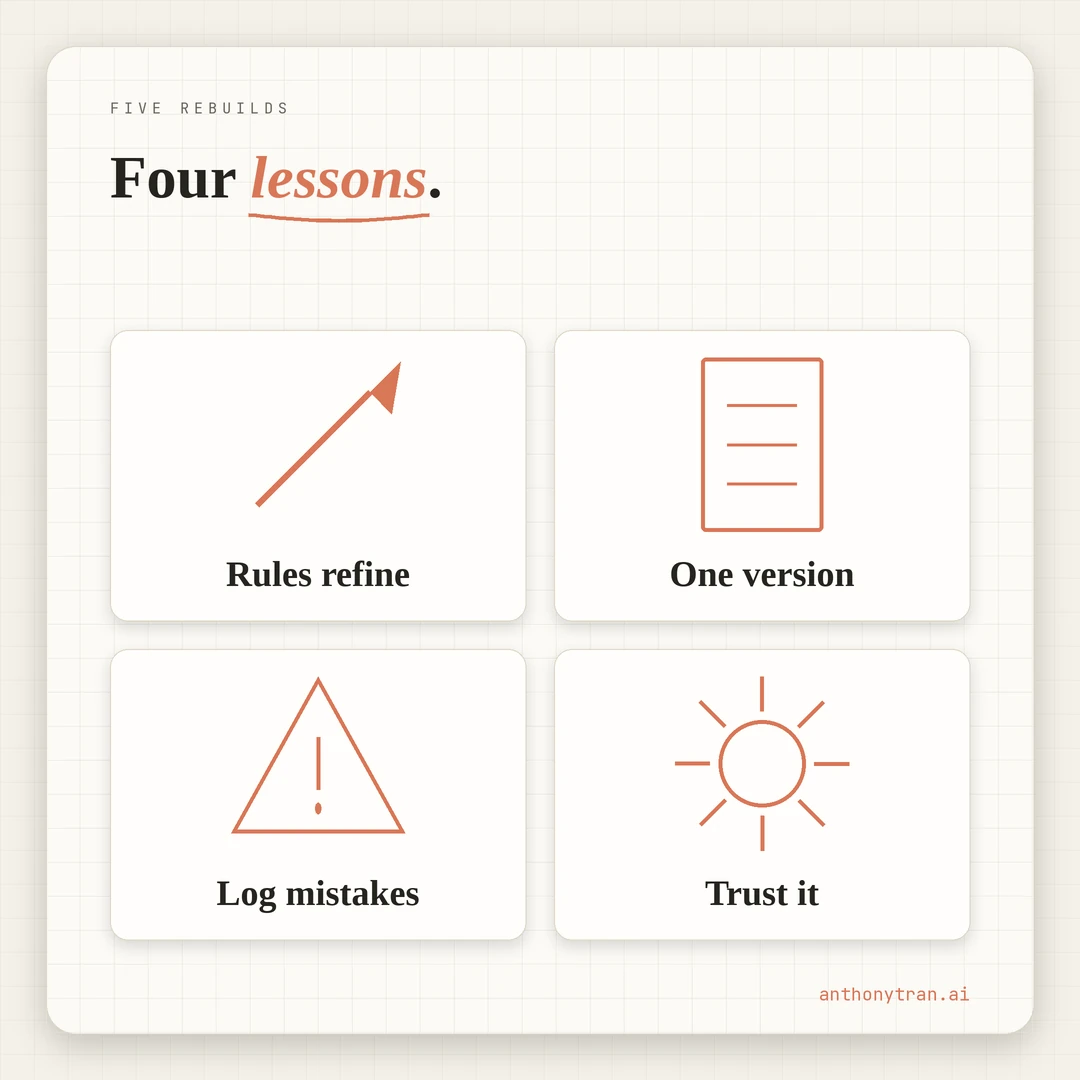
The lessons in one line each:
- Voice rules clean up writing. They cannot create the voice.
- One main version of each piece. Do not ask AI to write three.
- Every mistake you catch should go on your review list.
- The AI is the helper. The thinking is still the work.
The pattern underneath all four is the same. Stop asking the AI to figure out judgment you have not yet figured out for yourself. Every section below unpacks one lesson with a simple test you can run on your own setup today.
Lesson 1: Voice rules clean up writing. They cannot create the voice.
Most people start an AI writing setup the same way. They make a list of bans.
No em dashes. No corporate jargon.
No “delve” or “dive deep. No “thought leader.
No “in conclusion. Short sentences.
Friendly tone. Add about thirty more like that.
You paste the list into the AI. The next draft obeys every rule.
None of the banned words show up. The sentences are short.
The tone is friendly. And the post still does not sound like you.
My first version was exactly that. A long list of bans.
I assumed the bans would create the voice. They did not.
They produced clean writing that followed the rules and felt like nobody in particular.
The fix came when I started writing down the MOVES instead of just the bans. Not “do not use jargon” but “name a real place, a real year, and a real person in every scene.
Not “be friendly” but “write like a trusted older brother who has been through it. Not “short sentences” but “mostly medium-length sentences, a few short ones for emphasis, and almost no fragments unless the moment really earns it.”
The moves are where the voice lives. The bans are where the AI tells get cleaned up.
Bans keep the AI from sounding obviously wrong. Moves give it something recognizable to aim at.
You need both. If you start with only the bans, you get a draft that follows every rule and still feels generic.
The reader does not know why it feels off. You do not either. The fix is further upstream than the rules.
The simple test for your own setup: Pull up your current AI instructions. Count the rules that tell the AI what NOT to do. Then count the rules that tell it what TO do, in positive words, with examples. If the bans outnumber the moves by three-to-one or more, you have the same gap I had. Add positive instructions until the balance flips. The voice will start to show up.
This is why drafts from your AI should sound like you, not like AI imitating you. The bans alone cannot create the rhythm and the small details that make writing recognizably yours. The moves carry that weight.
Lesson 2: One main version of each piece. Do not ask AI to write three.
My second version tried to be efficient. One topic, three drafts.
Blog post for the website. Email for the newsletter.
Medium adaptation for the third platform. Same idea, three drafts, each one polished for its own platform.
It worked on paper. In practice, it cost more than it saved.
Every change to the topic had to be repeated three times. The voice slipped because each draft had its own little rules.
The AI was trying to do three jobs at once and ended up doing none of them as well as a single draft would have. By the fourth or fifth post, I was spending more time keeping the three versions in sync than I was actually writing.
The fix was to collapse three drafts back to one. The blog post became the main version.
The email is the same content with small tweaks for how it shows up in the inbox. The video is me reading the blog post on camera.
Same idea, three places it shows up, one piece of writing behind all of them. I might trim a section for the email or skip a paragraph on video.
I am no longer asking the AI to write three separate drafts. That is where the slipping voice was coming from.
One main version does not mean every channel looks identical. It means every channel comes from the same main piece.
The lesson is that most AI writing setups try to be too clever about producing multiple drafts. The cost of the cleverness keeps adding up. The cost of picking one main version is paid once.
The simple test for your own setup: List the drafts your AI is currently writing per topic. If there is more than one DISTINCT draft (not the same draft trimmed for a different channel, but actually different writing), ask whether each extra draft earns its place. If you cannot point to clear proof that the second and third drafts deliver something the first does not, collapse them. One main version. Everything else is just sharing the same content in different places.
The version of my setup that survived did less. That pattern has held across every AI workflow I have built.
Lesson 3: Every mistake you catch should go on your review list.
The third lesson is what to do AFTER your AI gives you a draft that is almost ready. Specifically, what to do when a second read catches a mistake the setup should have caught on its own.
I learned this the hard way. An early version of my setup kept producing posts that contradicted themselves.
The post would teach a rule, then break the same rule in its own examples. A post about “each rule lives in one place” used the same rule in two places as examples.
A post about “do not stack short sentences” opened with four short fragments in a row. The drafts looked clean on a first read. A second read caught the contradictions every time.
The fix was not to write better drafts. The fix was to add the catch to my AI instructions as a review-list item.
State the post’s one main message. Scan every example in the post for contradictions with that message.
Run this check at the review stage, not at first draft, not at publish.
Once the check was in the instructions, the mistake mostly stopped happening. The few times it did slip through, the next version of the check got sharper.
The same pattern played out with the AI-invents-specifics mistake (making up numbers, dates, or quotes the source did not contain), with the choppy-sentence mistake, and with the trying-to-force-a-tagline mistake. Each one became a review-list item.
Each item caught the next time the same mistake tried to slip through.
The simple test for your own setup: When a second read catches something in your AI’s draft, do not just fix it in that draft. Add the catch to your AI instructions. Write it down somewhere the AI will see it next time. Be specific. “Do not invent details” is too vague. “Before writing, list every name, date, and number my source mentions. If anything is missing, ask me first” is a rule the AI can actually follow.
Your setup gets better one caught mistake at a time. By version five, it catches most of what used to need a second pair of eyes.
Lesson 4: The AI is the helper. The thinking is still the work.
The trap at this stage of the build is to think the AI setup IS the work. Get the instructions right, and the writing takes care of itself. Get the rules dialed in, and the AI handles the rest.
That is wrong, and it took me five versions to really accept it.
The AI setup is a helper. A place where your thinking gets written down so the next draft starts further along than the last one.
But the setup cannot produce good writing on its own. It needs honest material from you.
It needs a real person making decisions about what the reader actually needs. It needs your taste applied to the draft before you publish.
Every AI workflow I have seen people give up on went the same way. They built the setup expecting it to do the writing.
The drafts came back wrong. They blamed the AI, blamed the prompts, blamed the tool.
The fix was almost always upstream. Better material from them.
Clearer sense of who the reader was. A sharper answer to “what is the one thing I want this piece to say” before any prompt got written.
What the difference looks like in practice:
- Weak input: “Write a post about AI writing setups.”
- Strong input: “Write for solo business owners in their 40s who built a custom GPT, added fifty voice rules, and still hate the writing it gives back. The reader is asking ‘why does my AI writing still feel generic?’ The one main message is: stop piling on bans, start writing down what you actually want the AI to do. Use my voice notes for tone. Pull the bans-versus-moves story from my own setup as proof.”
Same AI, same prompts, completely different draft. The setup is not where the difference lives. The thinking behind the setup is where the difference lives.
The simple test for your own setup: Look at the last draft the AI produced that let you down. Was the real problem the prompt, or was the material you gave it too vague? If the AI did not know the reader, the one main message, the proof you wanted it to use, or the point of view, the setup was not the problem. The missing thinking was. Before your next draft, write three things yourself first: who the piece is for, what the one main message is, what source material the AI is allowed to use. If those are fuzzy, the draft will be fuzzy too.
The AI setup reflects the thinking of the person who built it. If your thinking is fuzzy, the setup will be fuzzy. If your thinking is sharp, the setup writes it down so you do not have to think it through from scratch every time.
The work is the thinking. The setup is where the thinking gets saved.
Put This Into Practice
If you have an AI writing setup in any form (a custom GPT, a Claude project, or just a long note you paste in every session), here is the prompt I would paste in next to it to check it against these four lessons.
I am going to paste in the instructions for my AI writing setup. Check them against these four lessons, one at a time. Wait for my answer before moving to the next step.
Lesson 1 check. Count the rules in my instructions that tell you what NOT to do (bans). Then count the rules that tell you what TO do, in positive words, with examples (moves). Tell me the balance. If bans outnumber moves by three-to-one or more, flag the gap and suggest 3 to 5 positive instructions I could add to even it out.
Lesson 2 check. Tell me how many separate drafts my setup is supposed to produce per topic. If it makes more than one actual draft (not the same draft trimmed for a different channel, but actually different writing), ask me what proof I have that the extra drafts earn their place. If I do not have clear proof, suggest collapsing to one main draft per topic.
Lesson 3 check. Look for a review-list or review stage in my instructions. If there is none, suggest a starting structure. If there is one, ask me what mistakes I have caught in past drafts and whether each one is on the review list.
Lesson 4 check. Tell me where my instructions assume the AI will do the work and where they assume I will do the work. If the balance is off (the AI is being asked to make calls only I can make, or I am being asked to do work the AI could handle), flag the mismatch.
Be specific. If a rule is fuzzy, quote it back to me and ask me to sharpen it. If a rule is missing, name what it should cover and ask what mine looks like.
Run the prompt once on your current setup. Apply whatever changes still make sense after you read them.
Then run it again in a month. The setup gets sharper every pass.
Skip my rebuilds, keep the lessons
The five versions cost me weeks of rework. Some of that was unavoidable.
A lot of it was preventable if I had known these four lessons up front. The whole point of this post is to put the lessons in one read so you can skip a few of my rebuilds.
The first version of your AI writing setup will be wrong somehow. That is fine.
Keep refining. But refine toward something specific.
Not “more rules” but better rules. Not “more drafts per topic” but the one main draft that matters.
Not “the AI will figure it out” but “I will catch the mistake and write it down so the AI sees it next time.”
The AI is the helper. The thinking is the work.
The reader is the hero. Build for them, not for the AI.
If you are building your own AI writing workflow, start there. Come build with me.
~ Anthony
Frequently asked.
What is an AI writing setup?
Any saved set of instructions that tells AI how to write in your voice. It can be a custom GPT, a Claude project, a system prompt, or just a long note you paste in every time. The label does not matter. What matters is that the same instructions run every time you draft, so the AI produces consistent writing instead of starting from scratch each session.
How do you stop AI from drifting away from your voice?
Two layers. First, write down what you BAN (the words and phrases that are not yours). Second, write down the MOVES that create your voice (real names, real years, real places, real scenes). Bans alone are not enough. They clean up writing, they do not create the voice itself. The voice has to start as truth from real material, then the rules tidy what is already there.
Should you ask AI to write multiple versions of the same piece?
No. Pick one main version of each piece. Everything else is distribution. The trap is asking the AI to write a blog post AND an email AND a social caption from the same idea. Three separate drafts create drift between them, force the AI to do three different jobs at once, and add extra work with no real upside. Write one main version. Share that same content everywhere.
Stop re-explaining yourself to Claude.
Grab the free AI Starter Kit: my exact Claude setup, so it knows your business. Plus the lessons as they land.
Anthony Tran
13 years in marketing and an Air Force veteran. I use Claude every day to market and grow my own business, and I break down what works in plain English. Writing and recording from Arizona.