Real-sounding numbers, places, quotes, and scenes can sneak into your drafts. The damage shows up the moment a reader who knows you spots one.
Why AI invents specifics when you give it the chance
You hand AI your voice memo. You ask it to turn the memo into a blog post. The draft comes back, the voice mostly sounds like yours, and then you read a line and stop.
That detail is not yours. You never said that. So how did it get there?
That feeling is the most quietly dangerous failure mode in AI writing. AI is good at sounding like you.
It is also good at filling in plausible-sounding details when it does not have the real ones. The result is a draft that reads confident, sounds close to your voice, and contains things you never said.
The trap is that the invented specifics are almost always close to the truth. Close enough that you might miss them on read-back.
Close enough that the reader probably will not catch them. Until one reader does, and that reader happens to know you, and now the trust gap is permanent.
If you want the bigger picture of why I am building this personal brand with AI in the first place, the manifesto post is the starting point. This post is one of the failure modes I had to learn to catch before publishing more of this build in public.
The Tesla line that almost shipped in one of my own posts
A few weeks back I was drafting the first version of one of my earlier posts on this site, the one about why I am not a guru. I had done a voice memo brain dump that morning while my wife was still asleep.
In the dump, I rambled for a few sentences about how AI removes the kind of friction that used to break me. Tesla Full Self Driving was the analogy.
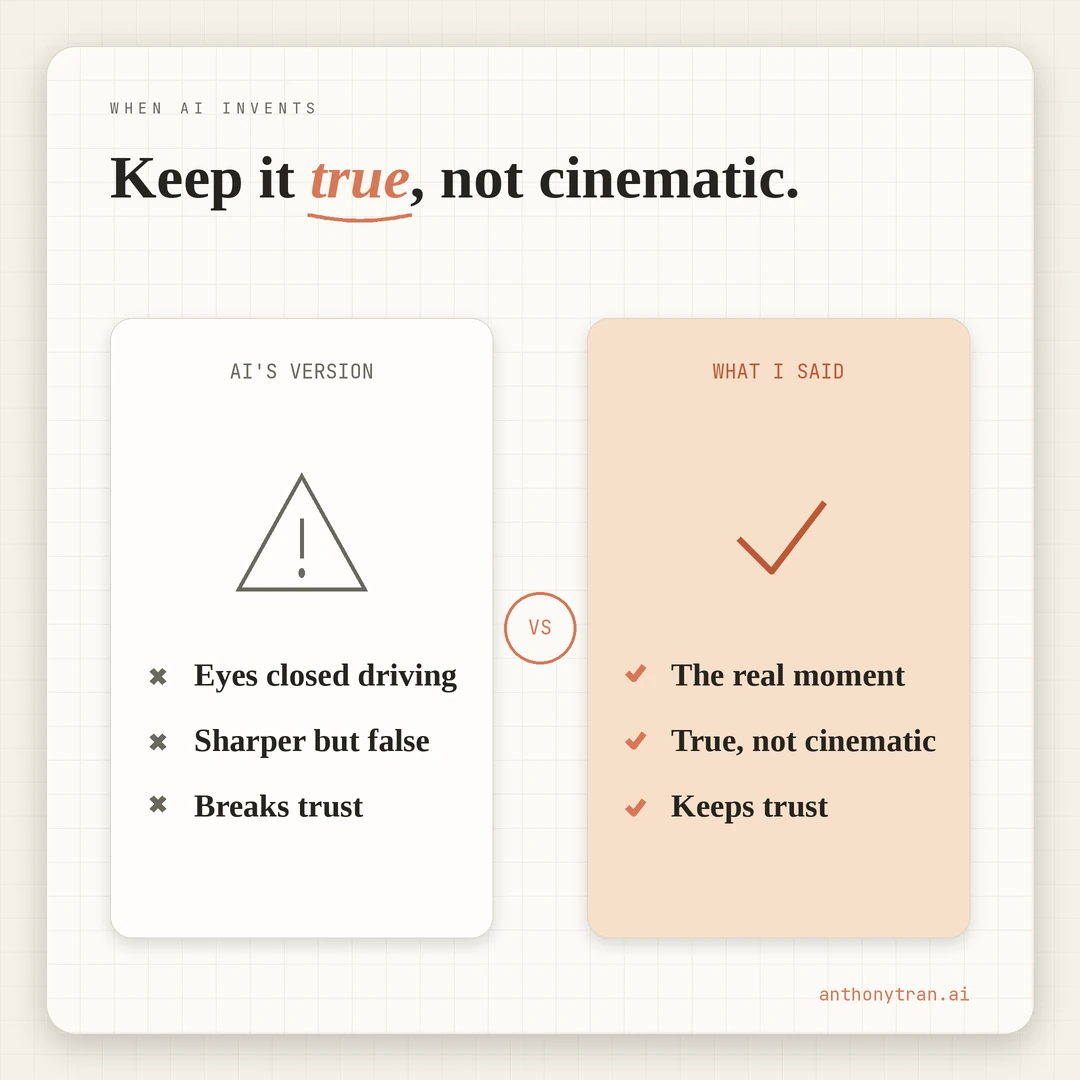
The exact words I used in the memo were “so I don’t have to drive.”
Claude’s draft came back with a different version. “So I can close my eyes on the highway.”
Cinematically sharper. The kind of line that lands.
Also a thing I never said and would never do. Closing your eyes on a highway is reckless.
Tesla FSD is a supervised driver-assist system. It requires the driver to stay attentive and ready to take over.
“Close my eyes on the highway” is a feature of a fantasy I do not actually have.
The fix took a few seconds. Replaced the line with what I actually said. The first draft was stronger for it.
But the lesson took longer to land. The AI was not lying on purpose.
It was pattern-matching. It saw “Tesla Full Self Driving” next to an idea about removing friction, then reached for a more dramatic version of the point. The cleanest narrative beat showed up, not the truth.
This is the broader pattern that the AI research world calls hallucination. When the model does not have a specific detail in front of it, the most statistically likely word goes in the blank.
Sometimes the most likely word is correct. Often it is plausible but wrong.
What invented specifics actually break
The damage is not just the false detail. It is what that false detail does to trust.
Specifics work in writing because they are true. The whole reason “Hanauma Bay” lands harder than “the beach” is that Hanauma Bay is a real place with a real shape that a real person remembers.
The reader feels the difference. They cannot always articulate why, but they feel it.
When you invent the detail, you lose the thing that made it work in the first place. The line now reads like marketing copy pretending to be memoir.
Readers can usually spot that, even when the surface looks smooth. Their instinct does the work.
The second cost shows up when a reader who knows you catches the invented moment. The cost is not just the one line.
The trust gap goes both directions. One invented detail puts a question mark on every other fact in your work.
The reader starts to wonder which other moments are real and which ones the AI filled in.
Personal brand writing depends on the reader believing the details are real. Once that belief breaks, your personal brand sits in a hole that is harder to climb out of than to never fall into.
What does the ask-before-inventing rule actually look like?
Here is the discipline I now run on every AI draft.
Before drafting, separate the details you documented from the details AI would have to guess.
Documented: anything in your context files, the voice memo or transcript you fed the AI, your existing About page, your past posts. Real years, real names, real numbers, real quotes. Use these freely.
Not documented: anything the AI would have to guess at. The exact year something happened.
An employer name not mentioned in source. A quote you assume someone said.
An internal number you have not shared. A scene that “would make sense” but you have not actually described.
For anything not documented, two options. Either tell the AI to ASK you with specific questions (“What year did you first read Building a StoryBrand?
What was the moment you realized you were misapplying it?”). Or tell it to write with vaguer language (“years ago” instead of inventing “in 2015,” “an old book I had been carrying around for a while” instead of inventing a title).
Vaguer language is honest. Invented specifics are not.
The rule sounds obvious when you write it down. It is not obvious in practice.
AI will not flag invented details on its own. It will not stop and ask whether you actually said the thing.
It will fill in the blank because filling in blanks is what it has been trained to do. The discipline has to live in your prompt or in your review pass. Or both.
Put This Into Practice
If you are about to ask AI to turn a voice memo or a rough draft into a finished post, paste this in next to the source.
I am going to paste in my source material and I want you to turn it into a blog post draft. Before you write, do this:
- Read the source material once.
- List every specific I gave you directly: dates, names, numbers, places, quotes, scenes.
- List every spot where the source is vague or missing a specific. Years I did not name, employers I did not name, numbers I did not give, quotes I did not say.
- For each vague spot, do ONE of these two things. Never invent.
- Ask me a specific question and wait for my answer before drafting.
- Write with vaguer language that does not require the specific (“years ago” instead of “in 2015,” “an old client” instead of a real name).
- Do not insert a year, a name, a number, a place, or a quote that you did not see in my source material. If you are about to, stop and ask me first.
- Every specific in your draft should be traceable to something I gave you.
- When you finish the draft, flag any detail you are unsure about so I can verify it before publishing.
Be honest. If the source is too thin to draft from without inventing, tell me. I would rather give you more material than ship a post with details I never said.
Run the prompt every time. Especially when the source is a brain dump that skipped over details.
The dump captures the emotional truth. The specifics often live in your head and never make it into the dump. AI will fill those holes if you do not tell it not to.
Honesty beats cinematic on a personal brand
The temptation with AI writing is to let the more cinematic line stand because it reads better. “Close my eyes on the highway” is a sharper line than “so I don’t have to drive.
Better in the sense that it lands harder. Worse in the sense that it is not yours and is not true.
Personal brand writing is not screenwriting. The job is not to deliver the best line.
The job is to put real specifics on the page that the right reader will recognize as real. That recognition is the connection. Connection is the whole point.
When AI hands you the cinematic version, the move is to thank it for trying and replace it with the honest version. The honest version may be shorter and less colorful.
It is also a better fit for the personal brand you are building. Cinematic is for fiction. Honest is for everything else.
Come build with me.
~ Anthony
Frequently asked.
Why does AI invent specifics when writing in your voice?
AI is trained on huge volumes of writing where the most colorful version of an idea usually has a sharper specific attached to it. When your source material is vague, the AI pattern-matches to the version it has seen most often in training. The result is a detail that sounds right but is not yours. The AI is not lying on purpose. It is filling in a blank with the closest plausible answer.
How do you stop AI from making up details in your writing?
Tell it to ask before inventing. Before drafting, the AI should scan your source material for specifics that are documented versus specifics it would have to guess at. For anything not documented, give it two options: ask you a specific question to get the real detail, or use vaguer language that does not require the specific. Inventing is never one of the options.
What is the ask-before-inventing rule?
A discipline you bake into every AI writing prompt. The rule says the AI cannot insert a year, a name, a number, a place, or a quote it did not see in your source material. If something is missing, it must either ask you for the real detail or write with vaguer language that does not require it. Invented specifics break trust the moment a reader who knows you spots them.
Stop re-explaining yourself to Claude.
Grab the free AI Starter Kit: my exact Claude setup, so it knows your business. Plus the lessons as they land.
Anthony Tran
13 years in marketing and an Air Force veteran. I use Claude every day to market and grow my own business, and I break down what works in plain English. Writing and recording from Arizona.