
I bought new clothes, new shoes, and a new watch for my first real industry conference in 2013. I thought I had to look the part. The costume cost me my voice.
The personal brand era of the rented Lambo
Open Instagram or YouTube and the same patterns repeat.
A man in a button-down shirt poses next to a Lamborghini that is not his. He rented it for the day.
The mansion behind him is not his either. It is a Tuscany-style Airbnb he booked for the weekend.
There are companies now that build fake private jet cabins for rent. Influencers book them by the hour, sit in the leather seats, and post a video that looks like a casual cabin shot of their first-class life.
AI does the rest. A whole reel of beach-road driving footage can be generated without the creator ever leaving their bedroom.
The rendered version is good enough to fool the average viewer. The line between real and not-real keeps moving, and most of the people scrolling do not know it has moved at all.
This is the world the personal brand stuff is being built in right now. The math gets harder for honest people every month.
I am building this brand without the costume. Not because I am morally above it. Because I tried that game in my last build and it cost me my real voice.
The clothes I bought to look the part
In 2013, I quit my corporate job in aerospace and bet twelve months of runway on a podcast. Linh agreed to keep working while I figured it out.
I had been studying personal brand books and entrepreneurship courses for two years before that. The books all said the same thing.
You are an authority. Position yourself like one. Show up like one.
So I did. The first big industry conference I attended that year, I bought a new outfit.
New shoes. A new watch.
Not because I needed any of it. Because I thought looking the part was the part.
I walked the conference floor that weekend with the right clothes and the wrong feeling. I was scanning the room to see who I should know.
I was running calculations about whose photo I should appear in. I was rehearsing the line I would say if I bumped into someone I had heard on a podcast.
The actual content of the sessions was secondary to the performance I was running about being there.
I came home with business cards from people I would never call again. I had spent the weekend building a costume for an audience that was not actually paying attention.
That was the first conference. Over the next six years I doubled down.
Speaking gigs and new decks for each one, a specific way I was supposed to look on stage, a specific kind of headshot, a specific kind of LinkedIn caption. I leaned into the version of me that the personal brand culture rewarded because the culture was very clear about what it rewarded.
By 2019 I was burned out and had stepped back from my own personal brand entirely. The volume of work broke me first.
The performance had been quietly draining me underneath the volume the whole time.
What it actually cost
The volume cost me my health. The performance cost me my voice.
I had spent six years sounding like the books I had read. I knew the cadence of the people I admired.
I knew the line spacing on the captions that “performed well. I knew the structure of a webinar that “converted.
What I did not have, by 2019, was a single piece of content that sounded like the version of me at home in sweats, talking to my wife at the kitchen table. That guy did not show up in any of the public-facing brand work.
When you write your way into being someone else, the audience that would have connected with the real you cannot find you. They are looking for someone in sweats at the kitchen table. You are showing up in a new watch.
The audience the costume attracts is the wrong audience. They are there for the costume.
When you take the costume off, they leave. The audience that actually wanted you was scrolling past your performance the whole time, not realizing the person behind it was their kind of person.
That is the cost. Not the clothes. The audience I never met because I was busy being someone else.
What I respect
Some of the personal brands I respect the most have built real reach and real authority. They do not hide it.
They share their numbers, sometimes their lifestyles, sometimes the rooms they stand in. That is not the part I am pushing back on.
Tony Robbins has helped millions of people get out of stuck patterns. The size of his life followed the size of his service. Dave Ramsey has helped millions of families get out of debt one radio call at a time.
The empire he built came after decades of help, not before it. They earned the authority.
The numbers are real because the help was real. When they share the numbers, it is to motivate, not to bait.
My problem is not with people who built something real and let the proof show. My problem is with people who skip the building and go straight to the proof.
Rented Lambos. Fake jets.
AI-generated travel reels. Inflated income screenshots from a course they made about how to make income screenshots.
The internet is heavy with the second category right now. The younger generation watching this content cannot always tell the difference.
They start to believe the unreal version is the standard. They get depressed because the standard is a lie.
They quit. Or worse, they imitate.
What I am doing this time
No costume. No new watch.
No staged shots. The version of me you see online is the version sitting at the kitchen table while my dog Alice props her head on my foot.
Mid-40s. Practical car, not a Lambo.
I would rather have a Tesla with full self-driving so I do not have to fight traffic than a sports car that draws attention I do not want.
If that version of me is interesting to you, stay. If it is not, that is fine.
I am not trying to be everyone’s cup of tea. I tried that the first time and it broke me.
This time the audience either finds me as I am or it does not find me at all. Either way, I keep my voice.
The bet is that there are enough people in their 40s with families and full lives who are tired of the staged version of personal branding. Who would rather hear from somebody at the kitchen table than from somebody pretending to be in a private jet.
People whose definition of success at this point is freedom over flash. If the bet is right, this build grows.
If it is wrong, I still get to be honest. Either outcome, I keep the part of myself I lost in the first build.
Put This Into Practice
If you are building a personal brand and you cannot tell whether you are performing or being yourself, run the kitchen-table test on your own work.
Open one of your recent posts, videos, or photos. Read it or watch it. Then paste this into Claude or any capable model.
Read the content I am about to paste and answer this question honestly. Does this sound like me on a Saturday morning at the kitchen table talking to a friend, or does it sound like a version of me trying to look like an expert?
Be specific. Quote the lines that feel performed. Quote the lines that feel real. Tell me which sections I would never actually say out loud to a friend over coffee.
[Paste the content here.]
You can run the same prompt across three or four pieces back to back. The patterns show up fast.
The lines that come back as performed are usually the lines you wrote because you thought you had to. Cut them.
Rewrite them as the kitchen-table version. The audience will feel the difference even if they cannot name it.
You will not get this right every time. I do not.
The point is not perfection. The point is to know when you are performing and to choose, in that moment, whether the performance is worth the cost. For me, almost never anymore.
Same conference, different person
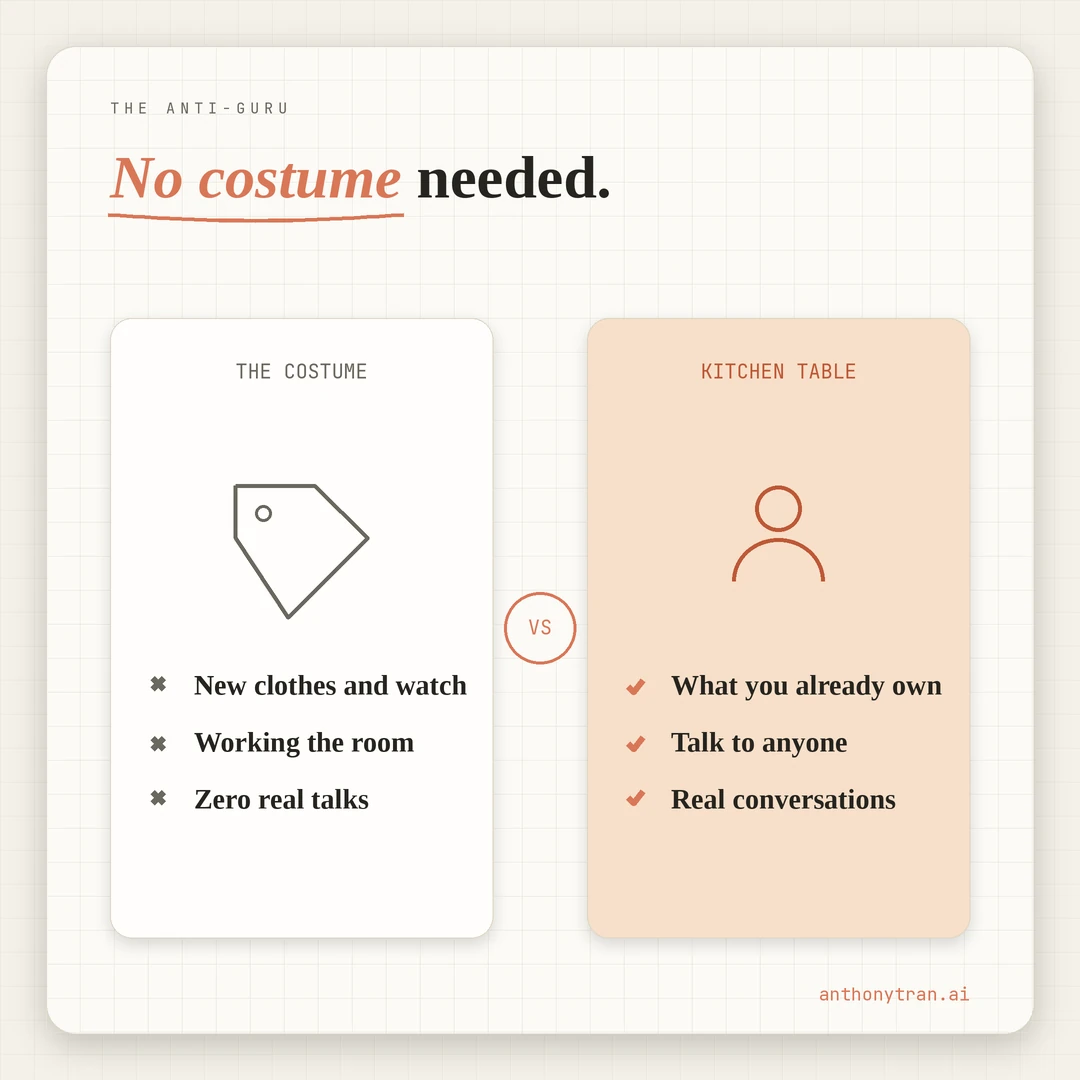
If I went back to that 2013 conference today, I would not buy new clothes for it. I would show up in what I already own.
I would not work the room. I would talk to whoever sat next to me at lunch and find out what they were trying to build.
I would leave at the end of the day with two real conversations and zero business cards.
That is the version of me the first build was supposed to be about. I lost it for six years. This time I am keeping it.
~ Anthony
Frequently asked.
What does anti-guru mean for a personal brand?
Anti-guru means refusing to perform success to attract an audience. No rented Lamborghinis. No fake mansions. No inflated income claims. The work and the help come first. The numbers come after, if they come at all.
Can you build an authentic personal brand without being flashy?
Yes, and the most respected personal brands work that way. Tony Robbins and Dave Ramsey built real authority by helping millions of people over decades. The numbers followed the service. The service did not follow the numbers.
Why is performing success bad for a personal brand?
Performing drains your real voice. The audience that would have connected with the actual you cannot find you under the costume. You also cannot keep performing forever. Burnout is built into that model.
Stop re-explaining yourself to Claude.
Grab the free AI Starter Kit: my exact Claude setup, so it knows your business. Plus the lessons as they land.
Anthony Tran
13 years in marketing and an Air Force veteran. I use Claude every day to market and grow my own business, and I break down what works in plain English. Writing and recording from Arizona.