
Your audience is not somewhere out there waiting to be discovered. Your audience is essentially you, working through the same problem you are right now. The avatar exercise most personal brand advice prescribes is the long way around the mirror.
Why the avatar exercise wastes your first year
If you read most personal brand advice, the first job is to research your audience. Build a persona.
Name them. Picture their kitchen.
Map their pain points. Write a one-page document about a fictional person you have never met.
Most personal brands spend months in that exercise and produce content that nobody connects with. The persona is too generic.
The problems are too abstract. The voice sounds like a marketer talking at a wall.
The shorter path is the mirror.
Your audience is essentially you, working through the same problem you are right now. If you are a few steps further along than you were last year, then someone else is at the stage you used to be at.
That person is your reader. You do not need to imagine them.
You can describe them in detail because you were them six months ago.
Stop inventing your audience. Remember them. They are you, six months ago, trying to solve the thing you are finally starting to understand.
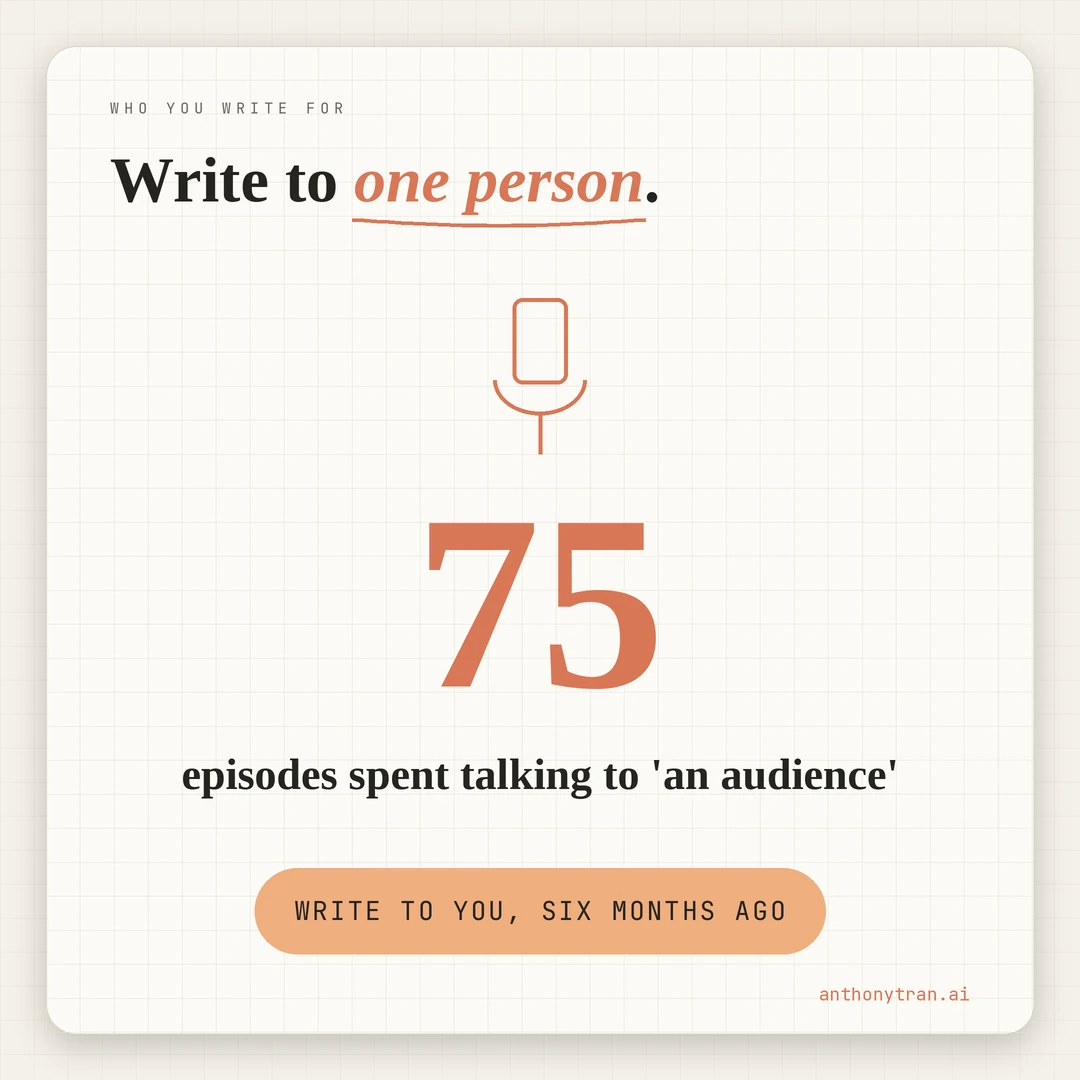
The 75 episodes I lost to talking to no one
The first time I built a personal brand, I started a podcast about digital marketing. The plan was to talk to “the audience.
Small business owners. Solopreneurs.
Anyone interested in marketing. I picked topics I found interesting and recorded them.
I made it 75 episodes before I noticed the pattern. People were listening.
The numbers were respectable. Listeners emailed in.
The show was working at a real level. But it was not growing the way I saw other podcasters at the same stage growing.
I had figured the gap was about consistency, production, or some marketing tactic I had not learned yet. It was not.
The gap was that I was talking to “the audience” instead of one specific person.
The lesson was simple in retrospect. If you talk to everyone, you talk to no one.
I had heard the line a hundred times during those 75 episodes. I never internalized it because I was too busy trying to sound like a marketer.
What I should have done was write to one specific person, by name, with a specific problem they were trying to solve this week. The closest person I knew that fit was me, two years earlier, when I was the one trying to figure out digital marketing for the first time.
I did not see it then. I see it now.
The audience-is-you reframe
This brand is built on the audience-is-you reframe directly. The reader I am picturing while I write this is not a fictional persona. It is essentially the version of myself working through the same problem I am working through, just one stage behind.
I am 45. I have a full life and a packed week.
I am rebuilding a personal brand using AI. I am building it late at night, after the workday is done, because that is the only time I have.
Every pain point I write about is one I am personally experiencing this month.
If you are also building a personal brand on the side in your 40s, you are essentially in the same chair. The post you are reading was written from inside your problem, not about it. That is why it lands different than the avatar-driven content you have probably been bouncing off of for months.
Your version of the same move is to ask yourself who you were six months ago, what you almost have figured out, and who else is in that earlier seat. Write to that person.
By the time the answer is fully clear to you, the same answer is fully clear to thousands of others, and you have lost the timing window. The work is most useful while you are still in the middle of it.
Why writing for yourself works
Three reasons.
The empathy is real because you are not performing it. You actually remember being stuck on the same step.
You can name the specific pain because you felt it. Avatar-driven empathy almost always reads thin because you have to imagine the feeling instead of recall it.
The content is specific because the problem is specific. Generic advice comes from generic personas.
When you write to one named version of yourself, the post answers one named question. Specificity is what separates a piece of content from a search-engine result.
The voice sounds natural because you are essentially talking to yourself. There is no translation step.
No “how do I make this sound relatable to someone in their 30s. You write the way you talk because the reader IS you.
Same vocabulary. Same references. Same shorthand.
These three are easy to underestimate from the outside. They compound on the page.
Put this into practice
If you are not sure who you are writing for, run this audit. Ten minutes, any AI you trust.
I am trying to figure out who I am writing for. Walk me through these questions one at a time and wait for my answer:
- What problem are you actively working on right now in your own work or life?
- What did you not know about that problem six months ago that you wish someone had told you then?
- Who else is at the same stage you used to be in, working on the same problem, and would benefit from what you have figured out?
- Write a paragraph addressed to that person. Use “you.” Be specific.
After all four, give me an honest read on whether the audience I just described is essentially me, six months back.
The point is not to land on a clever persona. The point is to notice that the persona you are searching for has been sitting in your chair the whole time.
For me, when I ran my own version of this exercise during the niche work for this rebuild, the answer kept narrowing to “me, today, age 45, building a personal brand late at night.” The exercise produced a description of myself in the present tense. That is the audience.
Your version may produce a different person. Most likely you, six or twelve months back, working on a problem you have almost solved.
The exercise is the same. The answer is yours.
The mirror was always the better tool
The avatar-research industry exists because it is easier to sell a worksheet than to suggest a mirror. The mirror is free. The mirror also requires you to be honest about what you are actually working on, which is uncomfortable.
If you have been spending months on persona research and not writing, drop the worksheet. Open a blank doc.
Write one paragraph to the version of yourself who needed help six months ago. Send it.
The audience you have been looking for is the one already reading.
~ Anthony
Frequently asked.
How do you find your audience for a personal brand?
The shortest path is to look in the mirror. If you are working through a problem right now and almost have the answer, your audience is the version of yourself that needed this help. Write to that person. Specifically. The avatar work most personal brand advice prescribes is usually a longer route to the same place.
What is the talking-to-no-one problem in content creation?
Talking to no one is what happens when you talk about topics instead of one specific person's problem. The content can be technically correct and still fail to connect because there is no human on the other end. If you talk to everyone, you talk to no one.
Why does writing for yourself work better than writing for an avatar?
Three reasons. The empathy is real because you are not faking it. The content is specific because the problem is specific. The voice sounds natural because you are essentially talking to yourself. Built-in honesty across all three.
Stop re-explaining yourself to Claude.
Grab the free AI Starter Kit: my exact Claude setup, so it knows your business. Plus the lessons as they land.
Anthony Tran
13 years in marketing and an Air Force veteran. I use Claude every day to market and grow my own business, and I break down what works in plain English. Writing and recording from Arizona.