
When an AI draft feels off, the fix is not a better prompt. It is a better diagnosis. Here is the drill-down I now use to find the rule the draft is actually breaking.
Why do most AI drafts feel off but still get shipped?
If you are writing with AI, you have probably hit this wall. The draft is close.
The bones are there. But something about the way it reads feels off, and you cannot quite name what.
Most of us do one of two things here. We ship it because the deadline is louder than the discomfort. Or we scrap the whole thing and start over, hoping the next draft will land cleaner.
Neither one fixes the actual problem. Shipping makes the gap permanent. Starting over usually produces the same gap in a slightly different shape.
There is a third option. It is the same drill the 5 Whys exercise teaches you to run on your motivation, only you point it at the draft instead.
Ask why it is not working. Then ask why again. By the third or fourth layer, the real problem has a name.
I learned the pattern the hard way. One morning I rewrote the same blog post six times in a row.
Each rewrite felt like progress. Each rewrite still came back with the same “something is off” feeling at the end.
The thing that broke the loop was not a better prompt or a smarter outline. It was asking “what is actually wrong with this draft” again.
And again. And again.
The rules I now use to write every post came out of that one morning. They were sitting under the writing the whole time. I just had to drill far enough down to find them.
The morning I rewrote the same post six times
One Saturday in early May I had a brain dump on the deeper reason behind my personal brand. I wanted to turn it into a post.
The first AI draft came back at about 2,400 words. It walked through my whole career arc, military to corporate to entrepreneurship to today, and stitched the lesson at the end.
On paper it looked fine. When I read it out loud, the sentences felt choppy.
The post read like a biography somebody asked an AI to summarize.
So I asked why it felt off.
The answer was two things. The sentences were trying to sound punchy in a way I do not actually talk. And the post was stacking multiple stories together when it really only needed one.
That gave me draft two. I fixed the rhythm so the sentences breathed, and I dropped the “look at all my jobs” framing. I kept the multi-story walk-through.
Draft two felt better. It still felt off.
So I asked why again.
The answer was deeper this time. Even with the rhythm fixed, the post was still trying to do too much in one piece.
The career tour was not actually serving the lesson. I just liked it because it was thorough.
That gave me draft three. I cut the career arc entirely and anchored the post on one scene.
An arcade machine I had bought during my burnout years that ended up sitting in a box because I had nothing left in the tank to enjoy it. A strong scene. Visual, sensory, real.
Draft three felt close. It still felt off.
I asked why again.
The structure was wrong. The post opened with the scene, and the reader had to wait until the second half to understand why they should care.
For a story-driven origin post, that works. For a teaching post about the deeper reason behind your work, that does not.
The reader needs to know what they are going to get before you walk them through your evidence.
That gave me draft four. I flipped the opening to start with the reader, planted the lesson in the first paragraph, and used the arcade scene as the proof. I also dropped in a thought experiment about the end of life, the kind of thing that focuses your attention on what really matters.
Draft four was tighter. It still felt off.
I asked why.
It was the title. The working title was “I thought I wanted fame.
I wanted freedom. It was a good-sounding phrase.
The body of the post barely mentioned fame at all. The title was gesturing at a frame the post never delivered.
That gave me draft five. I changed the title to “I thought I wanted financial freedom.
I wanted time with my family. Closer match. I kept the arcade scene in the body.
Draft five was almost there. It still felt off.
I asked why one more time.
The scene was the problem. The arcade machine was vivid and real, but it was not doing the work of the post.
The post was about the exercise that helped me drill past my surface answer for why I am building this. The arcade was set dressing.
The actual story was the drill-down itself. I was holding onto the scene because it was good, not because it served.
That gave me draft six. I dropped the arcade machine entirely.
The five layers of “why am I building this,” walking from financial freedom out to time with my family, became the actual scene of the post. The walk-through itself was the story.
Draft six was the one. About 1,270 words.
Slug renamed. Share preview regenerated. Published.
Six rewrites. One morning. One post.
Each rewrite revealed a rule that was already there
This is the part I missed the first time, and the piece I most want you to take away.
Each rewrite revealed a specific rule the draft was breaking. I did not invent the rules during the rewrites. They were sitting under the writing the whole time, waiting for me to ask why one more time.
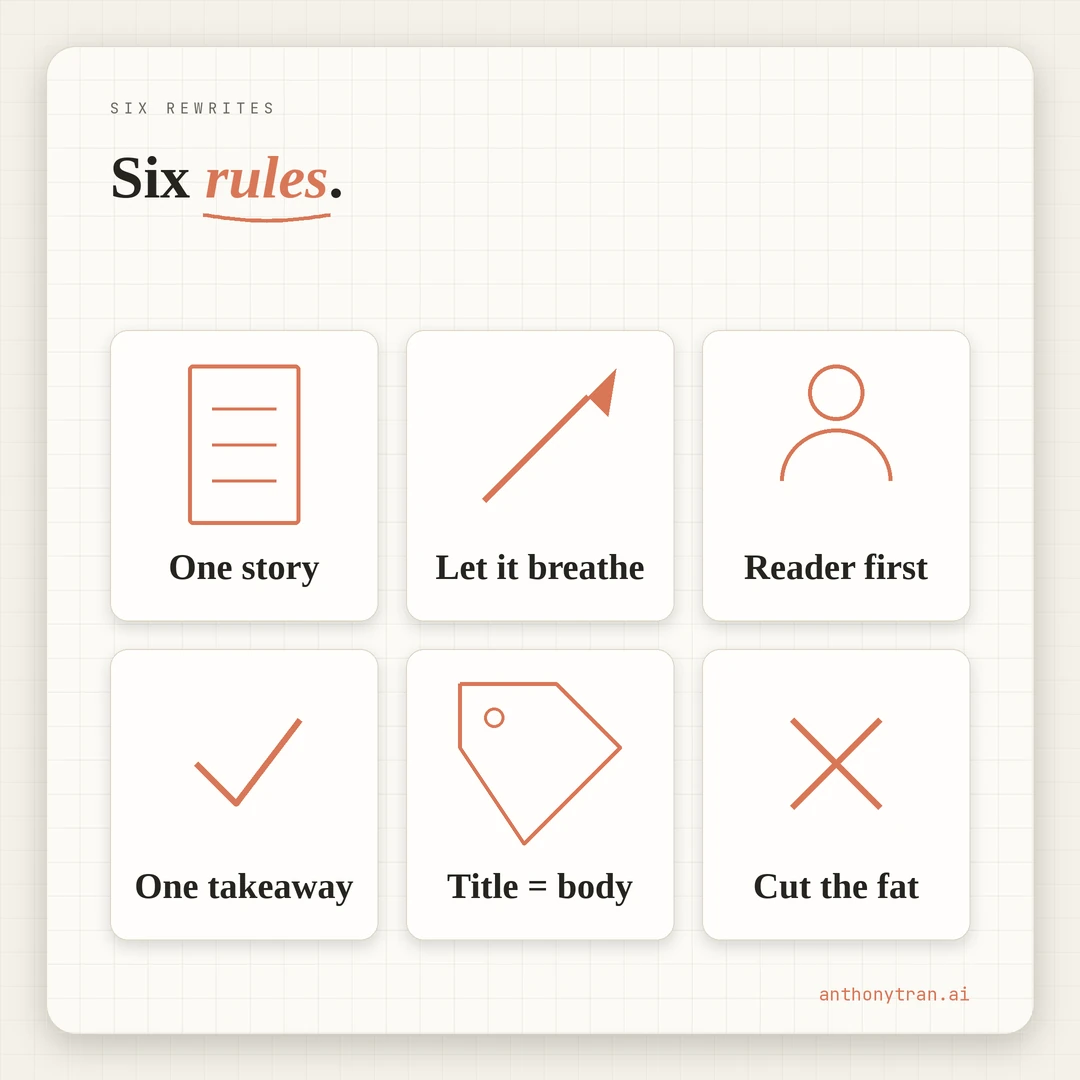
Draft one taught me to pick one story per post, not five.
Draft two taught me that the first draft should breathe, not bark.
Draft three taught me to open with the reader, not the scene, when the post is a teaching piece.
Draft four taught me that every post needs one message, one story, and one takeaway. No more.
Draft five taught me that the title and the URL have to match what the post actually delivers.
Draft six taught me that every scene in a post has to directly serve the message. If it does not, drop it.
Six rewrites. Six rules. Each one obvious in hindsight, none of them visible at the start.
This is the pattern I want you to steal. When a draft feels off, the fix is not a better prompt. The fix is a deeper question.
“What is wrong with this” gets you the surface answer.
“Why is that wrong” gets you one layer down.
“Why does that matter” gets you the real fix.
Most of us stop at the first question because the first answer sounds responsible enough. Choppy rhythm, boring opener, weak title. The first answer is almost always a placeholder for the real problem sitting one or two layers below.
The pattern is the same one the 5 Whys exercise teaches you to run on your motivation. Same drill, different surface. Run it on a draft instead of a why, and the same kind of buried answer comes up.
Why this matters more when you are writing with AI
Without AI, the draft at least comes from your own instincts. The mistakes are easier to trace because they are yours.
The voice is yours. The structure is yours. The problems are yours.
With AI, the draft comes out of a tool. The voice is partly yours and partly the model’s.
The structure is partly your prompt and partly the model’s defaults. When something feels off, you do not always know which part is the source.
That makes the drill-down even more important. You cannot only trust your gut to find the problem, because the problem is sitting in someone else’s hands as much as yours. You have to actually ask the question.
The good news is that asking the question forces the model to surface what it was doing. “Why does this paragraph feel like it is wearing someone else’s voice” produces a different answer than “make this better.
The first one asks the model to name the failure mode. The second one asks the model to guess at a fix.
Name the failure first. Then fix it.
Put This Into Practice
Here is the prompt I now use when a draft feels off and I cannot name why. Paste it into Claude or ChatGPT after you have an AI draft you are not happy with. Walk through it one layer at a time, the same way you would walk through the 5 Whys exercise on your motivation.
I just drafted a blog post with AI and something about it feels off. Do not rewrite the draft yet. First, help me diagnose what is actually wrong. Ask me these questions one at a time, and wait for my answer before moving to the next.
Here is the draft:
[paste draft here]
In one sentence, what feels off about this draft?
After I answer, ask why that bothers me. Have me name the specific cost of that problem. For example, “the sentences sound choppy” becomes “it reads like a robot, not me.”
Then ask why that is happening in this draft. What in the structure, the opening, the story, the title, or the takeaway is producing that effect?
Then ask what rule I have been breaking. Name it as a rule I could write down and apply to future drafts.
Then ask what the smallest change would be that fixes this draft right now.
After five layers, summarize the rule I just surfaced and the smallest useful fix. Then ask me whether the new draft, with the fix applied, would still feel off, or whether the new feeling is good enough to ship.
Run it once. If the new draft still feels off, run it again on the new feeling.
Most drafts need one or two passes. Some need six. The pattern is the same.
What you walk away with is not just a better version of the current draft. You walk away with a rule you can carry into the next draft.
That is the real prize. The post in front of you is the example. The rule is the asset.
Ask why before you scrap it
If you are writing with AI and a draft feels off, you have a choice. Ship it.
Scrap it. Or drill down on what is actually wrong and pull the rule out of it.
The third option is slower in the moment. It is cheaper across a year of writing, because the rule travels with you.
Every draft after the one you fixed is one rule sharper. Six rewrites is a high price for one post.
Six rewrites that produce a permanent framework for every post after that is a bargain.
The foundation that holds my personal brand together came out of mornings like this one. The system I use to write every post with AI did too. Each of them is the residue of a draft that felt off, then got drilled on, then gave up the rule that had been hiding underneath.
Ask why. Then ask why again.
Keep going until the answer is uncomfortable. That is the layer you came for.
~ Anthony
Frequently asked.
How do you fix an AI draft that feels off but you cannot name why?
Drill down on the off feeling with three or four why questions. Start with what feels off. Ask why that bothers you. Ask why that is happening in the draft. Ask what rule you have been breaking. The real fix is almost always sitting two or three layers below the first answer you gave.
Why do AI writing drafts feel off even after multiple prompts?
Because the voice and the structure are partly yours and partly the model's. When something feels off, you cannot always tell which side is the source. A better prompt does not help if you have not named the failure mode. Naming the failure first, then asking for a fix, produces better drafts than asking for a generic rewrite.
How many rewrites does a blog post actually need?
Until each rewrite stops revealing a new rule. Most drafts need one or two passes. Some need six. The signal that you are done is when the next rewrite would just be reshuffling the same words, not surfacing a new failure mode.
Stop re-explaining yourself to Claude.
Grab the free AI Starter Kit: my exact Claude setup, so it knows your business. Plus the lessons as they land.
Anthony Tran
13 years in marketing and an Air Force veteran. I use Claude every day to market and grow my own business, and I break down what works in plain English. Writing and recording from Arizona.