
Most personal brand operators wait until they have an affiliate link before they write the disclaimer page. I wrote mine on day one, with no links live, no products, no subscribers, and a full plain-English page already linked from every footer.
The page nobody clicks but every reader notices
If you are building a personal brand site, the disclaimer page is one of those quiet pages most operators avoid until something forces the issue. The first affiliate link goes live.
The first sponsored post. The first reader question that touches a legal or medical line.
By the time you sit down to write the page, you are already running behind it.
I went the other way. The site shipped with a full disclaimer page on day one. It sat there, written around FTC disclosure principles, linked from every footer, with nothing yet to disclose.
That sounds like overkill. It was not. The page was doing real work from the moment the site went up, and most of the work had nothing to do with paperwork.
The day I built the page that nothing was pointing at
The site went from a single-page prototype to nine pages in one weekend. A few of the pages were obvious: home, about, blog, resources, contact.
The five-page minimum I argue for in the methodology post accounts for those. The other four were operational: subscribe, thank-you, privacy, disclaimer.
None of them are sexy. All of them are infrastructure.
I built the disclaimer page from scratch that afternoon. Plain English.
Sticky table of contents on the left so a reader could jump straight to the section they cared about. Sections for educational use, what I am not (lawyer, CPA, doctor, financial advisor), how affiliate links work, how testimonials should be read, sponsorship labeling, external links, results, accuracy, and a contact line.
An amber callout at the top with a short version for anyone who did not want to read the full page. Sheet code A-98. The legal sheet number on the blueprint.
Then I added the link to every footer. The privacy and disclaimer links live in the same row at the bottom of every page, every post, every CTA page. A reader can find the disclaimer from any page on the site with one click.
I had nothing yet to disclose. I built the page anyway.
Why the page is a trust signal, not paperwork
Most personal brand operators treat legal pages like a tax. Necessary, defensive, written when forced, glanced at and forgotten.
The frame leads to the same wrong-direction logic that produces empty Speaking pages and empty Books pages on a brand new site. You wait for the trigger.
You write under pressure. You miss things.
The disclaimer is different from a Speaking page. A Speaking page advertises what you have done.
The disclaimer advertises how you operate.
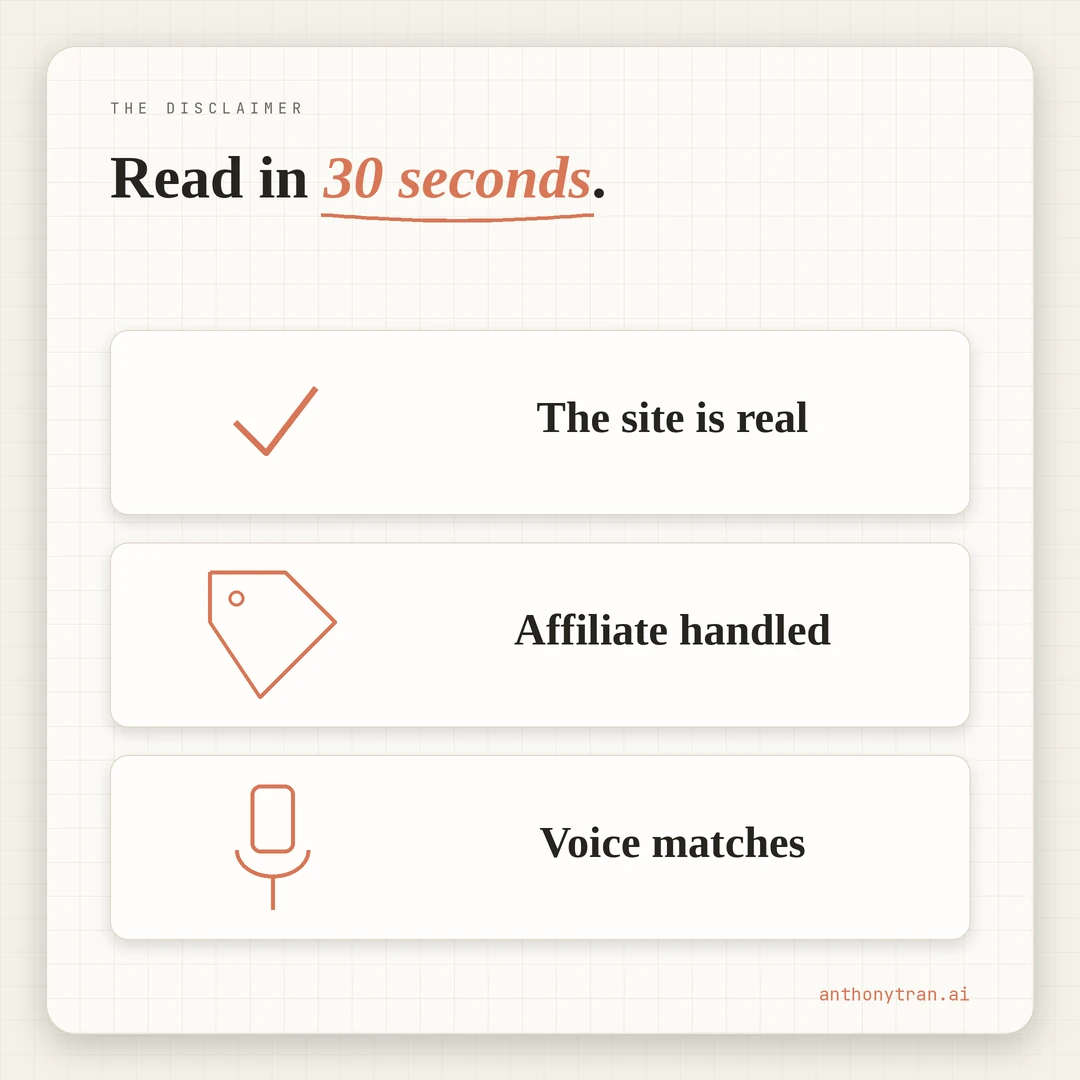
A reader who scrolls to the footer and clicks through to a clean, plain-English disclaimer learns three things in about thirty seconds:
The site is real, not a content farm. The operator has thought through how affiliate links and sponsorships will work before they show up. The voice on the disclaimer page sounds like the voice on the rest of the site, which means the personal brand is consistent.
That is more trust earned per square foot than most pages on the site can match, and it is earned passively. The disclaimer does not ask for anything, does not pop up, and does not nag.
It sits in the footer and waits for the rare reader who looks for it. When that reader finds it, the page does its job.
What does a plain-English disclaimer page cover?
The page is not legal advice for the writer or the reader. It is a plain explanation of the standing policy of the site. Mine covers ten short sections:
- Educational only. Everything on the site is for learning what the operator is doing, not professional guidance.
- Not a professional. Specific limits: not legal, financial, medical, mental health, or career advice. Each line names which professional to consult instead.
- Affiliate links. How they work, that the visitor pays the same price either way, how the operator labels them, and a reference to the FTC’s endorsement guides.
- Testimonials and examples. Single-person experiences, not promises of reader results.
- Sponsorships and paid partnerships. Will be labeled clearly when they appear.
- External links. Linked sites are out of the operator’s control.
- Your results. No guarantees. Reader’s own work, audience, timing.
- Accuracy. What gets fact-checked, what to do if a reader spots an error.
- Changes. Last-updated date at the top, material changes flagged in the newsletter.
- Contact. A working email and a contact page link.
Plain English. No legalese. The amber short-version callout at the top covers the same ground in two sentences for the reader who does not want the long version.
Why writing it early is the cheap version
The expensive version of this page is the one written in retrospect. You added affiliate links to a few posts last quarter.
You did not have a disclaimer page. A reader noticed, or a comment thread surfaced, or you read up on FTC endorsement guides and realized your existing posts needed disclosures inline near each affiliate link, and that the site itself needed a standing policy in one findable place.
Now you are writing the page under pressure, with already-published posts that need to be updated, with the energy of catching up rather than getting ahead.
Day one is the cheap version. There is no pressure.
There is no money on the table yet. The page can be written with care, with the right voice, with sections you have actually thought through.
Then the link sits in every footer from launch and the page is doing its quiet trust work the whole time you are writing the rest of the site.
The same logic applies to the privacy page, to the contact page, and to the basic FTC affiliate language inside individual posts that ever link to a tool. Wire it in early, while the cost is low.
Put This Into Practice
If you are building a personal brand site, paste this into Claude or ChatGPT. The point of the prompt is to draft a usable plain-English disclaimer page that fits your situation, without you having to read through a wall of legal templates first.
This is not a substitute for legal advice. It is a way to get your operating policy out of your head and onto the site.
Help me draft a plain-English disclaimer page for my personal brand website. I have not added affiliate links or sponsorships yet, but I plan to in the future. I want the page to read like a human wrote it, not a lawyer. Walk me through these questions one at a time and wait for my answer before moving to the next:
- What kind of content will live on your site? Blog posts, videos, newsletters, downloads, courses, anything else.
- What are you NOT a professional in? List every category where readers might mistake your content for advice (legal, financial, medical, mental health, career, other).
- Do you plan to use affiliate links eventually? If yes, how will you label them in posts (inline note, top-of-post callout, both)?
- Do you plan to accept sponsorships or paid partnerships? If yes, how will you label them?
- How should readers contact you with questions or corrections?
After I answer all five, draft a plain-English disclaimer page with these sections: short-version callout, educational only, not a professional, affiliate links (with FTC reference), testimonials and examples, sponsorships, external links, results, accuracy, changes, contact. Keep the voice human. No legalese. Reference the FTC endorsement guides at https://www.ftc.gov/business-guidance/resources/ftcs-endorsement-guides-what-people-are-asking. End with a “last updated” date placeholder.
Then list three concrete next steps: where to put the link in my site footer, how to label affiliate links inside individual posts, and how often to update the page.
The prompt produces a draft, not a finished page. Read it carefully.
If your situation has anything unusual (you are a licensed professional, you sell physical products, you operate in a regulated industry), your real disclaimer needs more than this prompt covers. For most personal brand operators sharing what they are learning, the prompt gets you most of the way there.
The page that pays its rent
A personal brand site is a living document. Every page on it should be earning its place in the layout.
Most operators look at the disclaimer page and assume it is dead weight, only worth writing when the lawyers force the issue. That frame misses the work the page is actually doing.
The disclaimer is a quiet trust signal. The reader who scrolls to it and reads it learns more about how the personal brand operates in thirty seconds than three paragraphs of about-page copy could deliver. And the page is doing that work passively, from launch, whether the operator has anything to disclose yet or not.
Build it on day one. Link it from every footer.
Update the date when policy changes. The page pays its rent the whole way.
Come build with me.
~ Anthony
Frequently asked.
Do I need a disclaimer page on my personal brand website?
Yes. If you ever plan to use affiliate links, accept sponsorships, share testimonials, or write about tools you use, the FTC expects clear disclosure. A plain-English disclaimer page covers the standing policy in one place. Visitors can find it from the footer, and every blog post can point to it in one short line instead of repeating the full disclosure.
When should I write the disclaimer page for my personal brand site?
Day one. Before you have an affiliate link, before you have a product, before you have a sponsorship. Writing it early is cheap insurance, lines up with FTC disclosure principles, and signals to the reader that the site is taking the work seriously. Adding it later, after you have already linked or accepted money, is the harder version.
What should a personal brand disclaimer page include?
Plain-English coverage of: the educational nature of the content, the limits of your expertise (not legal, financial, medical, or professional advice), how affiliate links work, how testimonials and examples should be read, sponsorship labeling, external link policy, results expectations, and how to contact you. Reference the FTC endorsement guides for affiliate sections. Date the last update.
Stop re-explaining yourself to Claude.
Grab the free AI Starter Kit: my exact Claude setup, so it knows your business. Plus the lessons as they land.
Anthony Tran
13 years in marketing and an Air Force veteran. I use Claude every day to market and grow my own business, and I break down what works in plain English. Writing and recording from Arizona.