I have a closet full of social proof from 13 years of work. I am keeping all of it off this new personal brand on purpose. At zero trust, the work I am doing right now does what credentials cannot.
The closet full of social proof I am not putting on the page
Since 2013, I have done a lot of public work.
Podcast episodes, guest appearances on other people’s podcasts, speaking at conferences, workshops and group talks, virtual summits, features in publications, a YouTube channel, a web design agency strong enough that my wife Linh left her corporate job to run it with me, hundreds of client projects, testimonials, a marketing role at a tech startup along the way.
That is the menu of social proof I could put on my About page tomorrow morning. Logos across the hero, a featured-in strip below the fold, a testimonial carousel halfway down, a speaker reel on the side.
I am not putting any of it on this site.
The reader is here for a reason. They are starting a personal brand from scratch.
Most of them do not have logos to put on a hero strip. Most of them have never been featured anywhere.
The minute I lead with mine, the gap opens. They are below me on the page before they have read a word of what I actually do.
That gap is the whole problem.
Why credentials slide off when nobody knows you yet
At zero trust, claims do not move the reader. Proof does.
By zero trust I mean the moment before a stranger has any reason to believe you. They do not know your name, your work, or your taste yet. Every claim on the page lives behind a small wall of skepticism.
The reader is skeptical for good reason. They know how easy it is to put a “featured in” strip on any site.
They know how cheap testimonials are. They know what a self-promotional page looks like.
What they cannot wave away is watching someone work in real time.
Real posts, real decisions, real mistakes, real revisions. A blog where the back catalog shows the operator figuring it out as they go.
That kind of proof moves the meter because it cannot be assembled in a weekend. I wrote about this last year as the broader why behind showing the work.
This post is the specific version of that thesis: at zero trust, your past wins cannot do the job your current work has to do.
Now the counter to that. Sure, but you have years of background.
You are choosing not to show it. That is easier than starting from real zero.
True. I do have the background.
Credentials are not the problem. They are just the wrong first move for the relationship I am trying to build here.
I also know that the moment I put the highlight reel on the page, the reader watching me figure this out turns into the audience watching me show off. Same content.
Different relationship. The honest call is to leave the menu in the closet.
The relatable everyman beats the trainer
The clearest proof of this mechanic is the one I keep seeing on Instagram.
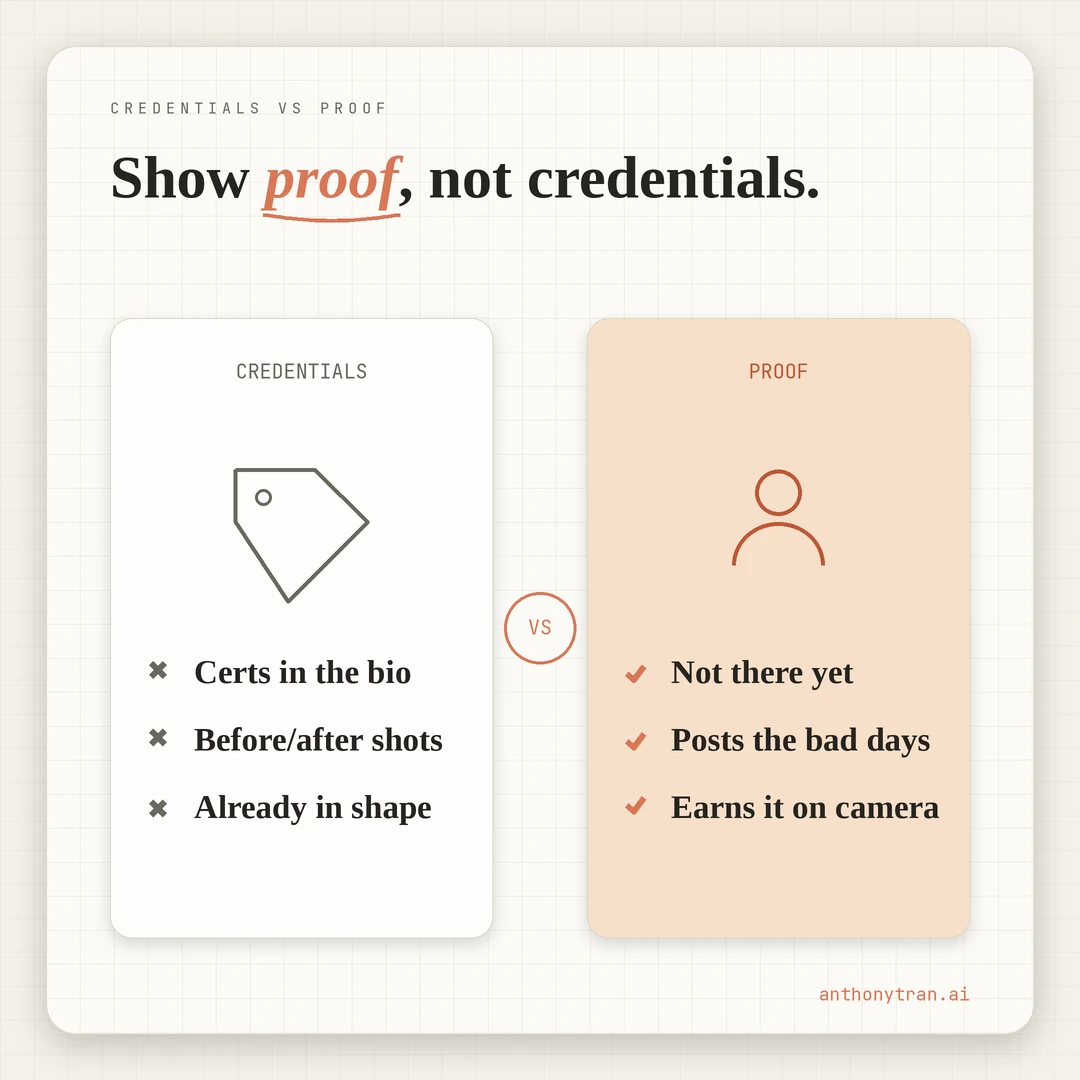
Two accounts try to teach the same thing. Account A is a personal trainer with a physique, certifications across the bio, before-and-after client photos in the highlight reel.
Account B is a regular person who is not in the shape they want to be. Account B posts every morning about bad meal days, good walk days, forgetting to drink water, trying a new recipe. The progress is slow.
After ninety days, six months, a year, Account B has the outcome on their grid. They earned it on camera. Strangers found Account B because they could see themselves in the early posts.
Account A had the credentials. Account B had the proof.
The reader of a new personal brand is not looking for an expert with a physique. They are looking for someone a few steps ahead who is willing to share what is working and what is not.
The trainer is a thousand steps ahead and cannot remember what it is like to start. The everyman can. That memory is the connection.
For me, “a few steps ahead” is the only role that works for a personal brand at zero trust. For you it might be the same role, or it might be something different.
Whatever the role is, the proof you have right now is the work you are doing right now. That is the part the reader will trust.
What can you put on the page if you do not have credentials?
The catch-up arc you are reading is the proof bank.
Every post is a decision made in real time: the website rewrites, the voice rules I had to learn, the drafts I killed, the platform list I cut from nine to three, the mistakes I caught, the frame shifts I lived through. Each piece is a record of the work, not a record of the wins.
This is the part I would have hidden the first time I built a personal brand. Back then the polished version was the goal and the rewrites were the embarrassment. This time the rewrites are the offer.
If you are starting a new personal brand and you do not have years of background behind you, the same offer is available to you. Whatever you are building this week is your proof.
The decision you are weighing right now is your proof. The post you wrote and then completely rewrote because it did not land is your proof. Put it on the page.
The reader is not waiting for you to be impressive. They are waiting for you to be honest about where you are.
Austin Kleon wrote a whole book on this called Show Your Work and it has aged perfectly into the AI era. Show what you are doing.
Share what you are learning. The work itself is the trust.
Put This Into Practice
Open Claude, ChatGPT, or any AI tool and paste this in.
I am building a new personal brand from zero and I want to figure out what proof I can actually put on my site right now, without leaning on past credentials. Walk me through these questions one at a time and wait for my answer before moving on:
- What did you work on this past week for your personal brand? Describe the specific thing you built, wrote, or decided.
- What is one decision you are weighing right now and not sure about?
- What is one mistake you caught and corrected in the past month?
After I answer all three, turn each answer into a short post idea that shows the work in real time. Each post should include one specific lesson someone else can use, and pass this test: does it help the reader save time, save money, make money, or make things easier?
You will end with three post ideas in front of you that came from this week’s real work. That is the proof bank starting to fill up.
A few steps ahead, not a few miles
The person on Instagram who never had the physique is the one I trust to help me try. Not because they have arrived. Because they are still on the road and they are still telling the truth about the walk.
That is the trust I am trying to earn here. The trust that comes from showing the work while the work is still in motion, not the trust that comes from credentials. The whole manifesto behind this rebuild sits on the same idea.
The credentials can stay in the closet.
~ Anthony
Frequently asked.
How do you build trust for a new personal brand with no audience?
Show the work in real time. At zero trust, past credentials cannot do the job because a stranger has no reason to take them at face value. What strangers do trust is watching someone make real decisions, write real posts, and own real mistakes in public. The journey itself becomes the proof.
Should I put my résumé and accomplishments on a new personal brand site?
Only if it serves the reader, not the ego. Leading with past credentials creates a gap between you and a new audience that mostly does not have them. Most new readers are looking for someone a few steps ahead, not a few miles ahead. The relatable operator builds trust faster than the credentialed expert.
What proof can I show if I have not built anything yet?
Whatever you are working on right now is the proof. The decision you are weighing this week. The post you wrote and rewrote. The mistake you caught and fixed. The reader is not waiting for you to be impressive. They are waiting for you to be honest about where you are.
Stop re-explaining yourself to Claude.
Grab the free AI Starter Kit: my exact Claude setup, so it knows your business. Plus the lessons as they land.
Anthony Tran
13 years in marketing and an Air Force veteran. I use Claude every day to market and grow my own business, and I break down what works in plain English. Writing and recording from Arizona.