
I trained for years to fly. Then a medical exam two weeks before flight school took the pilot career off the table forever. The pivot is the part nobody warns you about.
The medical exam two weeks before pilot training
It was 2003. I was 22, ROTC commissioned, and two weeks away from reporting to Undergraduate Pilot Training at Moody Air Force Base in Georgia.
I had spent years pointing at this. I had passed more than twenty eye exams to qualify.
I had paid for PRK laser eye surgery out of pocket using student loan money. I had qualified for the rare program that let post-surgery candidates fly. I had been selected for pilot training.
Everything was set, the bag was packed, the orders were cut.
The last hurdle was the final medical exam at MEPS in San Antonio. It was supposed to be a formality.
I had passed every check before this one. This was the day they signed me off and put me on a plane to Georgia.
There was a test I did not know about. Called the red lens test.
Two red dots that you have to sync into one as you focus. A test of binocular fusion. I could not do it.
The flight surgeon looked at me and said, “I’m not going to put my career on the line for you. You can’t pass this test. I’m going to have to medically disqualify you.”
24 hours to pick a new career path.
What do you do with 24 hours to pick a new career?
I do not remember much about that night. I remember sitting in a hotel room in San Antonio.
I remember the realization that the bag I had packed was not going to Moody. I remember thinking about what I would tell my parents.
I do remember the question that landed in my head before I went to sleep. If you cannot fly the mission, what is the next best thing?
The answer came pretty fast. Plan it.
If I could not be in the cockpit, I wanted to be the person who put together the plan that the cockpit followed. The logistics officer.
The mission planner. The one who figured out where the planes had to be, when, with what fuel, with what backup, with what timing.
The next morning I picked logistics.
The career pivot I did not plan
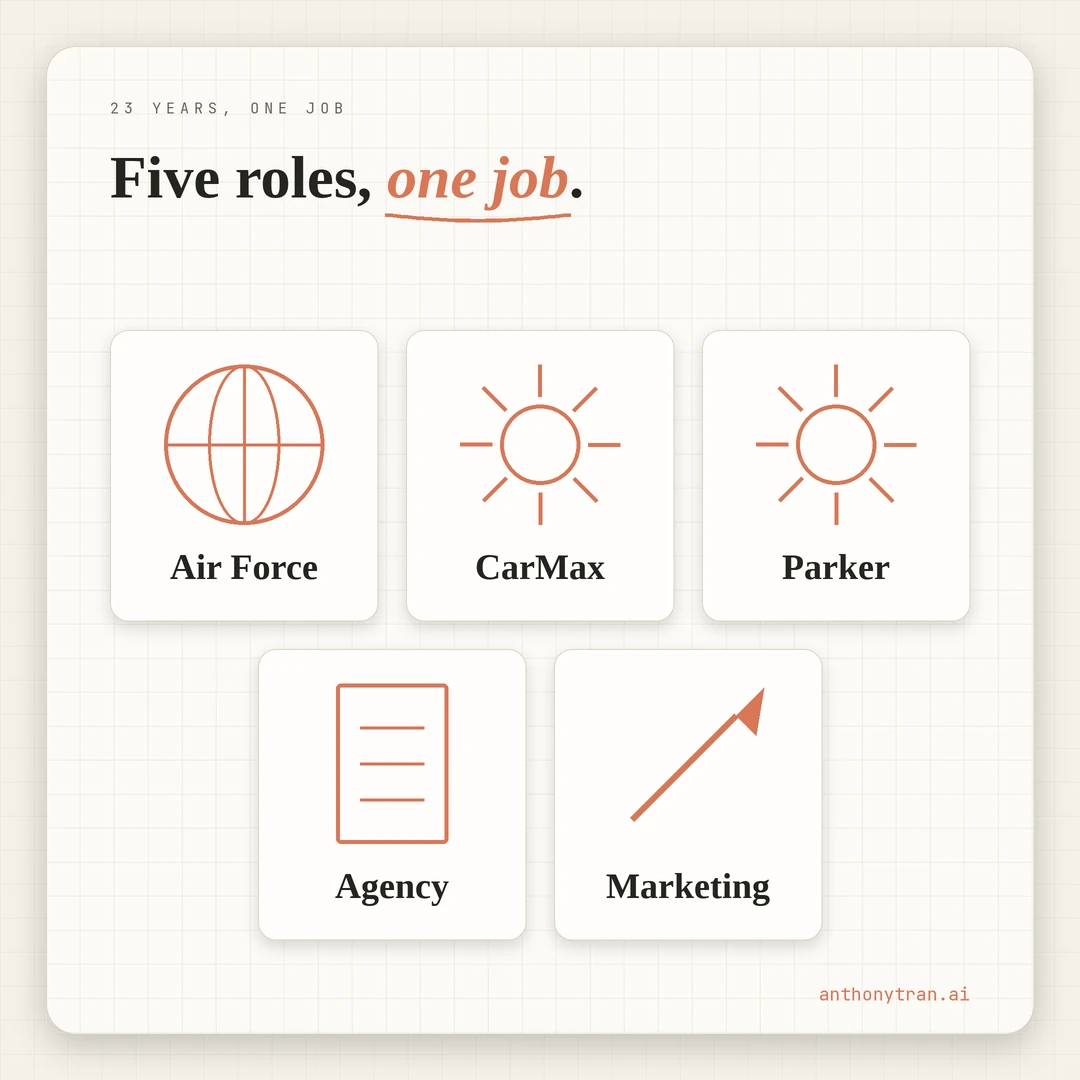
I served as a logistics officer in the Air Force during Operation Iraqi Freedom. Real planning.
Real pressure. Real stakes that had nothing to do with how cool a fighter jet looks at an airshow.
After the Air Force I went to CarMax as an operations manager. Inputs in, processes that had to run on time, outputs out.
Same job. Different uniform.
After CarMax I moved to Parker Aerospace as a senior planner, reviewing material lists and making sure components were ready for the assemblers. Same job. Different uniform.
Then I started a web design agency with my wife. Same job. Different uniform.
Then I went into marketing. Same job. Different uniform.
I did not see the through-line until I was almost 45. Every job I have had since 2003 was the same job.
The job I picked in a hotel room in San Antonio when I had 24 hours to figure it out. Plan the mission.
I never flew the jet, but I learned to plan the mission. The thing I trained for is not the thing I did. The thing I picked when the door closed turned out to be the thing I’ve kept doing for 23 years.
Why the pivot is the actual story
Most people would frame what happened in 2003 as a setback. The dream died two weeks before it started. End of story.
That is not how it played out. The pivot was the actual story, and everything I have built since came from the choice I made in that hotel room, not from the years I spent training for the choice that got taken away.
The training was not wasted either. The discipline, the prep, the years of pointing at one outcome, none of it disappeared.
It re-routed. The mission planning skills I learned as a backup to flying turned into operations work, then agency work, then marketing work, and now into the personal brand I am building right now.
If you are in your 40s and looking back at a career that did not go the way you planned at 22, you are not alone. Most of us did not end up doing what we trained for.
The job we have now was not on the roadmap. The pivot we did not choose became the work we actually do.
For me, the through-line was planning. Architecture. Putting the pieces in the right order so the build holds together.
For you it might be something else entirely. Storytelling, maybe, or selling, or teaching.
The point is not the specific skill. The point is that there is one, and it usually surfaces in the pivots you did not choose, not in the path you planned.
Put This Into Practice
Pull out a piece of paper. Or open a Claude or ChatGPT chat. Walk through your own pivots and look for the through-line you may have missed.
I want to find the through-line in my career. Walk me through these questions one at a time and wait for my answer before moving to the next:
- What did you train for in your early 20s that you did not end up doing?
- What was the pivot? When did the original plan close?
- What did you choose to do instead?
- List the actual skills you used in each job since the pivot. Not the job titles. The skills.
- What skill shows up in every job?
After I answer all five, tell me what the through-line is and how I might use it for the work I am building now.
The exercise takes 15 minutes. The answer might surprise you, the way mine did. I had been doing the same job for 23 years and had not noticed until I sat down and made the list.
If your origin story is part of your personal brand, this is the exercise that surfaces it.
What the pivot actually built
I learned to plan the mission. I never flew the jet. The career I did not pick at 22 turned out to be the career that built every job I have held since.
Yours is in there too. Look at the pivots, not the plan.
~ Anthony
Frequently asked.
What does it mean when your career pivot was not your choice?
An unchosen pivot still counts. The training, the prep, the years pointing at one outcome do not disappear when the original door closes. They re-route into the work you actually end up doing.
How do you find the through-line in a career that took unexpected turns?
List the pivots you did not choose. Look at the skills you trained for, not the job titles you held. The through-line is usually the skill set, not the role.
Why does your origin story matter when building a personal brand?
Your origin story is where the through-line started. Most personal brands skip the origin and pitch the present. The origin is the proof that the present came from somewhere real.
Stop re-explaining yourself to Claude.
Grab the free AI Starter Kit: my exact Claude setup, so it knows your business. Plus the lessons as they land.
Anthony Tran
13 years in marketing and an Air Force veteran. I use Claude every day to market and grow my own business, and I break down what works in plain English. Writing and recording from Arizona.