
Perfectionism fails on a personal brand because the subject is still moving. You are still figuring out who you are. The version you finally call perfect will be locked to who you were the day you locked it. Here is the test I use on anything I keep going back to fix.
The thing you keep going back to fix
There is probably something in your personal brand setup you keep going back to. Maybe it is the headline, the bio, the about page, the welcome email, or the footer. Some piece you have redone three times and still do not trust.
The reason you cannot get it right is probably not time pressure. It is that you are aiming at a moving target. The person your personal brand is supposed to represent is still becoming someone.
You are chasing a person who is still walking.
I want to walk you through how I handled a real one of these, and the test I use now on anything I find myself perfecting.
The email bug I decided not to fix
When I was setting up the ActiveCampaign RSS feed for this site, I hit a real one. Every time the system built an email from a new blog post, the first couple of paragraphs got wrapped in a giant link that pointed back to the original post on my website.
I tried to fix it. I tweaked the settings. I asked Claude to troubleshoot it with me, step by step.
We landed on the same answer. It is a bug in ActiveCampaign’s email builder, and the cost of working around it was higher than the cost of letting it sit.
So I sat with the situation for a minute. The email goes out.
It contains the full post. People read it inside their inbox.
The first paragraphs being clickable is technically wrong, but the reader gets the content. They are not measuring the email against a design spec. They are reading it on their phone over coffee.
I published the imperfect version and moved on.
Personal brand perfectionism is its own thing
Progress over perfection is a phrase I have been rolling my eyes at for years. Every personal brand coach uses it. It usually means stop being so hard on yourself, said by someone selling a course.
But there is a real version of it underneath the cliché, and it shows up specifically when the thing you are trying to perfect is yourself.
When you build a product, the thing you are polishing is at least more stable. A feature has a job.
A customer has an outcome. You can judge whether the product does what it is supposed to do.
A personal brand is different. You are still figuring out who you are.
The bold opinion you hold today might soften in six months when a new client gives you context you did not have before. The story you tell about your career might reframe itself the week after a project changes what you think you are actually good at. The headline you have spent eleven drafts on might feel embarrassingly small the month you take on work that proves you should have aimed higher.
What changes when you accept the moving target
The first thing that changes is your timeline. You stop trying to publish the final version. You start publishing the current version with the understanding that the next version will be different because you will be different.
The second thing is how fast you decide. The choice that took you three weeks of agonizing collapses into thirty minutes once you stop asking is this the right answer and start asking is this the right answer for the person I am right now.
The third thing is your willingness to revisit. The decisions you locked under the perfectionist frame felt permanent.
The decisions you lock under the moving target frame are explicitly temporary. They are load-bearing for now.
You will come back when you have new information about yourself.
This is not lowered standards. It is the right standard for a moving subject.
How do you tell if it is good enough or actually needs more work?
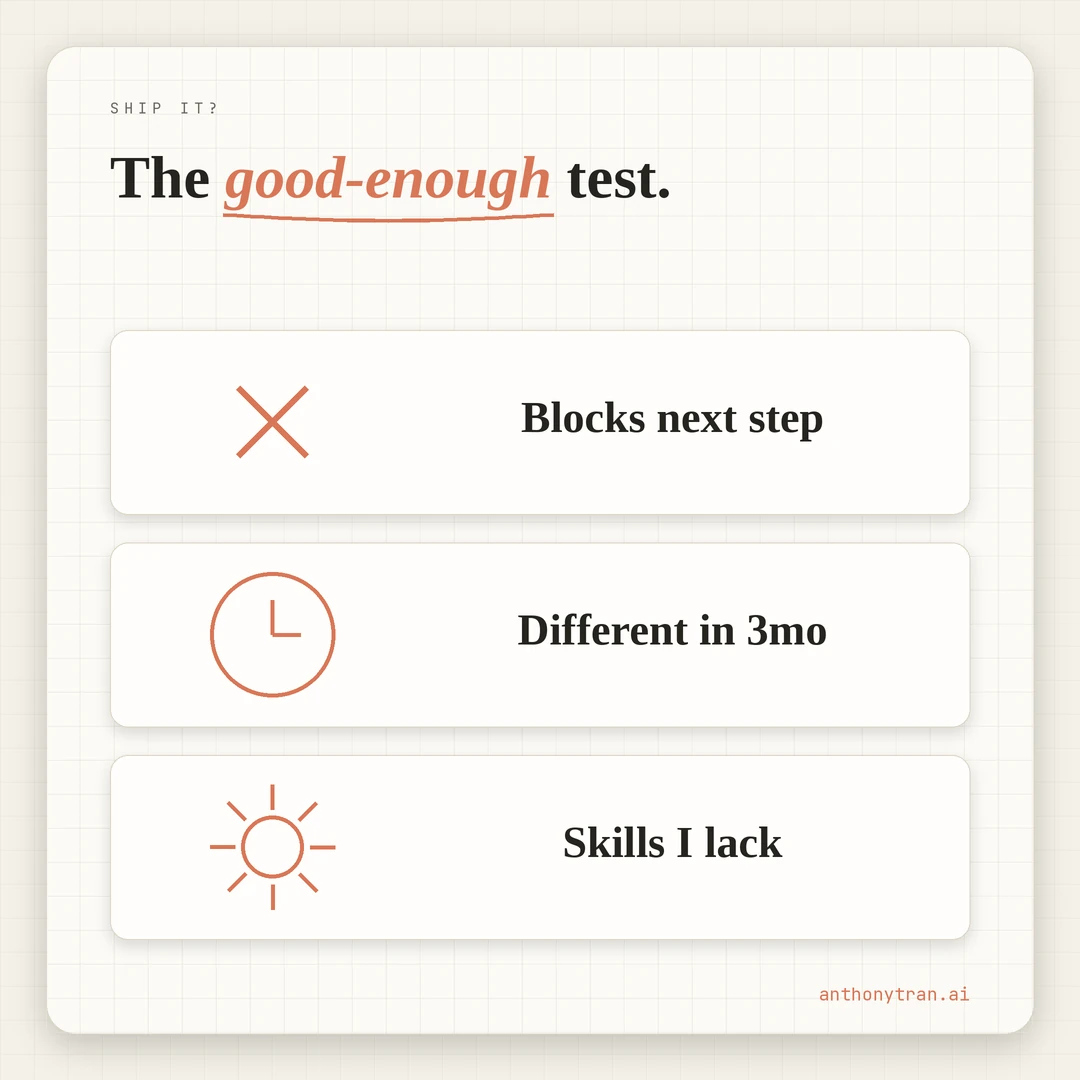
The risk with anything in this neighborhood is that it teaches stop trying when you should still be trying. These questions exist to separate meaningful friction from perfectionist noise, not to excuse sloppy work. I run three of them.
-
Does the imperfection actually block the next step in my work? If yes, it is not good enough. Fix it. If no, the imperfection is cosmetic to your forward motion.
-
Will I likely look at this differently in three months once I know more about myself? If yes, locking in a perfect version now is locking in a version of you that is about to change anyway. Publish the current version and plan to revisit.
-
Does fixing this require expertise I do not have right now? If yes, the cost of fixing it is much higher than the cost of accepting it. Most non-developers running personal brands hit this on technical bugs. The fix is six hours of learning you do not want to do. The acceptance is zero.
Two yeses means call it done. Three yeses means definitely move on. Zero or one yes means it is worth more investment.
The email bug was a three. The bug is cosmetic to the reader.
I am still figuring out my email strategy and the workflow will probably change again. And it is a vendor bug that I am not going to fix.
So I moved on. If you got this post by email, it probably went out with the bug still in it.
Why I am being honest about this
A lot of people only talk about their wins. They never mention the bug they could not fix.
They never mention the headline they hated for two months. They never mention the about page that went live with the wrong opening sentence because they were tired of looking at it.
The honest picture is different. Everyone building a personal brand is making these calls every week.
You hit a bug. You weigh the cost.
You accept the imperfection or you spend the time on the fix. Then you publish something and move on to the next thing.
If you are in the middle of a decision like this right now, this is normal. The doubt is normal. Revisiting the same decision three months from now and choosing differently is normal too.
There is no straight line in this work. You will hit roadblocks.
You will second-guess yourself. You will look back at a decision you were sure about and wonder what you were thinking.
That is the work. The people who succeed at it are not the ones who get every call right. They are the ones who keep showing up and keep adjusting.
Put This Into Practice
If there is something on your personal brand setup you keep going back to fix, run this prompt through Claude or ChatGPT. First name the thing. Then walk through the three diagnostic questions one at a time.
I am building a personal brand and I have something on my setup that I keep going back to fix. I want you to walk me through three diagnostic questions to decide whether it is actually good enough for now or whether it really needs more work. Ask me the questions one at a time and wait for my answer before moving on.
First, ask me to name the specific thing I keep going back to fix, in one sentence.
Then ask these three diagnostic questions one at a time:
Does the imperfection actually block the next step in your work? Tell me what step it blocks, or tell me what you would do next if this was solved.
Will you likely look at this differently in three months once you know more about yourself or your audience? Tell me whether your view of this piece has already shifted once in the last few months.
Does fixing this require expertise you do not have right now? Tell me whether the fix is something you can do in an hour, something you would need to learn for several hours, or something you would have to hire out.
After I answer the three diagnostic questions, count the yeses. Two or three yeses means I should accept the imperfection for now and move on. Zero or one yes means I should invest more time in fixing it. Give me your honest read and a specific next step based on the count.
Run it on the one piece you have gone back to most. The answer should be clear in five minutes.
The work is the iteration
The bug I decided not to fix is still in my email broadcasts today. Every post that goes out from this site has it. The reader gets the full post in their inbox, reads it, and moves on with their day.
I will come back to the bug eventually. Maybe ActiveCampaign will fix it on their end.
Maybe I will find a clean workaround. Maybe I will switch tools entirely as the personal brand evolves and a different email setup makes more sense for the version of me building it then.
The bug matters. It just does not matter more than the work in front of me today.
A future version of me might care enough to fix it. Or might not.
Either way, chasing perfection on something the reader cannot even see is not where my time goes today.
This is the same pattern I hit when I removed myself from my email broadcast by automating the publishing path. It was also the pattern behind publishing 15 posts before I had the perfect email setup.
Different surfaces. Same lesson. The work is the iteration, not the finish line.
A personal brand site is a living document. The person it represents is too.
What are you going back to fix that the reader probably cannot even see?
~ Anthony
Frequently asked.
Why is perfectionism a problem for a personal brand specifically?
A product can be perfected because it does not change while you polish it. A personal brand is about you, and you are still figuring out who you are. The version you call perfect is locked to who you were the day you locked it. The person you are becoming will outgrow it.
How do I know if something on my personal brand is good enough or actually needs more work?
Ask three questions. Does the imperfection block the next step in my work. Will I likely look at this differently in three months once I know more about myself. Does fixing this require expertise I do not have right now. Two yeses means call it done.
Is publishing an imperfect version of a personal brand the same as lowering your standards?
No. It is the right standard for a moving subject. Lowered standards say the work does not matter. Good enough for now says the work matters and will be revisited as you change.
Stop re-explaining yourself to Claude.
Grab the free AI Starter Kit: my exact Claude setup, so it knows your business. Plus the lessons as they land.
Anthony Tran
13 years in marketing and an Air Force veteran. I use Claude every day to market and grow my own business, and I break down what works in plain English. Writing and recording from Arizona.