
I was hunting for an automated email workflow from day one because I knew I would dread the manual version. One early attempt had Claude drafting an email version of each blog post. The writing got faster, but the workflow still ended with me pasting and clicking inside ActiveCampaign every week. The real fix was not a better draft. It was removing every human step after publish.
Half-automation isn’t enough on tasks you don’t enjoy
If you keep saying you will send the email this week and still do not send it, the problem probably is not discipline. It is friction. And if the task is one you do not enjoy already, even a small amount of friction is enough to lose you.
I knew this about myself before I built any of it.
When I started building this brand, I went straight to looking for ways to automate the email side. I have been doing email marketing professionally for years.
I am good at it. I still do not enjoy it.
I knew the manual version would not survive contact with my actual week. So I never tried to live the manual workflow. I went hunting for the automated version from day one.
One thing I tried early was having Claude draft an email version of each blog post. The thinking was that the writing is the slowest part. If the AI shrinks a post into an email in 30 seconds, the workflow becomes “edit and paste” instead of “write the whole thing from scratch.”
It almost looked like an answer.
Then I traced the full path. Write the blog post.
Hand it to Claude. Get a tight email version back.
Tweak a sentence. Open ActiveCampaign.
Paste it in. Format it.
Pick the list. Set the schedule. Hit send.
The AI did the hard part. The writing was no longer the friction. But the workflow still ended with me sitting inside ActiveCampaign every week, in email mode, clicking through the same five steps.
That was the moment I realized the AI step was solving the wrong problem.
Where the friction actually lives
The AI-drafted-email approach would have shrunk the work. It would not have removed me from the work.
I would still have been the one switching from “I just published a blog post” into “now I open ActiveCampaign and do all the email stuff. Even a few minutes in email mode every week is enough to lose me on a task I do not enjoy.
The friction is not the writing. The friction is the entire human step that comes after.
If you have ever tried to make a task you do not enjoy easier with a tool or a template, you may have noticed the same thing. Making the task easier does not mean you will do it. Removing yourself from it does.
Zero clicks after publish, or no consistency
On any recurring task you do not enjoy, half-automation is not enough. You need zero clicks after the trigger event or you will not be consistent.
I would rather send a slightly worse email that fires automatically every time than a slightly better email that I send half the time. Consistency is the actual outcome.
Not polish. Not perfection.
Showing up week after week so people start to recognize the cadence and begin to trust the relationship.
If I can choose between sending a great email 30 percent of the time and sending an okay email 100 percent of the time, I pick the second one. Every time.
What I actually did
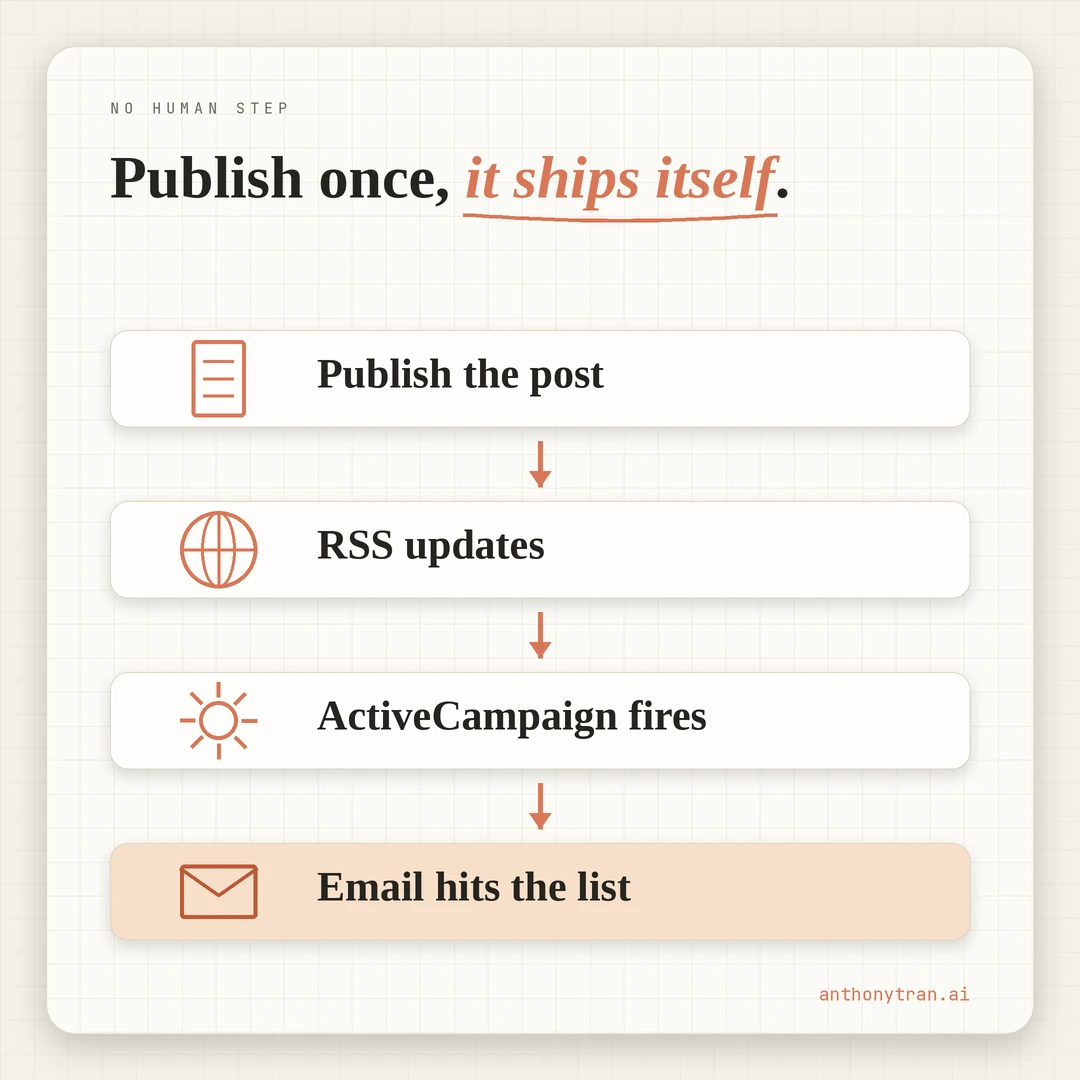
I pointed ActiveCampaign at my blog’s RSS feed.
RSS is an old web format that many blogs still generate automatically. My site puts one at /rss.xml. Every time I publish a new post, the feed updates with the new entry.
ActiveCampaign has an RSS-trigger campaign type. You point it at a feed.
You set a schedule. When new items appear in the feed, ActiveCampaign builds an email from the post content and sends it to the list.
I publish the blog post. The email goes out. I do not touch ActiveCampaign.
The handoff is zero clicks on my end after the blog post is live. That was the goal. Consistency requires that the path from “I finished the work” to “the email is sent” has no human step in the middle.
Honest update: it is not perfect yet
This did not turn into a perfect system overnight. But it did keep the problem in the right category.
There never was a discipline phase to recover from. The problem stayed a fix-it problem the whole way. I would rather solve that kind.
Some posts trigger the email send right on schedule. Others sit in the queue and never fire.
I am still digging into whether the issue is ActiveCampaign’s polling behavior, my feed structure, publish timing, or some combination. There is a separate post coming about a specific bug I hit with the RSS block in ActiveCampaign that I have not fully solved.
When the automation misses, I have a system to inspect and fix. That is a much better situation than the version where the workflow depended on me clicking through every week.
What this means for your setup
You probably are not on the same setup as me. The RSS-to-email pattern still works on almost every common tool out there.
Many popular email tools, including Mailchimp, Kit (formerly ConvertKit), MailerLite, and ActiveCampaign, support some version of RSS-to-email automated blog broadcasts. You point them at your blog’s RSS feed, set a schedule, and emails fire automatically when new posts appear.
If your blog is on Substack, the email is the post. You publish once and the email goes out. The trigger is the publish itself.
If your blog is on Ghost, the platform has a built-in email feature that fires on publish.
If your blog is on a popular hosted platform that does not have native email, third-party tools that connect blog RSS feeds to email tools are mature. Most major email platforms accept an RSS feed.
The principle holds no matter the tool. Find the path where you do not touch anything after publishing. If your current path has a human step between “post is live” and “email goes out,” that is the friction point that will eventually cause you to skip.
Put This Into Practice
Run this prompt through Claude or ChatGPT to audit your own setup. Walk through the questions one at a time.
I want to audit a recurring task in my personal brand workflow to find the friction that is making me inconsistent. Ask me these questions one at a time and wait for my answer before moving on.
What is one recurring task in your personal brand workflow that you keep meaning to do and keep skipping? Name it specifically.
Do you enjoy this task, neutral on it, or actively dislike it? Be honest.
Walk me through your current workflow for this task, step by step from start to finish. Include every click and every mode switch.
After the work itself is done, how many manual steps are between “the work is finished” and “the next thing happens automatically”?
What tool are you using? Does that tool have a feature that removes those manual steps entirely (RSS-trigger, native scheduling, webhook, etc)?
After the fifth answer, tell me whether the bottleneck is the work or the human step after it. If the bottleneck is the human step, give me a specific automation to set up this week that would remove me from the workflow.
Run the prompt on the one recurring task you have been skipping most. The output should give you a specific change to make this week.
Free your discipline for what only you can do
For every recurring task you do not enjoy, look at the workflow. Find the human steps. Then ask whether you can remove yourself from the steps you dread the most.
The same pattern shows up beyond email. A few that are easy to spot:
- File backups that run on a schedule instead of requiring you to click.
- Site updates that go live automatically when you save instead of waiting for you to click publish.
- Recurring social posts that pull from your blog’s feed instead of being typed in by hand.
Discipline is finite. Spend it on the work that actually needs your judgment. The recurring tasks that do not need your judgment should run without you.
For recurring tasks you already know you avoid, do not just make them easier. Remove yourself from the part you keep skipping.
This is the same pattern that showed up when I published 15 blog posts before I set up email automation and when I collapsed the workflow into one source piece for three channels. Different surface. Same lesson: remove friction at the edges so the work in the middle keeps happening.
Look at your own workflow this week. Where is there a recurring task you keep skipping, where the only thing between “the work is done” and “the next step happens” is you?
That is the place to remove yourself.
~ Anthony
Frequently asked.
How do I automate sending blog posts as emails?
Most email tools support RSS-triggered campaigns. Point your email tool at your blog's RSS feed, set a schedule, and the email fires automatically when a new post is live. No copy-paste required.
Why does half-automation fail on tasks I don't enjoy?
The friction wasn't the work itself. It was the human step after the tool does its part. If you don't enjoy the task, even five minutes of mode-switching is enough to make you skip.
Is it better to send a polished email weekly or an okay email automatically?
Better to send an okay email automatically. Consistency beats polish on email marketing. People recognize cadence and trust the relationship. They are not measuring your prose against a literary standard.
Stop re-explaining yourself to Claude.
Grab the free AI Starter Kit: my exact Claude setup, so it knows your business. Plus the lessons as they land.
Anthony Tran
13 years in marketing and an Air Force veteran. I use Claude every day to market and grow my own business, and I break down what works in plain English. Writing and recording from Arizona.