
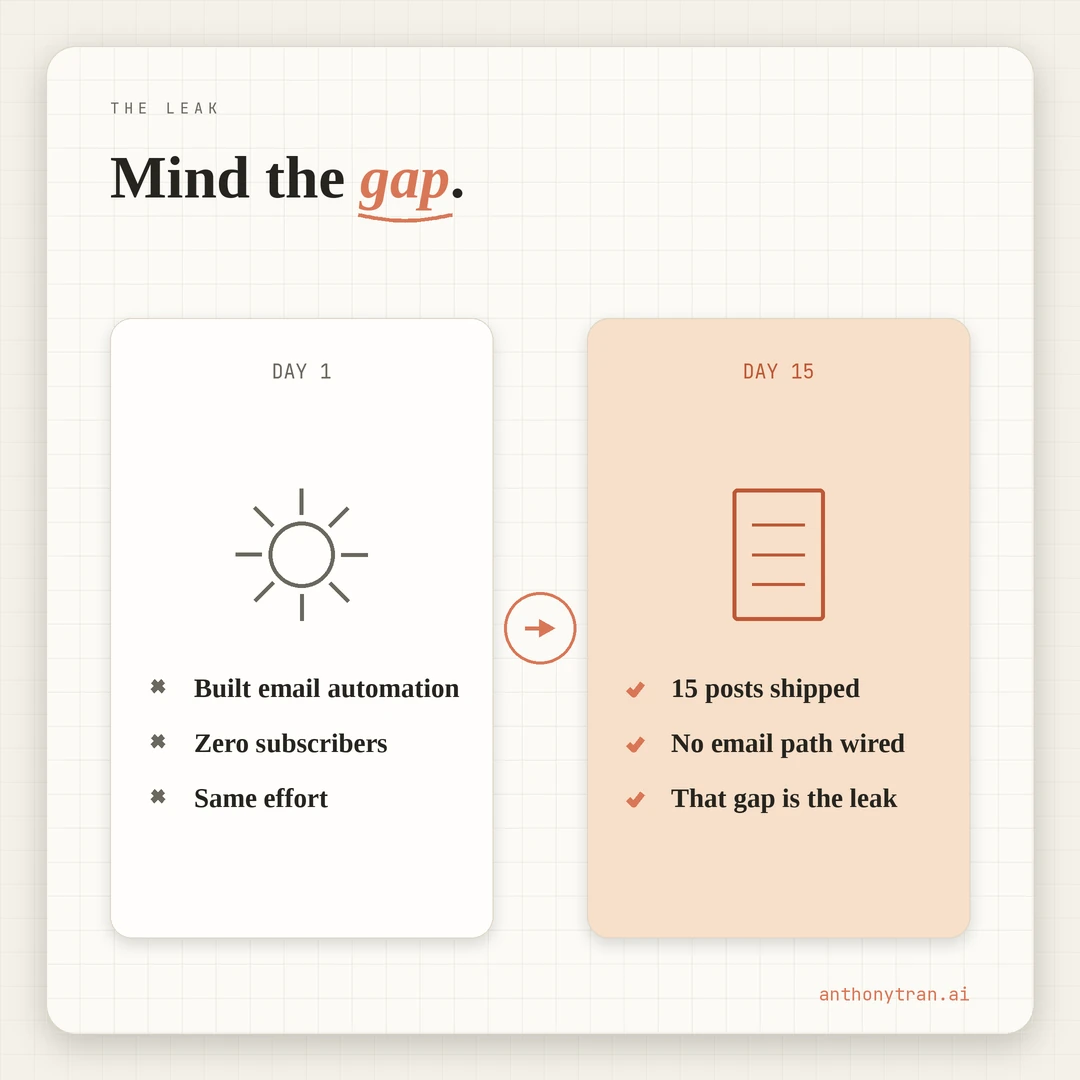
I published 15 blog posts before I set up email automation. From the outside it looked like discipline. From the inside it was procrastination of the one piece of setup work I dread the most. Here is the rule I would use if I started over: the setup task you keep avoiding should probably happen before the first post goes live, not after the fifteenth.
Why the boring setup work you keep avoiding is the one you should do first
If you are building a personal brand and you have a list of setup tasks to get through, there is one of them you keep moving to the bottom of the list. You know which one it is. It is the task you avoid every time it surfaces, the one you find a reason to push to next week, the one that feels like nails on a chalkboard the second you open the tool.
For me that task was email marketing. The setup, the welcome flow, the signup forms, the integration with the site.
I have been doing email marketing professionally for seven years. The open rates and click rates on the emails I manage usually run two to three times the industry average.
I am good at it. I still do not enjoy it.
That is the trap this post is about. You sell yourself a story about why the avoidance is actually a strategy.
You tell yourself you are being disciplined, doing it in the right order, waiting until the workflow is proven before you automate. From the outside it looks like patience.
From the inside it is procrastination wearing a strategy costume.
I published about 15 blog posts before I set up email automation. The framing I gave myself was manual posting first. The honest version was that I did not want to open ActiveCampaign.
What the manual-first run actually looked like
The website launched on April 21, 2026 with the first batch of blog posts already drafted. Over the next two weeks I kept publishing.
Each new post followed the same routine. Write the post, generate the social share image, push to GitHub, watch Cloudflare put the new page live, and that was it.
The blog updated. The RSS feed updated.
The sitemap updated. No email went out.
I told myself the manual workflow would teach me which steps were worth automating. That part was actually true.
The site was getting tighter every week. The blog writing process was getting faster. Each post taught me something about the next one.
But the manual workflow was teaching me nothing about email, because I had removed email from the workflow entirely. The signup forms on the site were live.
The list was empty. Anyone who decided to subscribe would have been signing up to nothing, because I had not built what they were supposed to receive.
Around 10 to 15 posts in I admitted it to myself. The lesson was not “wait until you have data to automate.
The lesson was “I have been avoiding the part of marketing I do not enjoy by hiding behind a strategy that sounded smart. Different problem.
The moment I forced myself to open ActiveCampaign
I sat down one evening, opened ActiveCampaign, and started looking at how to automate publishing a new blog post into an email broadcast. The first thing I tried was the integrations menu. I looked at Zapier, AI connector options, and every integration I could find that might let Claude, my site, or some middleman push a finished blog post into an email send.
None of the obvious connectors worked the way I wanted. They could create contacts, tag subscribers, fire a welcome email, or start an automation from a tag. But I could not find a clean path that said “a new post went live on my Astro site, turn that post into a broadcast and send it to the list.”
I sat with that for a minute. Then I told myself fine, I will just copy and paste each post into ActiveCampaign by hand on send day.
The friction would be small. The setup would be zero. I would do it manually.
A day later the aha hit.
The RSS aha from 13 years ago
About 13 years ago when I was first learning WordPress, RSS feeds were everywhere. People submitted their blog RSS feeds to aggregator sites so that every new post automatically got pushed out to a dozen other surfaces on the web.
It was a way to extend a blog’s reach without doing the publishing work twice. I had stopped using the pattern back then because I worried about duplicate content hurting my Google rankings.
I had not thought about RSS in years. The idea surfaced from somewhere old and unsexy in my memory.
ActiveCampaign supports RSS-triggered campaigns. My Astro site already generated a clean RSS feed at /rss.xml.
I could point ActiveCampaign at the feed, set a trigger that fires when a new item appears, and have the email send automatically.
I wired it up. Pointed ActiveCampaign at the feed.
Set the schedule. Tested with the next post that went live.
It worked. Mostly.
Some posts triggered the email send on schedule. Others sat in the queue and never fired.
I am still digging into whether the issue is ActiveCampaign’s polling behavior, my feed structure, publish timing, or some combination of all three.
But even a half-working automation changed the problem. Before, I had avoidance. Now I had a specific system to figure out.
It was not the clean automation I wanted on day one. It was a workaround I found weeks later, built on a 13-year-old pattern I had written off. And it was still only half working.
The point is not that RSS is the answer for every personal brand. The point is that the answer was sitting in old web tools I had stopped using.
The newer tools made me look for a newer answer. The actual answer was boring, old, and already generated by my site.
I would not have remembered the RSS pattern existed if I had not first sat down and forced myself to look at the email problem head-on. The avoidance had been protecting me from the moment I would actually solve it.
What I would do differently if I were starting over
This is the part I want to hand the reader. If you are starting a personal brand right now and you have not posted anything yet, do this:
Set up email automation before the first post goes live. Pick a tool.
Wire it to the site. Test it.
Make sure a new post triggers either an automated email send or at least a clean copy-and-paste routine. Get the welcome flow ready. Confirm a real test signup gets a real test email.
The reason is simple. The setup work is the same effort whether you have ten subscribers or zero.
Doing it on day one when no one is reading costs you nothing in audience momentum. Doing it on day 15 means 15 posts went out with no email path waiting to catch the people they reached.
That is not a tradeoff. That is a leak.
For me it was email marketing. For you it might be the same thing, or it might be something else.
Analytics. The legal page.
The about page. The SEO basics.
The newsletter integration. Whatever you keep moving to the bottom of the list every time it comes up.
Name the task. Then do it first or schedule it for this week.
Treat the avoidance itself as data. The thing you keep pushing is usually the thing that matters most.
Put This Into Practice
If you suspect there is a task you have been avoiding under the cover of strategy, run this prompt through Claude or ChatGPT. Walk through it one question at a time and answer honestly.
I am building a personal brand and I want to figure out whether I am procrastinating a piece of setup work under the cover of strategy. Ask me these questions one at a time and wait for my answer before moving to the next.
What is one task on your personal brand setup list that you keep moving to the bottom or pushing to next week? Name it specifically.
What is the story you tell yourself about why you have not done this yet? Be honest about the framing.
If you did this task today, what would it cost you in time? Estimate hours.
What does it cost you to keep delaying it? Estimate the leak in subscribers, traffic, trust, or audience momentum.
Is the delay actually teaching you something useful, or is the avoidance just easier than the doing?
After the fifth answer, give me an honest read. Tell me whether to do the task this week or whether the delay is genuinely earning its place.
Run the prompt on the one task you have been avoiding longest. If the honest read says “do it this week,” put it on the calendar before you publish another post.
The cover story is usually thinner than you think
I sold myself a story about manual posting first that lasted 15 posts. The story was real on paper.
Manual reps do teach you what to automate. The work I avoided was not the manual posting itself.
The work I avoided was the setup task underneath it. The story sounded like discipline because it pointed at the right principle while looking the other way.
This same pattern showed up in other parts of the system too. When I had too many channels, I had to cut platforms from 9 to 3.
When the content workflow got too scattered, I simplified it into one source piece for three channels. And before the foundation settled, I paid the rewrite tax of publishing 12 posts too early.
Different symptoms. Same lesson: simplify the system before the system starts leaking.
Name the task. Schedule it. Do it before the next post goes live.
The cover story is usually thinner than you think.
~ Anthony
Frequently asked.
When should a personal brand set up email automation?
Set it up before the first blog post goes live if you are starting fresh. The setup work is the same effort whether you have ten subscribers or zero. Delaying it past the first ten posts usually signals avoidance, not strategy.
Is manual blog posting before automation a good strategy?
It can be. Manual reps teach you which steps actually slow you down so you only automate what hurts. But manual posting can also become a way to avoid the setup task you do not enjoy. The honest test is whether the manual path is teaching you something or letting you procrastinate.
What is the simplest way to automate blog-to-email for a personal brand?
An RSS feed from the blog wired into an email tool that supports RSS-triggered campaigns. ActiveCampaign and most major email platforms support this. The blog post fires the email automatically on a schedule and there is no per-post copy and paste.
Stop re-explaining yourself to Claude.
Grab the free AI Starter Kit: my exact Claude setup, so it knows your business. Plus the lessons as they land.
Anthony Tran
13 years in marketing and an Air Force veteran. I use Claude every day to market and grow my own business, and I break down what works in plain English. Writing and recording from Arizona.