
I write for my audience. But one of my own posts reminded me I have another reader: the version of me who forgets what he built.
The post that reminded me of my own rule
I keep four small rules in my Claude settings. Each one tells Claude when to reach for a certain skill on its own.
That way it uses the humanizer, the fact-checker, the prompt-master, or the process-interviewer without me asking. I could not tell you exactly when I wrote them.
Hold onto that. It matters in a minute.
One day I turned those four rules into a post, Why Claude Won’t Use Your Skills Unless You Tell It To, and walked through each one so anyone with the same problem could copy the pattern. Simple enough. I was just writing down something I already did.
Except I wasn’t. Writing it surfaced something I did not expect.
It hit me that I had forgotten those rules were even there. I was explaining a setup to you that I had quietly lost track of myself.
Here is what I said when it landed: “I had forgotten that we had added that. This is why I write these blog posts to not only document and share what I did and learned to my audience but also to remind myself of the details.”
I had built the thing. I had forgotten the thing. And writing about the thing for you is what handed it back to me.
Writing as memory backup for your own brain
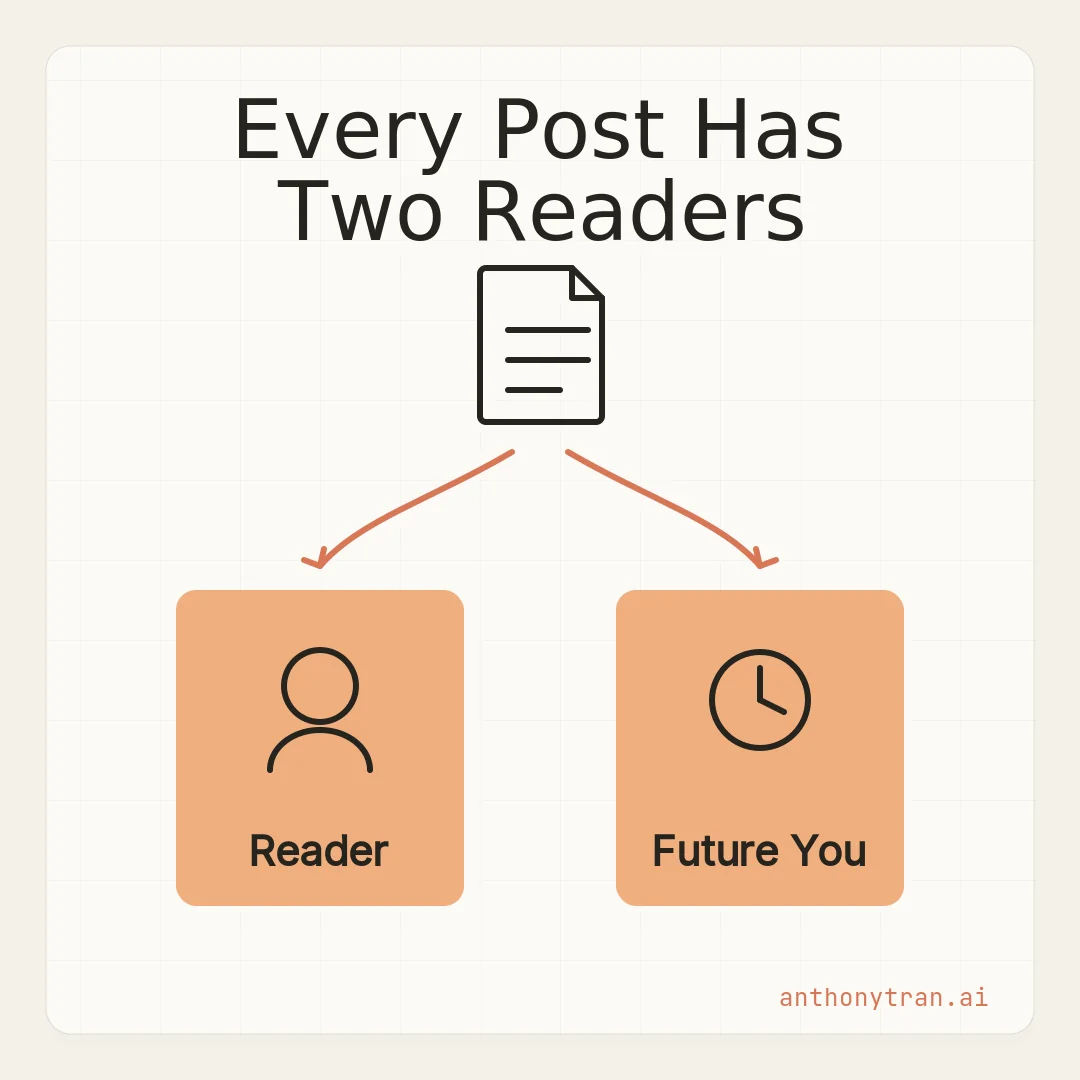
Here is what that moment taught me. Every post I publish has two readers, and only one of them is who you would expect.
The first reader is you, whoever is reading this on anthonytran.ai right now. You are the reason I write in plain English instead of jargon, the reason I explain the why before the how. That reader is real, and I write for you first.
The second reader is future-me. The version of me a few weeks or months from now, who has already moved on to the next problem and quietly forgotten the last one.
That reader never shows up in any dashboard. But he reads these posts eventually, usually while trying to remember why he did something a certain way.
You might be asking, isn’t that what note apps and to-do lists are for? I have tried those. A note sitting in an app I never open again is just one more thing I forgot, right next to the thing it was supposed to remind me of.
Writing it down where I would actually find it again is what made the difference. The rules did not stick in my head, I forgot them anyway, but the writing left me something I could get back.
It was searchable, it sat where I already look, and it carried the reasoning with it, the why I had the day I wrote it. That is the part a bare to-do note usually leaves out.
Mine happened to be a blog post, but publishing is not the point. Findable, with the thinking still attached, is the point.
Why writing still pays when no one reads it
Earlier, I wrote about how this whole record might outlast the brand itself, a chronicle someone could find years from now after I have moved on to whatever comes next. That post was about legacy. It was about other people, later, finding the words after I am gone.
This post is a different claim, and I want to keep the two apart. This one is not about someday. It is about this week, the next time you forget what you built last month and need it back fast.
If you are publishing your work into near silence right now, few readers, quiet comments, a view count that barely moves, I know how thin that can feel some weeks.
Here is a second reason to keep going that has nothing to do with how many people show up. You are building a copy of your own memory that you can search. You will use it, not because your audience needed it, but because you did.
I already write things down so Claude does not start every session from zero. That habit feeds the AI. This one feeds me, so future-me does not start from zero either.
Put This Into Practice
You do not need a full blog post to get the benefit. You need one short note, written the moment a session ends, before the details fade.
Before I close this session, write me a short note in plain English that future-me can search later. Cover:
- What I actually did in this session, in one or two sentences.
- Why I did it that way, including any rule or decision I made along the way.
- What I would need to know if I came back to this in a month and had completely forgotten it.
Keep it short enough that I would actually read it again. No jargon, no filler.
Paste the note into your blog draft, your journal, or even a plain text file you can search later. The format matters less than the habit. Write it down while you still remember it, in words you will actually understand when you do not.
The record you are actually keeping
I still write for you first. That has not changed.
But you are not the only one who reads these posts back later. I do too, usually when I have forgotten something I already worked out once.
Future-me is going to keep forgetting. That is not going away. So I keep writing it down, for you, and for the version of me who will need it later.
~ Anthony
Frequently asked.
Why should I keep writing about my own work if barely anyone reads it yet?
Your writing has a second reader besides your audience: future-you. A published post becomes a searchable backup for your own memory, so even at zero readers, the habit still pays you back the day you forget the details of what you built.
What is a good way to document what I did after a work session?
End the session by writing a short, plain-English note covering what you did and why. It can live in a blog post, a journal, or a document you paste into Claude. The point is that future-you can search it later and get the reasoning back, not just the task.
How is writing for myself different from writing for my audience?
Writing for your audience is about explaining something clearly to someone else. Writing for future-you is about capturing your own reasoning so you can find it again later. Both use the same post, but the second reason to write still holds even on the days your audience is thin.
Stop re-explaining yourself to Claude.
Grab the free AI Starter Kit: my exact Claude setup, so it knows your business. Plus the lessons as they land.
Anthony Tran
13 years in marketing and an Air Force veteran. I use Claude every day to market and grow my own business, and I break down what works in plain English. Writing and recording from Arizona.