
I spent months giving away free help and asking for nothing back. That is what ended up starting my whole business.
The private Facebook group that started it all
In 2013, I quit my job to start my own business, with twelve months of savings as my runway. I didn’t have a business yet, and I didn’t have any clients.
I just wanted to start a podcast and share what I learned along the way. My wife agreed to keep working and support the family, which gave me the time to figure things out.
Around that time I joined a private mastermind run by my coach back then, John Lee Dumas, the founder of the podcast Entrepreneurs on Fire. The group was his Fire Nation community, capped at 100 people, and I was number 97. I felt lucky to get in.
That group turned out to be one of the best investments I made, in time and in money. I made real friends in there, fellow entrepreneurs, and I still keep in touch with some of them today.
In most online groups there are thousands of people and you get lost. Nobody remembers you, and you do not remember them.
This one was small enough that the same faces showed up in the comments every day. So I started messaging people one at a time, just to get to know them.
Not to sell anything, since I didn’t have anything to sell. I just wanted to build a real relationship with as many of them as I could.
That small group is where everything started, because it was small enough that I actually got to know each person and we connected on a deeper level.
I answered the questions nobody else was answering
John had a course that taught everyone how to record a podcast and handle the audio. It did not teach them how to set up a website to put the podcast on.
So people kept asking in the group. How do I set up my WordPress site?
Which theme should I use? What plugins do I need?
How do I get my site on Google? Basic foundation questions, over and over.
I knew the answers. I had spent the couple of years before that reading books and taking courses on building websites with WordPress, and I had built a few test sites just to learn. I had a strong technical foundation and didn’t even realize it, because I figured everyone already knew this stuff.
So I just answered every question I could, for free, and I wasn’t asking for anything back. I was only trying to be helpful. Then the SEO questions started coming, and I answered those too.
The free webinar that made me “the WordPress guy”
Kate Erickson was John’s partner at the time, and she helped run the business and the mastermind. She noticed I kept answering the SEO questions in the group.
So she messaged me one day. She said there were a lot of SEO questions coming up that nobody could answer, and I clearly knew the topic, so would I be willing to teach everyone on a free webinar. I said sure.
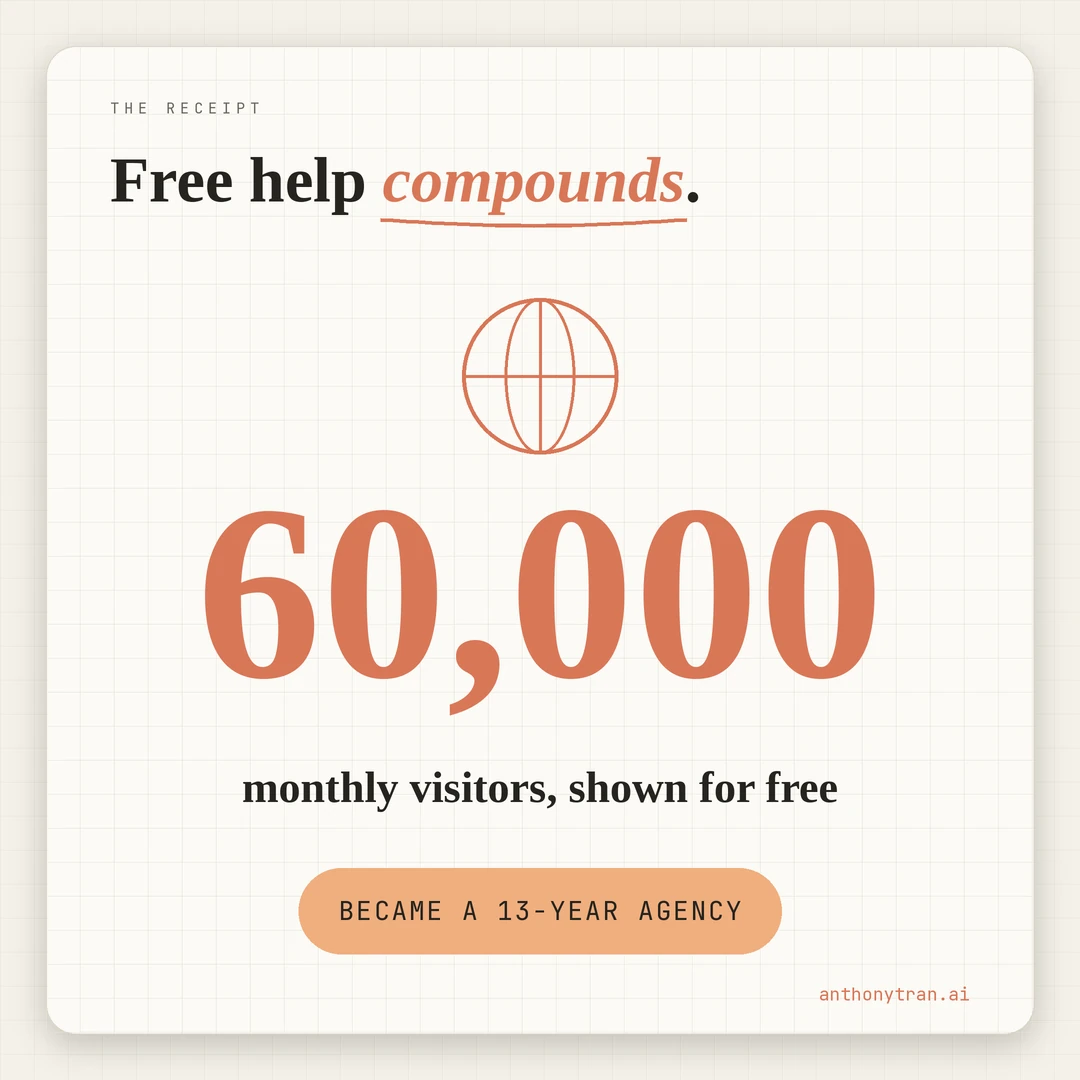
I built a slide deck and gave a free one-hour presentation on SEO, covering everything I knew: keyword research, meta titles and descriptions, on-page SEO, internal and external linking, setting up a sitemap, all of it. Then I showed a real case study, a fitness site I had built called Video Workout Review, with real screenshots of how it grew from zero to over 60,000 visitors a month. For a brand-new site, that was a big deal.
People were surprised, because a lot of them had no traffic yet and did not know how to get any from Google. Handing all of it over for free built real trust, especially since it was backed by a real site and not just theory.
That webinar taught me something I still believe. You do not need to be a guru or an expert. You just need to know a little more than the people around you, and to them you are the expert.
After that, I became “the WordPress guy. When somebody had a question, the answer in the group was “ask Anthony.
Even John would point people my way. I had not asked for that title. The free help earned it.
When the free help turned into paid work
Here is the part I did not see coming.
People started asking me to just build their WordPress sites for them. I had free guides and free videos out there, but a lot of people did not want to take the time to learn it. They would rather pay me to set it up, and others wanted help with their SEO.
My first reaction was to politely turn them down. I was flattered they thought of me as an expert, but I didn’t really see myself as one.
My goal back then was to be a content marketer, create content, and make money from affiliates and courses, not run a service business. The information I was sharing was already free on Google and YouTube anyway.
What I didn’t get at first was the feedback people kept giving me. They liked how I taught it and the way I broke things down in simple terms, and that is why they came to me.
People value their time. If they can see the value, plenty of them would rather pay than spend the hours learning it themselves. I get it, because I do the same thing with work I don’t want to do.
So I turned the requests down for a couple of months, and then the clock caught up with me. I had about two months left on my twelve-month runway and I had not made real money yet.
It was simple: either I start earning, or I go back to a corporate job. I had nothing to lose and I did not want to go back, so I said yes to a few website clients and charged for the work.
Once I started taking on those paid projects, the floodgates opened and people began spreading the word and referring business to me. That was the catalyst for the whole web design agency.
The demand got so big that I told my wife it was time for her to leave her job too. By then the business had grown enough to replace what we both earned at our jobs, and the whole goal had been for both of us to work from home.
So we went all in. That agency is still standing thirteen years later, and it changed our lives.
Does giving away free value actually build a business?
It does, but not the way most people think.
A lot of people don’t want to give away their time, because giving things away for free feels like losing money. But this is where the law of reciprocity comes in.
When you help people and ask for nothing back, they naturally want to return the favor. Maybe they refer business to you.
Maybe they write you a testimonial. Maybe they hire you, or help you out somewhere down the line.
That is what happened to me. I spent that whole year helping people and asking for nothing, and the goodwill paid me forward for years.
I want to be clear about the order, though. I did not give the help away as a move to get something later.
I gave it away because somebody asked and I could help, and the paid work came after on its own. People can feel the difference between someone helping them and someone running a play on them.
Building in public works the same way. You earn trust by being useful before you have anything to sell, and that trust compounds while you are just showing up.
For me, the skill was WordPress and the room was a podcasting mastermind. For you it might be a different skill in a different room.
The shape is the same. Find your people, help them wherever you can, and do it without keeping score.
One thing makes this a lot easier: the less financial pressure you are under, the freer you are to give. For a lot of people that means building this on the side while a steady paycheck covers the bills.
You get comfortable helping without needing every hour to pay off right away. Help people, and the rest tends to come back.
This is also how I stumbled into my niche. I listened to what people kept struggling with, and the business was hiding inside their questions the whole time.
Put This Into Practice
Pick the one community where your people already gather, then go be useful in it. The goal is not to spam a group with advice.
It is to find the room where your help is actually needed. Here is a prompt you can paste into Claude, ChatGPT, or any AI tool to map it out.
I want to become the go-to person in a specific community by helping for free. Ask me these questions one at a time and wait for my answer before moving on:
- What is a skill or topic I know more about than most people around me?
- Where do the people who need that skill already gather online, in a group small enough that members recognize each other?
- What questions do those people keep asking that nobody is fully answering?
After I answer all three, give me a simple one-week plan to start answering those questions for free, in that community, in my own voice. Keep it specific and doable around a busy schedule.
You will not become the go-to person in a week. That part took me months. But the first useful answer you give in the right room is where it starts.
~ Anthony
Frequently asked.
Does giving away free content actually help you build a business?
Yes, when it is real help and not a tactic. The reputation and the demand are byproducts of being useful first. People can feel the difference between someone helping them and someone running a play on them.
How do you become the go-to person in an online community?
Answer the questions people keep asking, for free, in a group small enough that people remember your name. You do not announce that you are the expert. The free help earns you the title.
Should you give away your knowledge for free or charge for it?
Lead with free help to build trust and reputation. Paid work follows on its own, because a lot of people would rather pay someone they trust than take the time to learn it themselves.
Stop re-explaining yourself to Claude.
Grab the free AI Starter Kit: my exact Claude setup, so it knows your business. Plus the lessons as they land.
Anthony Tran
13 years in marketing and an Air Force veteran. I use Claude every day to market and grow my own business, and I break down what works in plain English. Writing and recording from Arizona.