My grandfather lived 98 years by one life lesson. "Cái gì cũng vừa vừa." Everything in moderation, or the way I have always heard it, everything in balance. Forty years later, that voice still runs in my head every time I am tempted to add the next thing to my personal brand.
The dining table where I first heard the lesson
My cousins and I would spend our summer breaks visiting our Grandpa in Hawaii. He lived in a small one-bedroom apartment in Honolulu.
We would go snorkeling at Hanauma Bay and afterwards he would take us out to eat at Denny’s. In the evenings, he would let us play at the Fun Factory arcade so we could play Street Fighter 2.
Those summers are some of my favorite memories. But the moments I remember most are the quiet ones at the dining table.
In the mornings, he often sat by his rock garden fish pond sipping a cup of tea while trimming his bonsai tree.
One day, he asked me to come sit next to him at the dining table because he wanted to tell me something. My grandpa was a quiet wise man, so when he rarely spoke, I made sure to pay special attention. He looked at me and said, in Vietnamese:
“You are still young and you may not understand what I am about to tell you. But listen carefully. Because someday it will all make sense.”
I sat still and listened intently. He often spoke in metaphors which helped me understand and remember his lessons as a young child.
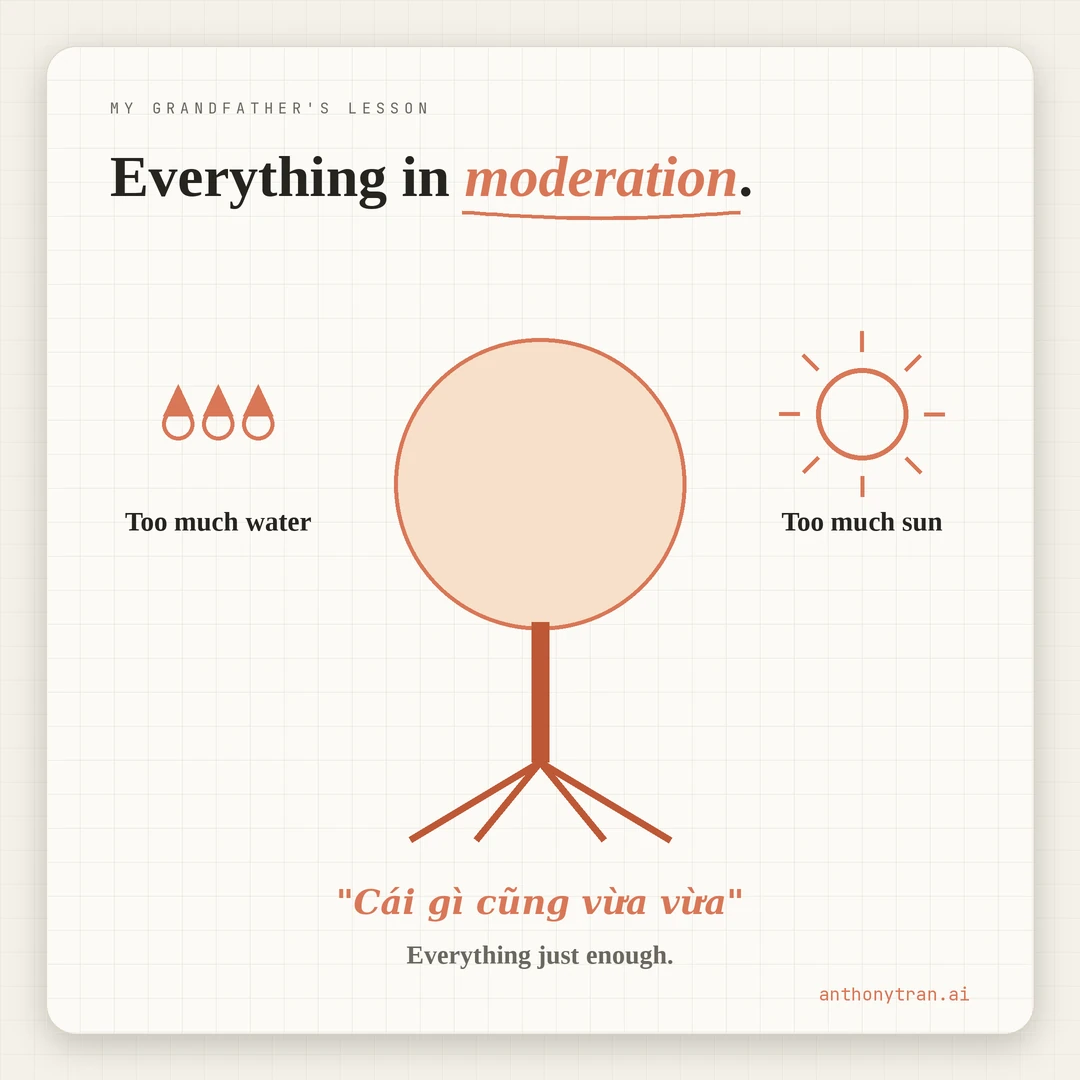
Then he pointed at the bonsai tree on the table between us and said, “Life is like a tree. It starts as a seed in the ground, and slowly the roots grow stronger into the soil.
The roots are the foundation. They have to be strong so that it can withstand the strong winds.
As the tree sprouts, he said, there has to be balance. Too much water and the plant dies.
Too much sun and the plant dies. “Cái gì cũng vừa vừa.
Everything in moderation. The way I have always interpreted it is that your life has to be balanced.
When the balance is right, the leaves come out and the fruit comes in. The fruit falls and plants new seeds, and the cycle continues.
He paused.
“But sometimes in life there will be storms,” he said. “The strong winds will blow off the leaves.
But because you have strong roots the tree will survive. Your tree will grow back the leaves and will bear fruit again.”
He lived 98 years by that lesson. My grandpa survived many “storms in life.
He survived a rocket explosion while shielding my father from a blast that landed four meters away, which left him with a permanent limp for the rest of his life. After the Vietnam war he had to help his wife and kids escape his home country with only the clothes on their backs on a small boat drifting in the middle of the ocean waiting weeks to be rescued.
Luckily, they were welcomed by Americans at refugee camps in Camp Pendleton in San Diego. He had to start over at the age of 48 in California.
He eventually moved to Hawaii alone to paint portraits for tourists from a kiosk in a Honolulu mall. It was the only way he knew how to make money without the ability to speak English.
He spent many years living by himself in a modest small apartment so he could send most of what he earned back to support his wife and children back in California. He helped pay for their mortgage, their food, and even put two of his daughters through college.
At the time, I was only five years old so I did not understand the significance of the story of the tree yet.
But now that I am forty-five years old it is all starting to make sense now. His life lessons continue to teach me everyday.
When his life lesson of staying balanced started to make sense
For most of my life, my superpower was outworking everyone in the room.
I was not the smartest, I was definitely not the tallest, and I didn’t come from a rich family. But, I was always willing to put in the work and extra hours to accomplish my goals.
In school I studied late into the nights and weekends. In ROTC I worked out and trained every free moment I had.
In the Air Force I would work with little sleep to ensure the mission was accomplished. I climbed the corporate ladder because I was willing to do the work that my peers didn’t want to.
Through sheer grit and determination I was able to excel at what I put my mind to. The system rewarded me for it.
Promotions, awards, recognition. The pattern reinforced itself.
The harder I worked, the more the world told me I was on the right track.
So when I started building my own business in 2013, I ran the same playbook. My plan was to outwork everyone.
I recorded podcast episodes, created YouTube tutorials, published blog articles, created a course, spoke at conferences, trained on webinars, posted on social media, and took on coaching clients and website projects. I was working twelve hours a day, six days a week with no team and no breaks.
So by 2019 I had completely burned out.
My grandfather had given me his secret to life when I was a child. I always remembered it, but never applied it.
“Cái gì cũng vừa vừa” was a memory. The lesson about the tree was a story that I always remembered, but the philosophy didn’t register until I recently started to question what I was committing to before starting anything new.
What got you here will not get you there
Marshall Goldsmith has a book title I understand differently now: What Got You Here Won’t Get You There.
It is the cleanest one-line summary of why men in their 40s burn out building a personal brand.
The outwork-everyone approach got me through my 20s. It carried me through my 30s when I started the agency.
By the time I hit my 40s, the model stopped working. Not because I was lazier. Because the math changed.
In your 40s, you have a real life pressing on every hour. A spouse, a kid, a house, aging parents.
A body that does not recover from a five-hour sleep the way it used to. A mind that needs more time to think and less time to scramble.
The hours you used to spend pushing through tedious work are now the hours your family needs you present.
Working harder produces worse output. You make bad decisions when you are tired, write terrible drafts at 1am, snap at the people you love, skip the walk and the workout, stop reading. The output goes up but the quality goes down.
The shift is not from working hard to working easy. The shift is from outwork to delegate.
From doing everything alone to leaning on a team, a partner, an outsourced specialist, or AI. In your 40s, you do the few things only you can do, and you let go of the rest.
For me, that means writing the blog post (the part only I can do) and letting AI help me shape it (the part it does faster than I can on my own). It means letting Linh run our agency day to day instead of trying to sit in both seats. It means cutting the things that do not earn their place in the week.
Cái gì cũng vừa vừa. Now capacity is part of the strategy, not an afterthought.
Not adding the next platform until the current one has proven results. Not chasing another shiny object that costs me my health or my presence at home.
The question I ask before I add the next thing
The lesson does not stay quiet in my head. Every time I am about to commit to something new, my grandfather’s voice asks the question.
Am I going too far in one direction? Am I about to add something I cannot sustain? Is this the next-thing trap, or is the current thing actually done?
Most of the time the honest answer is to wait. Finish the current thing. Make it real before adding the next.
If I had asked the question at any point between 2015 and 2018, it would have told me to stop adding. I did not ask it.
I kept stacking channels and commitments until the system collapsed under me. I started doing the same thing on this rebuild, then cut from nine platforms to three when the math caught up with me.
The question is small. It takes maybe a minute. But you have to actually ask it.
For me, the voice in my head is grandfather at the dining table. For you it will probably be someone else.
A parent, a mentor, a coach, an old friend. Or just your own honest gut from a season when you got the balance right.
Whatever the voice is, the lesson is the same. Ask the question before you add. Most of the time the right answer is do not add yet.
Even with the voice running, I fall out of balance constantly. The work pulls me one way.
Family pulls another. My health asks for attention I let slip.
I notice the cholesterol number creeping up, dial it back, find the line, drift again, return again. That is the actual practice.
Not a state of perfect balance. A constant recalibration.
The lesson does not promise you will stay balanced. It tells you when you are out, you have to come back.
Put This Into Practice
If you are not sure whether you are building sustainably or just stacking commitments, open Claude, ChatGPT, or any AI tool and paste this in.
I am building a personal brand around a full life and I want to make sure I am not setting myself up to burn out. Walk me through these questions one at a time and wait for my answer before moving on:
- What am I currently committed to for my personal brand this month? List every platform, content type, and recurring task.
- Of everything on that list, which one item is the most important and only I can do?
- Which item on the list am I about to add or expand next, and why now?
After I answer all three, do two things. First, tell me honestly whether the next add is the right move or whether I should make the current scope real first. Use this as the test: do I have proof that what I am already doing is sustainable for the next 12 months? Second, name the one thing on my list that I could delegate, outsource, or hand to AI right now to keep the rest in balance.
You will leave with a clear picture of what to keep, what to delegate, and what to wait on. That is the lesson applied to one decision. The discipline is to ask the question again at the next one.
Roots and storms
My grandfather passed last Valentine’s Day, a reminder to keep our loved ones in our hearts. The bonsai tree on his table is gone, but the life lesson stays.
I will not pretend the storms have stopped. Every so often they blow your leaves off, when you least expect it, the same way they came at unexpected times in his life and in mine.
The roots hold. The leaves grow back.
Cái gì cũng vừa vừa. Everything in moderation.
Everything in balance. That is the lesson that kept him standing for 98 years.
That is the lesson I am trying to learn to live my life with now.
Thank you Grandpa for all the memories and life lessons. Love you always,
~ Anthony
Frequently asked.
How do you avoid burning out while building a personal brand?
Treat balance as a question you ask at every big decision, not a setting you turn on once. The question is whether you are about to go too far in one direction before you add another platform, another commitment, or another output target. Most personal brand burnout comes from doing too much, not from doing too little.
What does everything in moderation mean for building a personal brand?
It means saying no to the next add. Not the next post, not the next platform, not the next channel until the current one is real. The personal brand version of the lesson is to keep adding only after you have proof the current scope is sustainable.
Why do men in their 40s building a personal brand burn out?
The workhorse approach that worked in your 20s and 30s does not scale into your 40s. You have more responsibilities, your body and mind do not recover the same way, and you have less time. Working harder produces worse output. The shift is from outwork to outsource and delegate.
Stop re-explaining yourself to Claude.
Grab the free AI Starter Kit: my exact Claude setup, so it knows your business. Plus the lessons as they land.
Anthony Tran
13 years in marketing and an Air Force veteran. I use Claude every day to market and grow my own business, and I break down what works in plain English. Writing and recording from Arizona.