
I cut Medium from my plan, then reversed it a few weeks later. Here is what made me change my mind, and how to add a republishing channel without competing with your own site.
Nearly sixty posts and no road in
I sat down and did the honest math on my blog.
Nearly sixty posts published. Each one drafted, edited, reviewed, and put live, most of them written late at night after the house went quiet.
And almost nobody was reading them.
The search footprint was close to nothing. For a stretch, a quiet technical bug even blocked Google from indexing the site.
The few people who might have found it through search couldn’t. The email list was small enough that I knew it wasn’t growing on its own.
I had built a store in the middle of the desert, and no roads led to it.
That made me reopen a decision I thought I had closed. A few weeks earlier I had cut Medium from my plan. Now I was staring at all that work with no one to read it, asking if that was the right call.
Why I cut Medium in the first place
When I trimmed my platform list from nine to three, Medium got cut.
My reasoning was about audience match. My read was that Medium leaned more toward self-help, career-change, and broad creator writing than the specific lane I was trying to build in.
My topic is building a personal brand with AI. The fit felt loose.
On top of that, I didn’t want the upkeep of one more place to post.
So I cut it, and it felt clean and disciplined at the time. I even published a post saying Medium was out. That post is still live on my blog.
Then I sat with that picture and realized I had been solving the wrong problem.
What actually changed my mind
I cut Medium to protect a pure audience match. But you can’t protect an audience you don’t have yet.
At zero readers, audience match is a luxury problem.
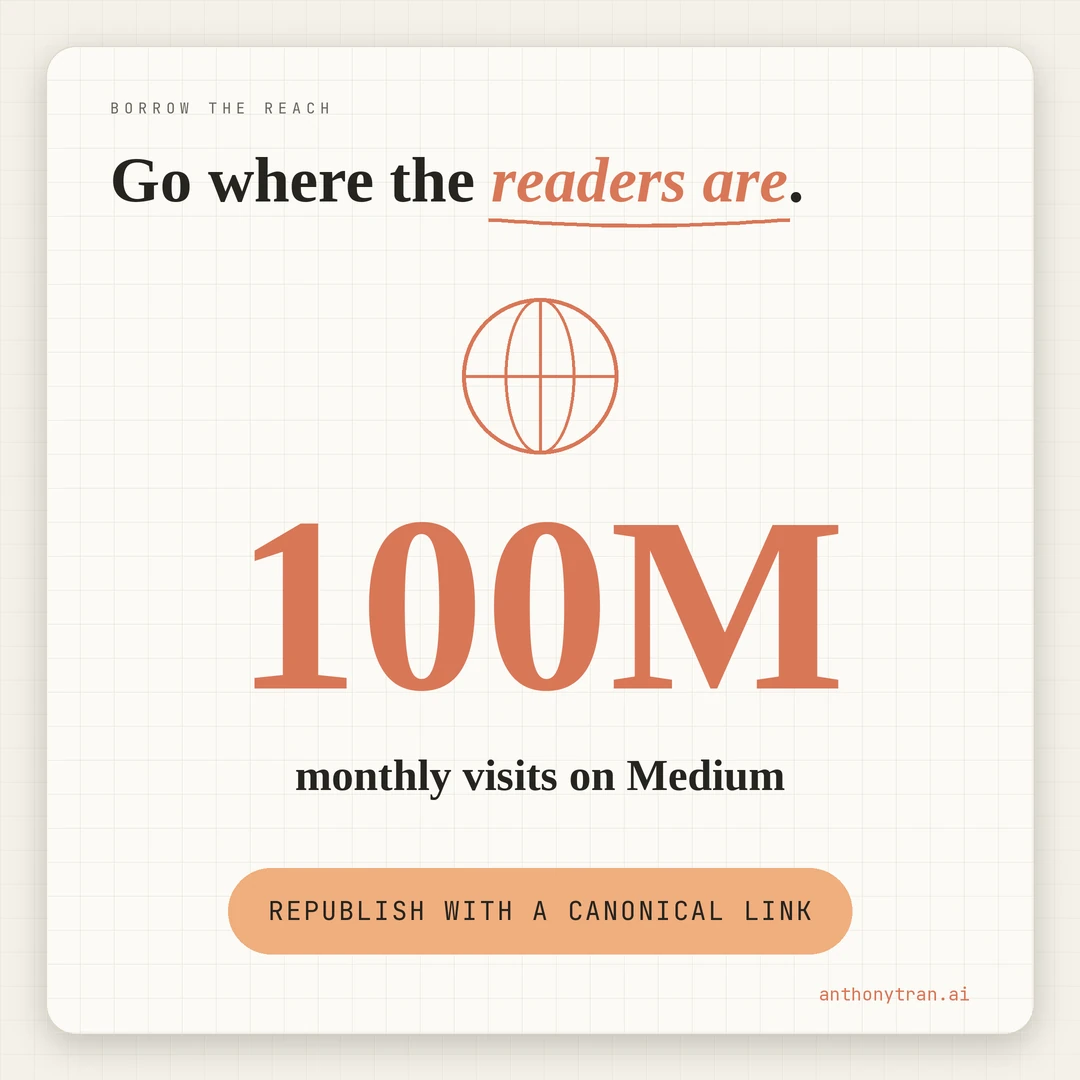
The real problem was that almost nobody knew the work existed. Medium already has a huge built-in audience.
By most estimates it gets more than a hundred million visits a month. My blog has Google, slowly, and a small email list.
One of them sits on a highway. Mine was out in the desert.
The second reason for cutting it was upkeep, and that turned out to be smaller than I thought. I’m not writing new posts for Medium.
I’m republishing the ones I already wrote. Medium has a built-in import tool that pulls in a post from a link, and it takes about five minutes to tune the title and tags.
The work I cut to avoid mostly isn’t there. The audience I cut to protect doesn’t exist yet. Both reasons fell apart when I looked at them straight.
Does putting your posts on Medium hurt your own site?
This was my real worry. If I post the same article in two places, do I compete with myself in Google and split my own traffic?
Usually no, as long as you set the canonical link correctly.
A canonical link is a small tag that tells search engines which version you want treated as the original. When you use Medium’s import tool, it adds that tag back to your post automatically, and you can also set it by hand.
It is not magic and it is not an ironclad promise. Google still decides which version to show.
But a canonical link is the normal way to republish a piece without confusing search engines about where the original lives.
That changes Medium’s role. It is not a competing store.
It is a road from the highway back to mine. People find the work on Medium, where the traffic already is, and the link leads them home to my site, where the email signup lives.
My blog is still the store. Medium is just a road that brings people to it.
The part I had to be honest about
Cutting Medium felt disciplined. Subtract, focus, do less but better. I write about that idea a lot, and I believe it.
But some of that “discipline” was really about wanting my setup to look clean. A tidy three-platform plan is satisfying to look at. It also doesn’t help a single reader when no road reaches the store.
The first time I built a personal brand, it was about me and how the whole thing looked. This time it’s supposed to be about the people I’m trying to help.
Adding Medium back isn’t a step backward. It’s putting the work where people already are. Audience first, the neat plan second.
Changing your mind in public feels risky. The old post is still up.
Anyone can see I reversed myself. But I’d rather sleep on a decision and change it than defend a clean plan that isn’t working. That is what building in the open actually looks like.
Put This Into Practice
If you’re building a personal brand and almost nobody is reading yet, you might be guarding a plan instead of reaching people.
Here’s the rule I’m using now. If a platform can put my work in front of new readers, lets me keep my own site as the original, and takes only a few minutes per post, it earns a spot on the test list.
Paste this into Claude or ChatGPT and run it on your own setup.
I’m building a personal brand and I publish my main content on my own website at [your site]. I’ve published about [number] posts, and right now very few people are finding them. I’m thinking about republishing my posts on a bigger platform like Medium to get discovered, while keeping my own site as the original.
Help me think it through. Ask me these one at a time and wait for my answer before the next one.
- Where does my target audience already spend time reading?
- Which big platform lets me republish full articles and reaches more readers than my site does today?
- Does that platform let me set a canonical link back to my original post, so my own site stays the version Google credits?
- How much time would each republished post take if I’m not writing anything new, just reposting?
- What is the one call to action I want on every republished post to pull readers back to my site and email list?
Then tell me whether adding this republishing channel is worth it right now, and give me a simple five-minute-per-post checklist to do it without competing with my own site.
If a platform can’t point a canonical link back to your site, I’d skip it for republishing whole posts. The whole point is to feed your home base, not to hand your work to someone else’s.
Closing
I don’t know yet how much Medium will move the needle. I’ll report back when I have real numbers instead of guesses.
But the lesson already landed. When your store is in the desert, you don’t reorganize the shelves. You build a road to where the traffic already is.
~ Anthony
Come build with me.
Frequently asked.
Does republishing your blog posts on Medium hurt your SEO?
Usually not, as long as you set a canonical link. A canonical link tells search engines which version you want treated as the original. Medium's import tool adds it back to your post automatically. It is a strong signal rather than a guarantee, but it is the normal way to republish without competing with your own site.
Should you put your blog posts on Medium?
It depends on what you are solving for. If almost nobody is finding your own site yet, a bigger platform with built-in readers can feed people back to you. Republish with a canonical link so your site stays the version Google credits, and keep a clear call to action that pulls readers back to your email list.
What is a canonical link?
A canonical link is a small tag that tells search engines which version of a page is the original when the same content lives in more than one place. It prevents duplicate-content problems and keeps the credit on the source you choose.
Stop re-explaining yourself to Claude.
Grab the free AI Starter Kit: my exact Claude setup, so it knows your business. Plus the lessons as they land.
Anthony Tran
13 years in marketing and an Air Force veteran. I use Claude every day to market and grow my own business, and I break down what works in plain English. Writing and recording from Arizona.