AI is fast, confident, and fluent. That is what makes its small falsehoods so easy to miss when it builds your personal brand site with you. The discipline is reading every word AI writes about you before it goes live.
The ‘open now’ badge AI wrote on my home page
When I was building my home page, I added a section near the bottom called “What you’ll find here.” Three cards in a row, with YouTube on the left, blog in the middle, and email on the right. Each card has a status line at the bottom with a green dot if it is live and a short label saying what the state actually is.
The YouTube card said “Coming soon,” which was honest because I had not started publishing video yet. The blog card showed the number of posts live, pulled automatically from the blog itself so it stays accurate as new posts go up.
The email card said “Open now.”
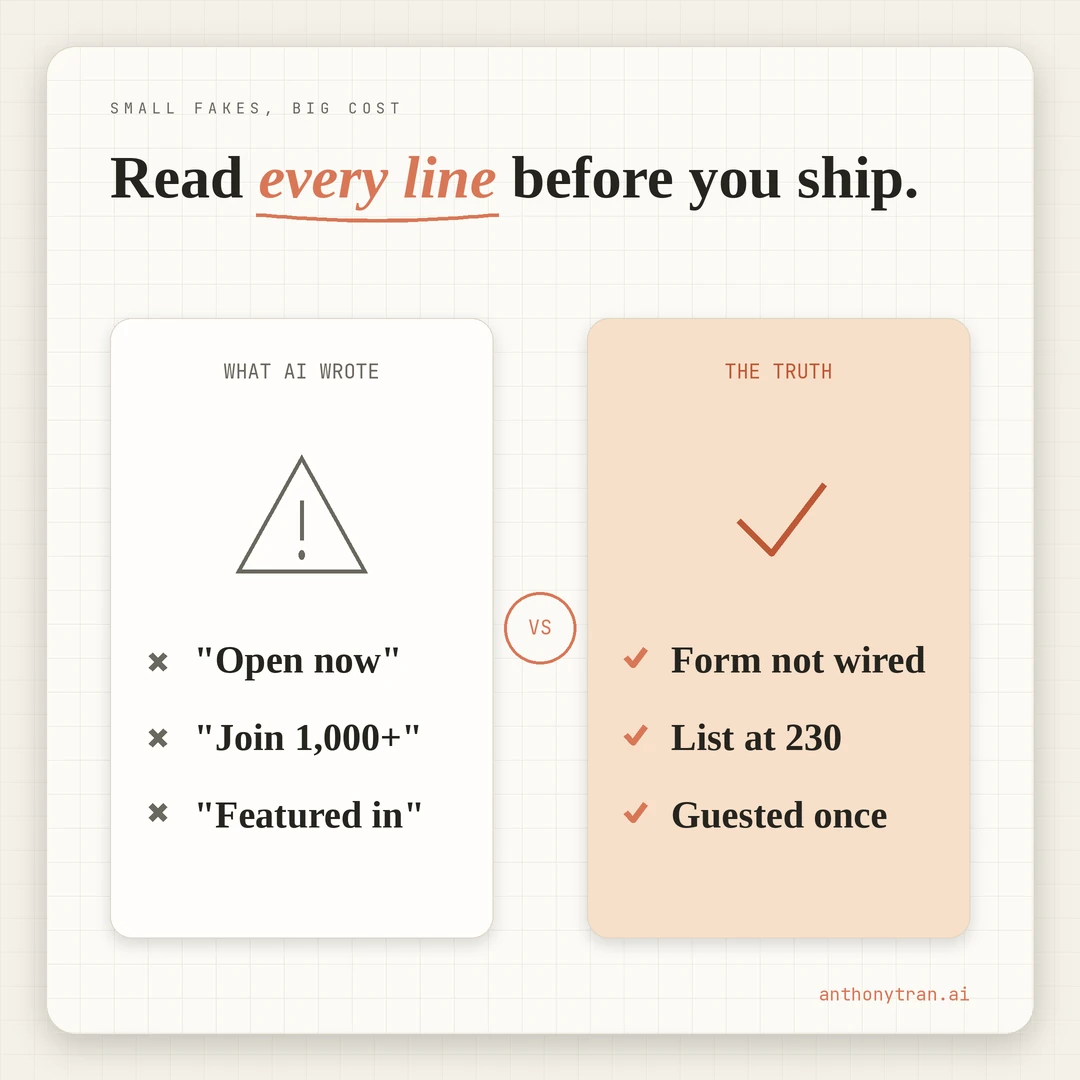
The form below it was not wired to anything. The email setup was still on the to-do list. The AI building the page had filled in “Open now” because that is what the rest of the design language implied, and it had no way to know whether the email was actually wired up yet.
The front end looked like a working subscribe form. The back end was not doing the thing the page implied it was doing.
Most people would not have noticed. A few might have. But that was not the point.
I noticed. I changed the badge.
Why AI writes small fakes on your site
The AI did not lie on purpose. It is tuned to produce output that reads well, not output that lines up with the actual facts of your business.
When AI helps you build a personal brand site, it fills in plausible-sounding details to make the page look finished. A status badge here.
A subscriber number there. A short tagline that sounds like something you would say.
Some of the filler is harmless. Some of it is not true yet, and the AI has no way to tell the difference.
The reader sees the finished page. They cannot tell which lines came from you and which lines came from the AI guessing. They take all of it at face value until something feels off.
The reader is also already a half-step more skeptical than they were two years ago. Every small fake on the page costs you a little more trust than the same fake would have cost before.
How small AI fakes erode personal brand trust
Most of these fakes are too small to trigger an immediate bounce. A wrong status badge here.
A slightly inflated number there. A tagline that overstates what you actually do.
Each one is forgettable by itself, but the reader still feels the mismatch.
The trust meter gets a half-step less trusting every time something feels almost right but a little off. By the time enough signals stack up to notice, the trust is mostly gone already.
The damage is upstream of where you can see it. You will not get an email saying “your ‘open now’ badge eroded my trust.
You will get fewer subscribes, fewer comments, fewer return visits. By the time the numbers tell you something is wrong, the cause is months in the rearview mirror.
The fix is also upstream. Catch the fakes before they go live.
Treat every word AI writes about you as a draft, not a finished piece. The bar is not “what can I get away with. The bar is what I can honestly say is true.
Admiral William McRaven’s “Make Your Bed” commencement speech has a line I keep thinking about. “If you can’t do the little things right, you will never do the big things right.
The badge is not really about the badge. It is about the habit.
Where AI puts small fakes on personal brand sites
If you have used AI to write or build parts of your site, one or two of these are probably hiding somewhere right now.
A status badge that AI generated to match the design pattern, like “Open now,” “Live,” or “Available,” when the back end is not actually doing the thing. A subscriber counter that says “Join 1,000+” when the list is at 230 because the AI thought that read better than the real number.
A “Featured in” logo strip that includes podcasts you were a guest on once, framed to look like real media coverage. A testimonial paraphrase that reads like a real quote from a client but is actually the AI summarizing the vibes of a thank-you email.
A stat claim like “I’ve worked with 500+ clients” with no actual count behind it. A year on your About page that AI rounded for clean copy.
A tool stack list that includes things you tried once and dropped.
Each of these reads as a small lie to a careful reader. Most readers are not careful. But some are, and the ones who are careful are usually the ones you actually want as readers.
The fix usually does not mean taking the element down. Sometimes it means rewriting the label to match reality.
Sometimes it means removing the element until the claim is true. Sometimes it means wiring up the back end so the claim becomes true.
The honest version is rarely complicated. It just requires admitting where you actually are.
This is the same discipline I learned the hard way on long-form writing when I caught AI inventing specifics in a draft about Tesla Full Self Driving. The surface is different.
The lesson is the same. AI will fill gaps with plausible-sounding stuff if you do not check it.
Put This Into Practice
If you want to do a quick honesty audit of every place AI touched your personal brand site, paste this prompt into Claude or ChatGPT.
I want to audit my personal brand website for any small fakes that an AI might have introduced when it helped me write or build a page. Ask me these questions one at a time and wait for my answer before moving to the next.
Walk through every page on your site. For each page, list the elements that an AI helped you write or generate. Status badges, subscriber counts, taglines, testimonials, “featured in” logos, stat claims, year claims, tool lists, anything else.
For each element on that list, tell me whether the claim is currently true, the claim used to be true but is not now, or the claim was filler the AI generated that you never verified.
For each element that is not currently true, what is the cost of fixing it? Rewriting the label, removing the element, or wiring up the back end so the claim becomes true.
Which of these elements would a careful reader most likely notice as off, and which would slip by most readers?
Based on your answers, give me a short list of changes to make this week, with the easiest fix first.
Run it on your own site this week. Then change whatever needs changing, or connect whatever needs connecting.
The small things are practice
The badge on my home page is honest now. The email is actually open, the form is wired to a tool that fires the email automatically when I publish, and the subscribers go somewhere useful.
But the moment I caught the bad version is what matters more to me than the fix. The bar I am holding is not “what can I get away with.” The bar is what I can say is true.
That bar gets harder to hold as the audience grows, the AI does more of the building, and the temptation to leave the small fakes in for the sake of finished-looking pages gets stronger. The small honesty habits I build right now are the only thing that will keep me honest later.
The badge on the home page is practice. So is the disclaimer page I wrote before any affiliate link was live.
So is every word I read before AI’s draft goes live on my site.
Look at your own site this week. Where is something AI wrote promising more than what is actually behind it?
That is the place to start.
~ Anthony
Frequently asked.
How do I know if AI added something untrue to my personal brand site?
Look for small claims that AI would have no way to verify. Status badges. Subscriber counts. 'Featured in' attributions. 'Available now' labels. Anything that asserts a fact about your business, your numbers, or your status that you did not actually tell the AI. Those are the spots most likely to contain filler that reads like fact.
Does AI invent fakes about my personal brand on purpose?
No. AI is tuned for fluent-sounding output, not truth. It fills gaps with plausible details when it does not have the real fact. The fakes are not malicious. They are filler. Your job as the operator is to catch them before they go live on the site.
Is it safe to use AI to write my personal brand content?
Yes, with one discipline. Read every word AI writes about you, your business, your numbers, or your status before it goes live. The risk is not AI writing your content. The risk is shipping AI's content without checking the small claims inside it.
Stop re-explaining yourself to Claude.
Grab the free AI Starter Kit: my exact Claude setup, so it knows your business. Plus the lessons as they land.
Anthony Tran
13 years in marketing and an Air Force veteran. I use Claude every day to market and grow my own business, and I break down what works in plain English. Writing and recording from Arizona.