I write my blog posts with one AI, then run the draft through a different AI before I publish. The second model reads it with fresh eyes.
Why a second AI catches what the first one misses
If you write with AI, you already know the trap. The draft is close.
The bones are there. You read it back and most of it sounds right.
But something is sitting under the surface that you cannot quite name, and you do not fully trust the model to name it for you because it just wrote the draft itself.
That is the gap a second AI fills. Not your AI. A different one.
I draft my blog posts with Claude. Before I publish, I copy the whole draft into ChatGPT or Genspark and ask for a review.
The two models read the same words but they read them differently, and the second one almost always catches something the first one missed in its own output. Self-contradictions, repeated ideas, numbers stated as facts when they are really rough guesses. Lines I had gone numb to that needed to come out.
The workflow is small, and it has changed almost every post I have shipped in the last month.
The blindspot problem in one sentence
The model that wrote the draft has too much investment in the draft to read it cold.
This is the same reason you cannot proofread your own writing well after staring at it for an hour. Your eyes skip over the gaps because your brain already knows what the sentence is supposed to say.
Something similar happens when you keep working inside the same AI conversation. The model carries the context of where the draft is going, and it reinforces earlier choices even when those choices deserve another look.
A different model has no investment in the draft. It reads the words as written, not as intended. That is the gap the second review pass fills.
The one review that paid for the whole workflow
A few weeks ago, I shipped a post called The three-layer Claude settings stack. The thesis was simple.
Each rule in your AI config belongs in exactly one place. Put it in one layer and one layer only.
No duplication. No drift.
I drafted it with Claude, read it back twice, felt good about it. Then I pasted the whole thing into ChatGPT for a review pass before publishing.
The catch came in the first round. ChatGPT flagged that I had used the same example, foundation files, in two different layers in the body of the post.
The thesis said “each rule lives in one place. The examples broke the thesis in the same post arguing for it.
That is the kind of catch the writing AI is less likely to make. It wrote both examples.
It does not see them as a contradiction because both felt right when it produced them. The second model reads them side by side, and the gap shows up immediately.
I fixed it before I pushed. The post shipped without arguing against itself.
What to accept, what to reject
The second AI will give you a lot of suggestions. Most of them will not be right for the piece.
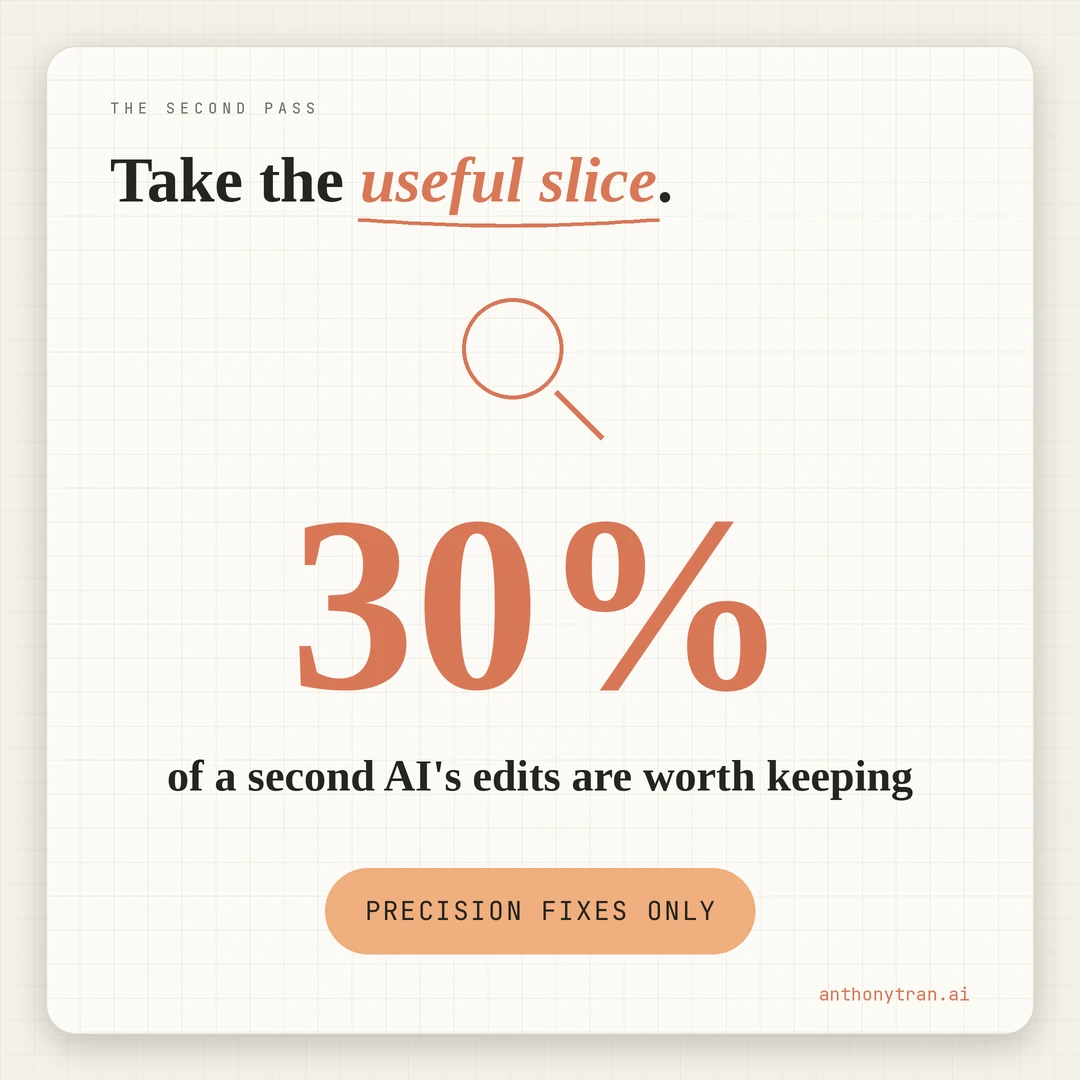
Around 30 percent of mine are worth applying. The other 70 percent are wrong for my voice, wrong for my rules, or just generic AI-flavored “improvements” that flatten the writing.
I do not apply suggestions on autopilot. I run them through a filter first.
Accept the precision fixes. If the reviewer flags a number, a date, a claim about a tool, or a status word, that is worth a second look. I had one post where I called the disclaimer “FTC-compliant.” The reviewer pushed back. Compliant is a determination a regulator makes, not a self-claim by me. I softened it to “written around FTC disclosure principles” and the line got more accurate and more honest in the same edit. Precision fixes are mostly free wins.
Accept the repetition catches. When I have said the same idea three different ways across three sections, I have usually gone numb to it by the time I read the draft back. The second model has not. If the reviewer points out that I am saying the same thing four times, I keep the strongest version and cut the rest. The line that should have landed clean lands clean.
Accept the strong-line callouts. The reviewer will often quote one line back to you as the line that captures the whole post. Those lines are worth pulling out, isolating in their own paragraph, and reusing across email subject lines and video hooks. The second model is unusually good at spotting which line is doing the most work.
Reject the voice rewrites. The reviewer does not know how you talk. If it rewrites a paragraph in smoother corporate prose, the smoothness is the AI signal you have been trying to remove. Trust your own voice and reject the rewrite.
Reject the title changes that lose the keyword. About half the time, the reviewer will push you toward a punchier, more curious title. Sometimes that title is better. Most of the time it drops the search phrase that makes the post findable. If the new title loses the keyword, reject it.
Reject anything that breaks your own rules. I have a rule against guru-flavored language. No “expert,” no “thought leader,” no positioning that puts me on a stage instead of next to the reader. The reviewer suggests authoritative phrasing in roughly half my reviews because that is what AI knows how to write. I reject it every time, no matter how cleanly the line reads. My rules trump the reviewer’s instincts.
The filter is not complicated. Precision in, voice out. Catches in, rewrites out.
Why the variety of models is the value
The 30 percent accept rate is the number that surprised me when I first started running this workflow. Most of what the reviewer suggests is not actionable for me. The reason it still pays for itself is the kind of catch that does land.
Self-contradictions, repeated ideas, a claim that is one word too strong, or a buried line that should be doing more work.
None of those are voice questions. They are precision questions. And precision is the area where a different model with fresh eyes does its best work.
The specific model matters less than the separation. I rotate between ChatGPT and Genspark.
Both have caught things the other missed on different posts. The variety is the value.
Two reads from two different models will surface different gaps.
Put This Into Practice
If you are writing with AI and not running a second review pass, you can add it to your workflow this week. Block 15 minutes.
Open whatever AI you did not draft with. Paste this in.
I want you to review a blog post I just wrote. I drafted it with a different AI and I want a fresh pair of eyes before I publish.
Here is the draft:
[paste the whole draft]
Please look for the following, in this order:
Self-contradictions. Are there any places where the post argues against itself? Where an example breaks the thesis, or two sections take positions that do not line up?
Repeated ideas. Are there ideas that show up three or more times in different words? List each one. I want to keep the strongest version and cut the rest.
Precision overclaims. Are there numbers, percentages, dates, status claims, or tool descriptions stated more confidently than the evidence supports? Where should I soften the claim?
The single strongest line. If you had to quote one line back to someone who never read the post and that one line had to capture the whole point, which line would it be?
Anything else that feels off. Be specific about what and why.
Prioritize substance over style. I care more about contradictions, overclaims, repetition, and unclear logic than smoother wording.
Do not rewrite the draft. Do not change my voice. Flag the issues and let me decide.
When the review comes back, run each suggestion through this filter. Accept precision fixes, repetition catches, and strong-line callouts. Reject voice rewrites, title changes that lose the keyword, and anything that breaks your own rules.
You will not apply most of what comes back. The few you do apply will be worth the whole pass.
The close
The point is not to outsource your judgment. The point is to add one more set of eyes between the first draft and the published post. Your judgment still picks what to keep.
Two different AIs reading the same draft will see different things. The second one is cheap, fast, and catches the blindspots the first one cannot see in its own work. That is the whole pitch.
Then I read it one more time. Then it ships.
~ Anthony
Frequently asked.
Why use a second AI to review writing you already wrote with AI?
The first AI cannot fully see its own blindspots. A different model with no investment in the draft reads it cold and flags self-contradictions, repeated ideas, and overclaims the first AI missed. The second model catches what the first one cannot see in its own output.
Which AI should you use for the review pass?
Any model that is not the one you wrote with. If you drafted with ChatGPT, review with Claude or Genspark. If you drafted with Claude, review with ChatGPT or Genspark. The variety is the value. Two different models reading the same draft will catch different things.
Should you accept every suggestion the second AI makes?
No. Around 30 percent of the suggestions are worth applying. The other 70 percent are wrong for your voice or your rules. Accept precision fixes, repetition catches, and factual catches. Reject voice rewrites, title changes that lose your keyword, and any suggestion that violates your own rules.
Stop re-explaining yourself to Claude.
Grab the free AI Starter Kit: my exact Claude setup, so it knows your business. Plus the lessons as they land.
Anthony Tran
13 years in marketing and an Air Force veteran. I use Claude every day to market and grow my own business, and I break down what works in plain English. Writing and recording from Arizona.