
You keep hearing the words AI agent, and nobody tells you what they mean. The plain version: it is a virtual assistant you hand a job to, and it comes back with the work done.
What is an AI agent?
An AI agent is an AI you hand a goal to, and it works through the steps on its own, using the tools it is allowed to use, until it has something to show you. Think of it as a virtual assistant you delegate a whole task to, except the assistant is an AI.
A chat hands you an answer you then act on. An agent goes further, does the work, and hands you the result to review.
Here is the part that surprises people. You have probably already used something close to one and did not know it. So let me break it down the way I wish someone had done for me, as someone who is not a coder.
The technical definition, in plain English
Let me give you the real definition first, so I do not skip it. Anthropic, the company behind Claude, describes an agent this way, and I am quoting them directly: “systems where LLMs dynamically direct their own processes and tool usage, maintaining control over how they accomplish tasks.”
If that made your eyes glaze over, here is the same thing in plain English. You give the AI a goal.
It decides the steps on its own. It uses the tools it has access to, like searching the web or connecting to your apps.
And it keeps going, checking its own work as it goes, until it has a result for you or it hits a wall and asks. The difference is not just that it takes action, because plenty of software takes action.
The difference is that the AI decides how to get there. A chat answers you. An agent works through the job.
Think of it like handing work to an assistant
You are probably not a technical person, but you run a business and you want AI to get things done for you. So here is the way that will make the most sense.
An AI agent is basically an assistant you delegate to. Think about what you do when you hand off work to a real one.
You give them a goal. You give them instructions, maybe an example of what good looks like.
Then you let them work, and a while later they come back and say, here you go, it is ready for you to review. That is what an AI agent does. Same idea, except the assistant is an AI.
The Fiverr writer who taught me this
Let me tell you the story of when this clicked for me, because it started with a real person, not an AI.
A couple of years ago I was running a niche blog, and I hired writers on Fiverr to help me fill it. If you have not used it, Fiverr is a marketplace where you find someone who is great at one specific thing, a blog article, a thumbnail, a logo, and you hire them for that one task.
So I would find a writer, give them a goal and instructions, sometimes a screen recording, a doc with screenshots, links, whatever I could, so they could nail it on the first try. A day or two later, boom, an email: your article is done.
If it was good, I paid them and sent the next one. If it needed work, I asked for revisions.
One time I found a really good writer, and I ended up using her over and over. That was the aha moment.
I could finally scale my blog without doing all the writing myself. She had her own login, she got to know my brand and my writing style, and I did not have to micromanage her.
Over about two years, we built up more than a thousand articles for that niche blog, and it grew to millions of views with income coming in mostly on its own.
All I did was the keyword research and the content calendar. She worked the list and drafted the articles.
I checked her work, made sure it was good and on brand, and published it. I had handed off a repeatable project to someone who knew my business, which freed me up to step back and play the CEO role, focused on the strategy instead of the grind.
That is how I explain an AI agent now. It is that assistant, except instead of a person, it is an AI.
I give Claude a goal and my instructions, and it works through the task and brings me something to review. To be clear about which Claude I mean: a regular chat answers one message at a time, while the agent version is Claude Cowork, which can plan a multi-step job, use the tools you approve, and keep working while you step away.
That is the part that feels like handing a project to my Fiverr writer.
I do not want to pretend the AI is the same as a person, though. A good human writer brings judgment, accountability, and real experience that an AI does not have. The AI is faster on some tasks and often cheaper, but it can be confidently wrong, so it needs clearer boundaries and a real review before anything it makes goes out.
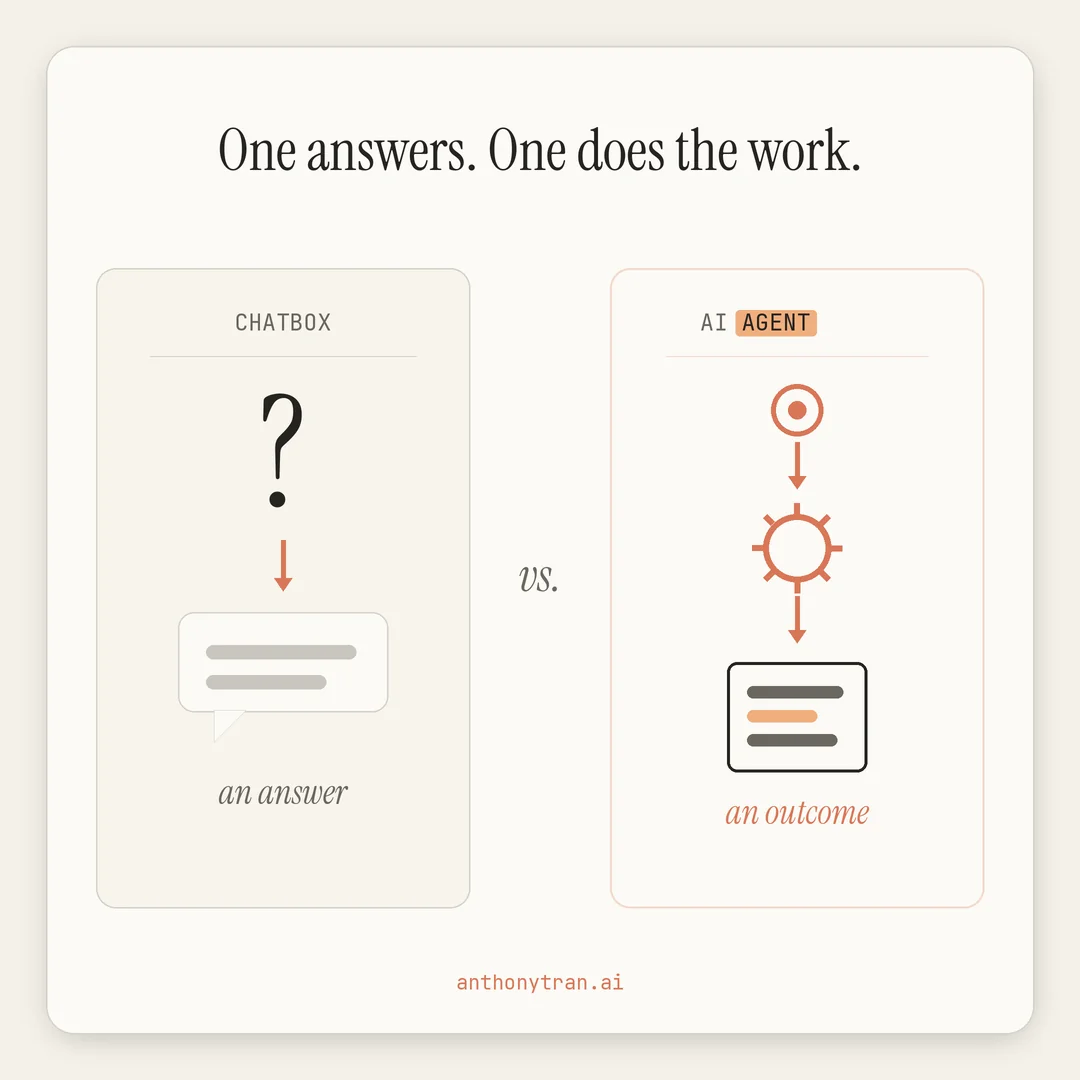
A chat box gives you an answer. An agent gives you an outcome.
If you take one thing from this, take that line. A chat box gives you an answer.
An AI agent gives you an outcome, a finished piece of the project you handed off. That is the whole shift.
It does not just tell you how to do the thing. It goes and does the thing.
Here is what that looks like in practice. Say you want a quick writeup on three competitors.
A regular chat gives you tips on how to research them. An agent goes and does it, reading your brief, looking up each one, pulling their pricing and positioning, noticing a gap and looking again, then handing you a tidy summary with the sources. You gave the goal, and it worked out the steps.
One honest word of caution
I do not want to oversell this, because an AI agent is not magic, and I would not run it fully hands-off. Some people let it run completely on its own.
I keep a human in the loop, meaning me. I still set the strategy, I fact-check the output, and I make sure it is true and on brand and in my voice.
Anthropic’s AI Fluency framework has names for that part, discernment and diligence, which just mean judging whether the work is any good and owning the result as yours.
This matters even more for a personal brand. You spent a long time earning your audience’s trust, and one bad output that goes out without your eyes on it can chip away at it.
Be extra careful when the agent can actually do things, like send messages, publish a post, spend money, or change your files. Start it with only the access it needs, and make it ask before anything that is hard to undo.
Hand off the work, but stay the person who reviews it before it ever reaches anyone.
Put This Into Practice
The next time you have a multi-step task, try handing it to an agent like Claude Cowork instead of doing it yourself. Give it the goal, your brand guide, your writing style, your rules, and only the files and tools it actually needs.
Let it work, then review it, fact-check it, and give it feedback. It gets better as you correct it, and you make that stick by saving your preferences in your instructions or a project, so you are not starting from scratch each time.
Here is a prompt to delegate your first task the way you would brief an assistant.
I want to hand you a task the way I would hand it to an assistant.
The goal: [what you want done]. The context you need: [your role, your audience, your brand, and an example of what good looks like]. My rules: [tone, format, and anything to avoid]. My boundaries: do not publish, send, delete, or spend anything without checking with me first.
Work through the steps, then show me a first version to review. If something important is missing, ask me instead of guessing.
Start with something low-stakes so you can see how it works before you trust it with the important stuff.
The whole thing in one line
An AI agent is a virtual assistant you delegate work to, except it is an AI. You give it the goal, it does the work, and you stay the boss who checks it before it goes out.
That is the whole thing. Go ahead and hand off one small task tonight and see how it feels.
~ Anthony
Frequently asked.
What is an AI agent in simple terms?
An AI agent is an AI you give a goal to, and it figures out the steps, uses the tools it needs, and keeps working until the job is done. Think of it as a virtual assistant you delegate a whole task to, except the assistant is an AI. A chat box answers a question, an agent finishes the work.
What is the difference between an AI agent and a chatbot?
A chatbot gives you an answer. An AI agent gives you an outcome. You ask a chatbot a question and it replies. You hand an agent a goal, and it works across multiple steps to deliver a finished result you can review. The line is not always sharp, since some chat tools now include agent features.
Do you need to be technical to use an AI agent?
You do not need to code to use a ready-made agent like Claude Cowork. You brief it in plain English, give it the goal and your rules, then review what it hands back. Building your own agent or wiring one into private business systems can take technical help, but using one does not.
Stop re-explaining yourself to Claude.
Grab the free AI Starter Kit: my exact Claude setup, so it knows your business. Plus the lessons as they land.
Anthony Tran
13 years in marketing and an Air Force veteran. I use Claude every day to market and grow my own business, and I break down what works in plain English. Writing and recording from Arizona.