
When I write, it comes out formal. When I talk, I sound like myself. People connect with the second one, so I am learning to write the way I talk.
The article I almost published in the wrong writing style
This past week I wrote a blog post about how I started my first business, and the draft was fine. It was clean and organized and it said all the right things, but something felt a little off, like I was presenting to a room instead of talking to a friend.
So I read it out loud, the way I would actually tell the story if you were sitting across the table from me, and the words that came out were not the words on the page.
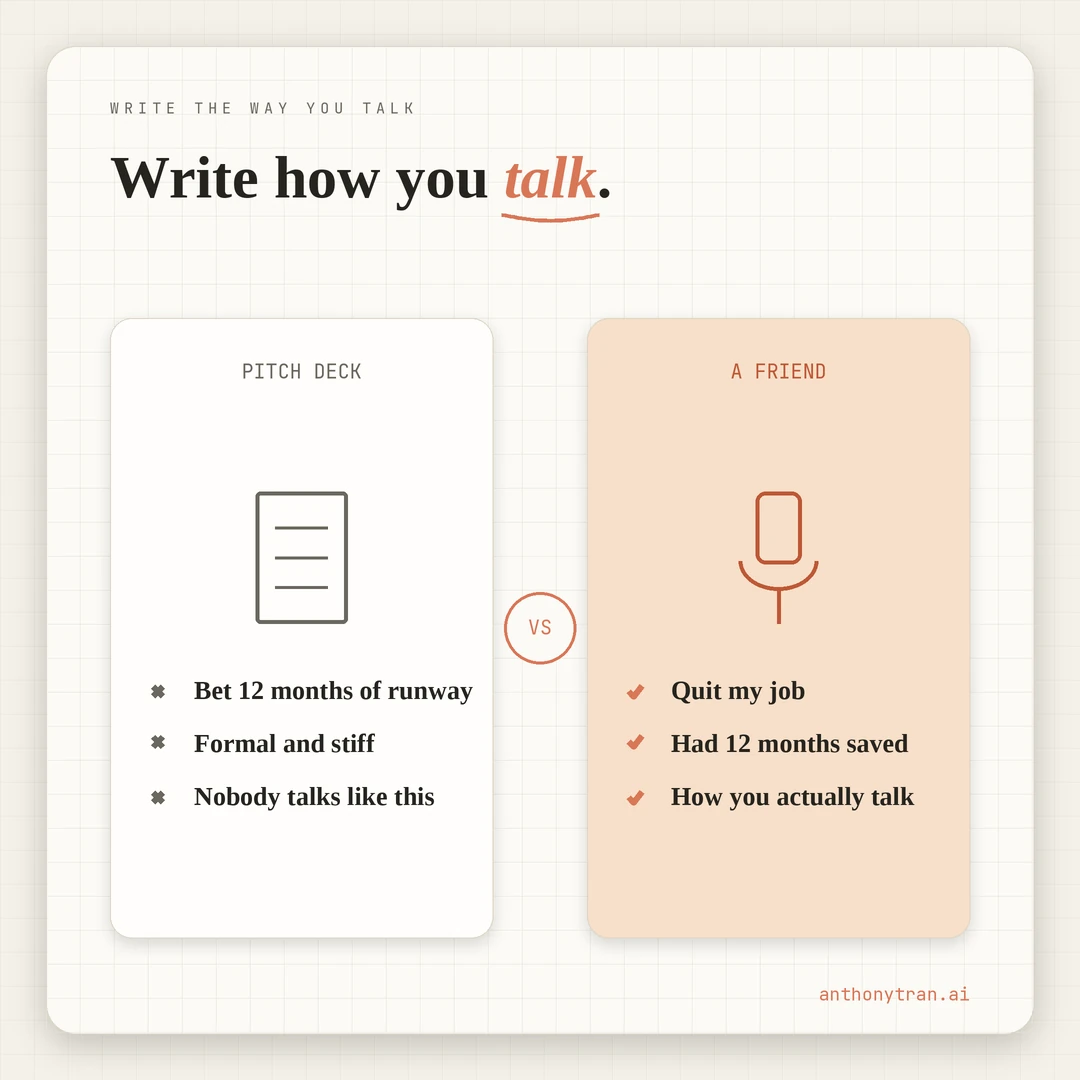
The draft opened with this: “In 2013, I bet twelve months of runway on building something of my own.” What actually came out of my mouth was, “In 2013, I quit my job to start my own business, with twelve months of savings to figure it out.” It is the same idea, but one sounded like a pitch deck and the other sounded more like me.
That gap is what this post is about. The version I speak is almost always warmer than the version I write, and once you hear the difference you cannot unhear it.
Where the formal writing comes from
Growing up, I learned to write in a formal, professional style. In school they teach you proper grammar and format, and you write essays.
In college it is professional essays and a thesis. Then in the Air Force they train you to write with military jargon and acronyms, everything clear and formal and buttoned up.
After that I spent years at a Fortune 500 company writing performance reviews for my team and proposals for projects, all in that same professional style.
So that writing style became my default. School, college, the military, and corporate all rewarded it, because in those rooms they want you to come across as competent and like you know what you are talking about. It is a good writing style for those places.
The problem is it does not work for social media, blogs, or YouTube. Social media is social.
You interact with people like they are your friends. The writing style that fits there is informal.
People crack jokes, use slang, tell stories, and talk like they are sitting right next to you. That is what people connect with.
When you sound like a press release, they cannot relate to you, they think it is boring, and they keep scrolling. They can read that kind of writing at work.
They do not want it when they are trying to be social online.
Why the talking voice wins
I learned this the first time around, even if I did not have a name for it back then.
From about 2013 to 2015 I ran a podcast, and people would listen to me talk for 30 or 45 minutes at a stretch. A lot of them came away feeling like they already knew me, because they had heard my voice, my pauses, and the way I explain things. That builds trust faster than anything I have ever written.
These last few years I mostly wrote and emailed instead. I did not share my voice, I did not share my face, and the connection got weaker because there was less of me in it.
People connect with how you speak more than how you write.
That is why I am focusing on publishing more videos for this personal brand, so people can hear my voice, see my face, and watch how I actually talk. But it changes how I write too.
If the talking version of me is the one people connect with, then the talking version is the one that belongs on the page. The creators I learn from, like Dan Koe, run one voice across everything.
He will write a script for a video and use that same script as his email newsletter, so you get the same person whether you read it, listen to it, or watch it.
So how do you write the way you talk?
You do not have to be a great writer. You just have to capture how you actually talk and get it onto the page.
The main thing I do is read the first draft out loud and ad-lib it, the way I would explain it to a friend. When I try to write, I default to the professional writing style.
When I talk, I speak more freely, and I reach for the words I would actually use in everyday life. So as I read a draft, whatever comes out of my mouth is what I revise it with.
That is exactly what I did with the post this week, and it changed the whole thing.
My full process looks like this. I talk through my thoughts out loud and let AI capture them as a rough first draft.
I run that draft past a different AI for a second opinion, then have the first one revise. Then I read the whole thing out loud.
Some lines I keep, some I change on the spot, and the AI updates them from my recording. Sometimes it takes two or three passes, but each round it gets better at matching how I talk, so the next post needs fewer fixes.
You can also flip it and talk first. Record yourself explaining the topic out loud, like you are telling a buddy about it over coffee, then shape what you said into the post.
One caveat, because I learned this the hard way. Do not just paste in the raw recording and call it done.
When you talk, you ramble, you repeat yourself, and you trail off on tangents. Keep the cadence and the real words, but tighten it so it reads clean.
You are going for yourself on a good day, explaining something clearly, not a word-for-word dump of everything that came out.
This matters even more if you use AI to help you write. Most AI writing sounds off because the AI does not know how you talk yet.
It gives you the generic, formal, technically correct version until you show it your real, spoken voice. So do not just ask it to make your draft better.
Give it contrast. Show it the stiff written version and the way you would actually say the same thing, and let it study the gap.
Put This Into Practice
Here is a prompt you can paste in to do exactly that.
I am going to paste in something I wrote, plus a few sentences of how I would actually explain this out loud to a friend. Study the difference between the two.
- Tell me where my written version sounds formal, stiff, or like a press release.
- Show me the specific words and phrases from my spoken version that sound more like a real person.
- Rewrite the piece the way I actually talk, keeping my real words and cadence, but tighten it so it reads clean. Do not add new ideas or make up facts.
- Flag any line that still sounds like a robot wrote it.
[Paste your written version, then your spoken version, here.]
If you do not have anything written yet, just record yourself talking about the topic for two minutes, get that onto the page, and start there. It is a lot easier to clean up real words than to invent fake ones.
The point is connection, not grammar
The goal here is not perfect writing. It is connection.
If a line breaks a rule they taught you in school but it sounds like you, keep it. The people you are trying to reach are not grading your grammar.
They are deciding whether you feel like a real person they would want to listen to. The closer your writing sounds to the way you actually talk, the easier that decision gets.
~ Anthony
Frequently asked.
Should you write the way you talk?
For personal brand content, yes. Formal writing creates distance, and the casual way you talk to a friend builds trust faster. It is fine to break a grammar rule if the line sounds like you.
How do you make AI writing sound like you?
Show it how you actually talk. Read your draft out loud and ad-lib how you would say it, or record yourself explaining the topic first and work from that. AI writes the generic formal version until you show it how you actually talk.
Why does formal writing hurt a personal brand?
Stiff, buttoned-up writing reads like a press release, and people cannot relate to a press release. The casual, talking version of you is the one that feels human and builds a relationship.
Stop re-explaining yourself to Claude.
Grab the free AI Starter Kit: my exact Claude setup, so it knows your business. Plus the lessons as they land.
Anthony Tran
13 years in marketing and an Air Force veteran. I use Claude every day to market and grow my own business, and I break down what works in plain English. Writing and recording from Arizona.